


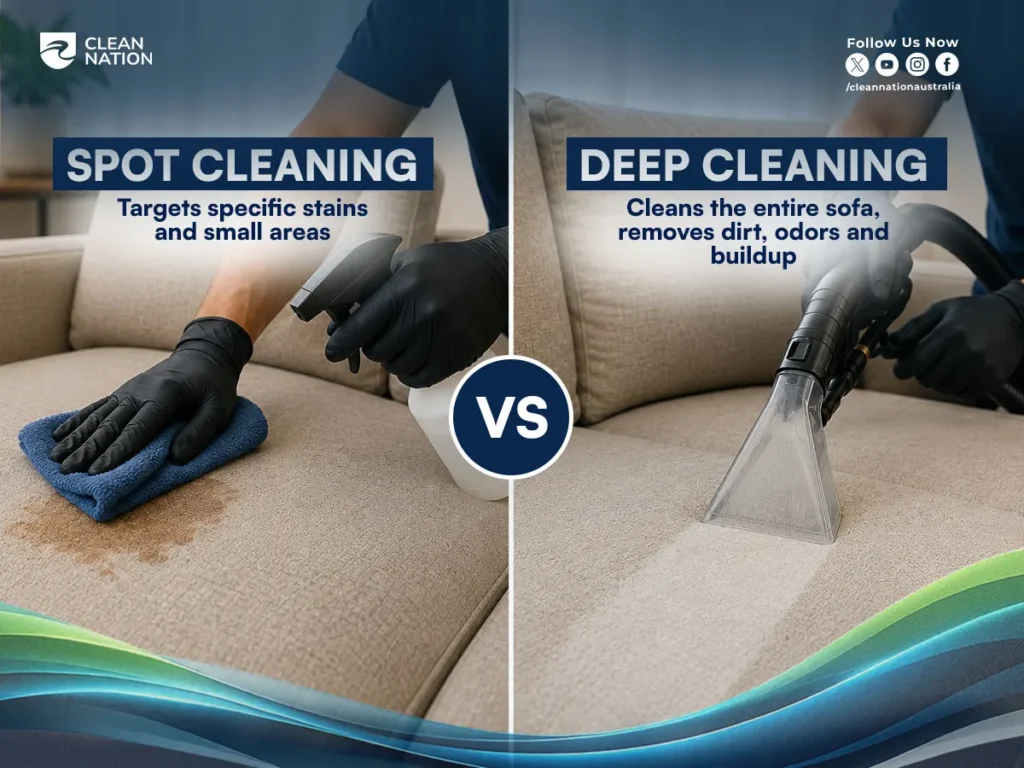
Spot cleaning and deep cleaning serve different purposes for a fabric sofa. Spot cleaning targets fresh, isolated stains, while deep cleaning addresses wider soiling, embedded dirt, odors, and overall upholstery buildup. The right method depends on the sofa’s fabric, cleaning code, condition, and manufacturer’s care instructions. In many cases, both methods can work together for better upholstery care.
What Is Spot Cleaning a Fabric Sofa?
Spot cleaning is a targeted treatment used to deal with a particular spill, stain, or small area of contamination rather than cleaning the entire sofa. It is especially useful when something has recently been spilled or when one clearly defined area needs attention.
The important point is that spot cleaning should still follow the sofa manufacturer’s care instructions. Australian fabric-care guidance recommends treating spills promptly, gently removing surface material, avoiding vigorous scrubbing, and preventing the upholstery and filling from becoming saturated.
When Should You Spot Clean Sofa?
Spot cleaning makes sense when the problem is localised rather than widespread. Examples include a fresh coffee spill, a small food mark, or an isolated stain on one section of a cushion. Acting promptly can prevent the affected material from remaining on the upholstery for longer. However, the appropriate cleaning method still depends on the fabric’s care requirements and cleaning code.
What Are the Limitations of Spot Cleaning?
Spot cleaning deals with the area you treat; it does not automatically clean the rest of the sofa. If the upholstery has widespread grime, embedded soil, accumulated oils, or persistent odours, repeatedly treating individual marks may not address the broader condition of the fabric. In those situations, a more comprehensive cleaning approach may be appropriate.
What Is Deep Cleaning?
Deep sofa cleaning is a more comprehensive approach that goes beyond treating one visible mark. It is intended to address accumulated soil and contaminants across a larger area of upholstered furniture, including problems that may not be obvious from the surface alone. BISSELL Australia describes deep cleaning as a way to target gradual buildup of oils, odurs, and set-in stains.
Unlike a quick spot treatment, deep cleaning requires greater attention to the sofa’s construction, fabric, cleaning code, condition, and the cleaning method being used. Australian upholstery-cleaning standards specifically require cleaners to assess factors such as fibre, weave, texture, backing, cushion filling, colourfastness, and existing treatments before selecting equipment and cleaning agents.
Spot Cleaning vs Deep Cleaning: What’s the Difference?
The simplest distinction is coverage and purpose. Spot cleaning concentrates on an individual problem, whereas deep cleaning addresses broader soiling and the overall condition of the upholstery. A small fresh spill may only require targeted attention, while a sofa with widespread dirt or accumulated odours may benefit from a more comprehensive cleaning process.
| Factor | Spot Cleaning | Deep Cleaning |
| Main purpose | Treat a specific problem | Address broader upholstery soiling |
| Coverage | Localised area | Larger sofa surface |
| Best suited to | Small spills and isolated stains | General buildup and heavier soiling |
| Approach | Targeted treatment | More comprehensive cleaning |
| Frequency | As needed | When the sofa requires broader cleaning |
| Main consideration | Correct treatment for the affected fabric | Fabric, construction, condition and cleaning method |
The two approaches are not necessarily alternatives. Professional upholstery-cleaning standards specifically include spot cleaning where required as part of a wider cleaning process.

Can Spot Cleaning Replace Deep Cleaning?
Not always. Spot cleaning can be enough when a sofa is generally clean and only one small area has been affected. However, it does not address general soil that has accumulated across other parts of the upholstery, so treating individual stains cannot automatically substitute for a broader cleaning process.
If the sofa has widespread visible dirt, multiple affected areas, persistent odours, or accumulated grime, a more comprehensive approach may be more appropriate. BISSELL Australia similarly distinguishes spot cleaning for concentrated stains from deep cleaning for broader buildup and deeper-seated messes.
When Is Spot Cleaning the Better Choice?
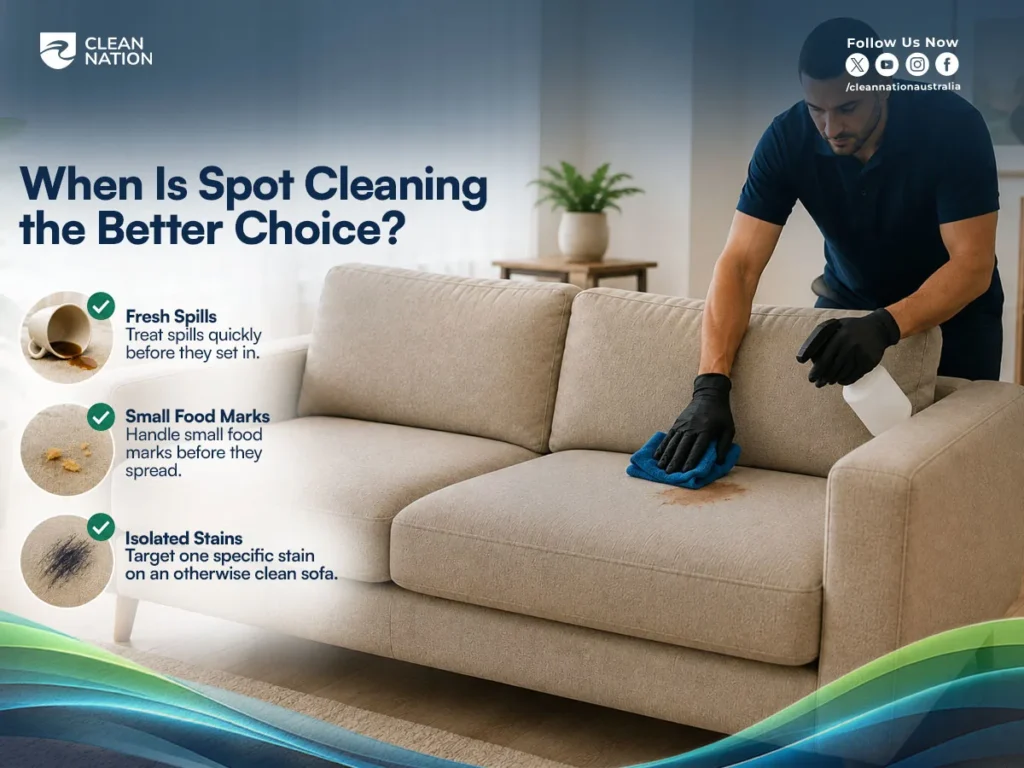
Spot cleaning is generally the more practical option when the issue is small, isolated, and clearly defined. A fresh drink spill or food mark does not necessarily mean the entire sofa needs to be cleaned immediately. Treating the affected area according to the fabric’s care instructions can be appropriate for a localised problem.
The key is to avoid assuming that every stain can be treated with the same product. Fabric-care guidance recommends prompt treatment and specifically warns against scrubbing or saturating upholstery, while cleaning codes help determine which types of cleaning methods are suitable.
Fresh Drink Spills
A fresh drink spill is a typical reason to consider spot cleaning. The first priority is to remove the liquid or spilled material from the surface without aggressively rubbing it into the fibres. The appropriate follow-up treatment depends on the upholstery’s cleaning instructions and the type of fabric involved.
Small Food Marks
Small food marks can often be handled as localised spots when they have not spread across the upholstery. Remove loose material carefully first and follow the sofa manufacturer’s cleaning instructions for the remaining mark rather than applying an untested household cleaner.
Isolated Stains
An isolated stain on an otherwise clean sofa is different from widespread soiling. Targeted treatment can focus attention on that specific area, but the cleaning product and method should be compatible with the upholstery. Testing an appropriate product in an inconspicuous area is recommended when the manufacturer’s guidance calls for it.
When Does a Fabric Sofa Need Deep Cleaning?
Deep cleaning becomes more relevant when the issue extends beyond one isolated stain. A sofa that has accumulated general grime, body oils, odours, or multiple stained areas may require more comprehensive treatment rather than repeated spot cleaning.
Usage also matters. Sofas used heavily by families, children, pets, or frequent guests can experience more regular exposure to soil and spills than furniture used occasionally. Rather than relying on one universal schedule, the cleaning requirement should be judged according to the sofa’s condition, fabric, usage, and manufacturer recommendations.
Widespread Visible Dirt
When dirt is visible across several cushions, arms, seats, or backrests, treating individual spots will not address the entire problem. A broader cleaning process can be more appropriate because the concern is no longer confined to one isolated mark.
Embedded Soil
Some contamination can move beyond the immediate surface of upholstery. BISSELL Australia notes that spills and messes can move deeper into furniture padding, which is one reason a deeper cleaning method can be useful for suitable water-cleanable fabrics.
Persistent Odours
Lingering odours can indicate that simply treating a visible surface mark has not addressed the broader source of the problem. Deep cleaning can be used to target accumulated oils and odour-related buildup when the fabric is suitable for that cleaning method.
Does Deep Cleaning Remove Stains Better Than Spot Cleaning?
Neither method is automatically better for every stain. Spot cleaning is specifically designed to concentrate treatment on an individual mark, while deep cleaning addresses broader upholstery soiling. A professional cleaning process may use both approaches, treating specific stains while also cleaning the wider upholstery.
The outcome depends on factors including the type and age of the stain, fabric construction, colourfastness, previous treatments, and the cleaning method permitted by the manufacturer. Australian upholstery-cleaning standards require these factors to be assessed before selecting cleaning agents and equipment.
Can You Spot Clean Before Deep Cleaning?
Yes. Spot treatment can be part of a broader upholstery-cleaning process when specific stains require individual attention. Australian training standards for fabric upholstery specifically include spot cleaning according to the job requirements and manufacturer’s recommendations, followed by cleaning methods selected according to the type of soil.
This means you do not necessarily have to choose between the two. A sofa may need targeted attention for particular stains while also receiving a more comprehensive clean across the upholstery.
How to Choose Between Spot Cleaning and Deep Cleaning
Start by looking at the size and nature of the problem. One fresh, isolated mark on an otherwise clean sofa is a different cleaning requirement from multiple stains, general discoloration, embedded soil, or persistent odours across several areas.
The fabric itself is equally important. Check the manufacturer’s cleaning code before choosing a method. BISSELL Australia identifies W as water-based, S as solvent-based, WS as compatible with both, and X as professional cleaning only.
One Small Fresh Stain
Choose targeted spot treatment when one small area has been affected and the rest of the sofa is in good condition. Follow the fabric-care instructions and avoid turning a small spill into a larger wet area through excessive cleaning.
Several Stained Areas
Multiple stains across different sections suggest that the issue may be broader than one isolated spot. Instead of repeatedly treating individual areas, consider whether the sofa would benefit from a more comprehensive upholstery-cleaning process.
General Dirt or Embedded Soil
When the sofa has accumulated visible dirt or deeper soiling across its surface, spot cleaning alone is unlikely to address the whole problem. A suitable deep-cleaning method can provide broader coverage when the fabric’s care instructions allow it.
Unknown or Delicate Fabric
If you cannot identify the fabric or its cleaning requirements, avoid guessing with water, solvents, or household mixtures. Australian upholstery standards call for assessment of fabric construction, fibre, texture, backing, filling, colourfastness, and existing treatments before selecting the cleaning method.
Why Does Fabric Type Matters Before Either Cleaning Method?
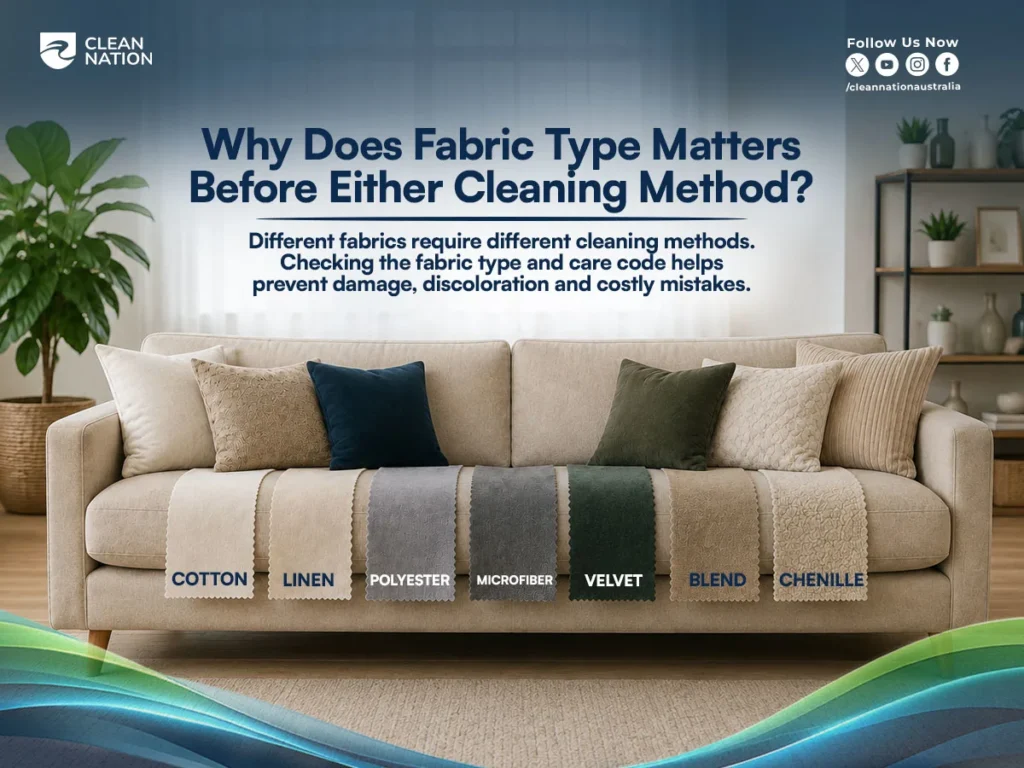
Fabric type can change the entire cleaning approach. Upholstery may contain different fibres, weaves, textures, backing materials, cushion fillings, and surface treatments, and these characteristics can influence which cleaning agents and equipment are appropriate. Australian upholstery-cleaning standards specifically require these factors to be assessed before cleaning.
The manufacturer’s care code should therefore be checked before either spot cleaning or deep cleaning. Some upholstery fabrics can be treated with water-based methods, while others require solvent-based cleaning or professional-only treatment. Australian fabric-care guidance also provides examples where professional cleaning is recommended and warns against saturating upholstery or using unsuitable detergents.
W and WS Fabrics
W indicates water-based cleaning, while WS means both water- and solvent-based cleaning methods may be suitable according to the manufacturer’s instructions. These codes can make certain water-based upholstery-cleaning approaches appropriate, but the specific fabric-care instructions should still be followed.
S and X Fabrics
S indicates solvent-based cleaning, while X indicates that the upholstery should generally be handled through professional cleaning rather than assumed to be suitable for water-based treatment. These codes are important because using an incompatible method can create avoidable upholstery problems.
Should You Spot Clean or Professionally Deep Clean Your Sofa?
For a small, recent stain on suitable upholstery, careful spot cleaning may be all that is required. Professional deep cleaning becomes more useful when the sofa has widespread soiling, multiple stains, persistent odours, delicate materials, or cleaning requirements that are difficult to determine.
A professional cleaner should assess the upholstery before choosing a method rather than treating every sofa identically. Australian competency standards specifically require cleaners to evaluate the fabric and furniture construction, check pre-existing damage, assess colourfastness, and select equipment and cleaning agents according to the manufacturer’s recommendations.
FAQs:
The following are the faq’s
Is Spot Cleaning Enough for a Fabric Sofa?
Spot cleaning can be enough when your sofa has one small, isolated stain and the rest of the upholstery is clean. Clean Nation recommends checking the fabric’s cleaning code before treating any spot to avoid using an unsuitable method.
How Often Should a Fabric Sofa Be Deep Cleaned?
There is no single schedule for every sofa. Cleaning frequency depends on usage, pets, children, spills, fabric type, and overall condition. Clean Nation can assess your upholstery and recommend whether it needs targeted cleaning or a more comprehensive deep clean.
Can You Deep Clean a Sofa After Spot Cleaning It?
Yes. Spot cleaning and deep cleaning can be used together. Clean Nation may treat specific stains individually before carrying out a broader upholstery-cleaning process, depending on the fabric and manufacturer’s cleaning requirements.
Does Deep Cleaning Remove Old Sofa Stains?
Deep cleaning can help address broader soiling and some established stains, but results depend on the stain type, age, fabric, and previous treatments. Clean Nation assesses the upholstery before selecting an appropriate cleaning method.
Is Professional Sofa Cleaning Better Than Spot Cleaning?
They serve different purposes. Spot cleaning targets individual marks, while professional cleaning can address wider soiling across the upholstery. Clean Nation can determine which approach is appropriate based on your sofa’s fabric, condition, and cleaning requirements.
Can Every Fabric Sofa Be Deep Cleaned With Water?
No. Fabric cleaning codes determine which methods may be suitable. Some upholstery can accept water-based cleaning, while others require solvent-based or professional-only treatment. Clean Nation checks the fabric and care requirements before choosing a cleaning method.
Conclusion:
Spot cleaning is best for isolated spills and stains, while deep cleaning is designed for broader upholstery soiling and a more complete refresh. One does not automatically replace the other. In many situations, targeted spot treatment and comprehensive cleaning work together as part of a suitable upholstery-care routine.The safest choice always starts with the sofa itself. Check the fabric, cleaning code, manufacturer’s instructions, and current condition before deciding how much cleaning it needs. When the upholstery is delicate, heavily soiled, or difficult to identify, professional assessment can help avoid unsuitable cleaning methods.