



A newly renovated kitchen and a newly built home may look completely different, but both can be left covered in construction dust, paint marks and building residue. The cleaning needed afterwards, however, is not always the same.
Renovation cleaning focuses on removing building residue while protecting existing parts of a property. New build cleaning generally covers an entire newly constructed space, including new floors, fixtures, windows and fittings before handover.
Understanding these differences helps Australian homeowners, builders and property managers choose the right cleaning service, identify what needs attention and avoid unexpected work during the final clean.
This guide compares renovation cleaning vs new build cleaning, including their cleaning requirements, surface risks, scheduling and cost considerations.
What Is Renovation Cleaning?
Renovation cleaning is a specialised cleaning service carried out after improvements or alterations to an existing property. It removes dust, building residue and marks left by tradespeople while taking care of surfaces and fittings that were already there.
The work may follow a kitchen renovation, bathroom refurbishment, flooring replacement, home extension or commercial fit-out.
Unlike cleaning an entirely new building, post-renovation cleaning often involves both new materials and older surfaces. For example, a renovated bathroom might contain new tiles and tapware alongside an existing vanity or timber door.
The cleaning approach must account for these different materials rather than applying the same treatment throughout the room.
Renovation dust can also reach areas outside the worksite. A kitchen renovation may leave fine dust on nearby hallway skirting boards, living room furniture and other surfaces, even when protective sheeting was installed.
What Is New Build Cleaning?
New build cleaning is the detailed cleaning performed on a newly constructed property before it is handed over to its owner, tenant or building manager.
It is commonly called an end-of-build clean, builder’s clean or post-construction clean.
The scope generally includes newly installed floors, kitchen cabinets, bathrooms, windows, doors, internal fittings and other surfaces affected by construction work.
Because the property is newly built, cleaning is often needed across the entire premises rather than in one renovated section.
Typical jobs include:
- Removing construction dust from surfaces and fittings.
- Cleaning window glass, frames and tracks.
- Removing suitable protective films and adhesive residue.
- Detailing newly installed cabinetry and fixtures.
- Removing paint spots, grout haze and other trade residue using appropriate methods.
- Preparing the property for final inspection or occupancy.
New build cleaning may be completed in stages depending on the construction schedule. The final clean usually takes place once major building work is finished and the site is ready for detailed cleaning.
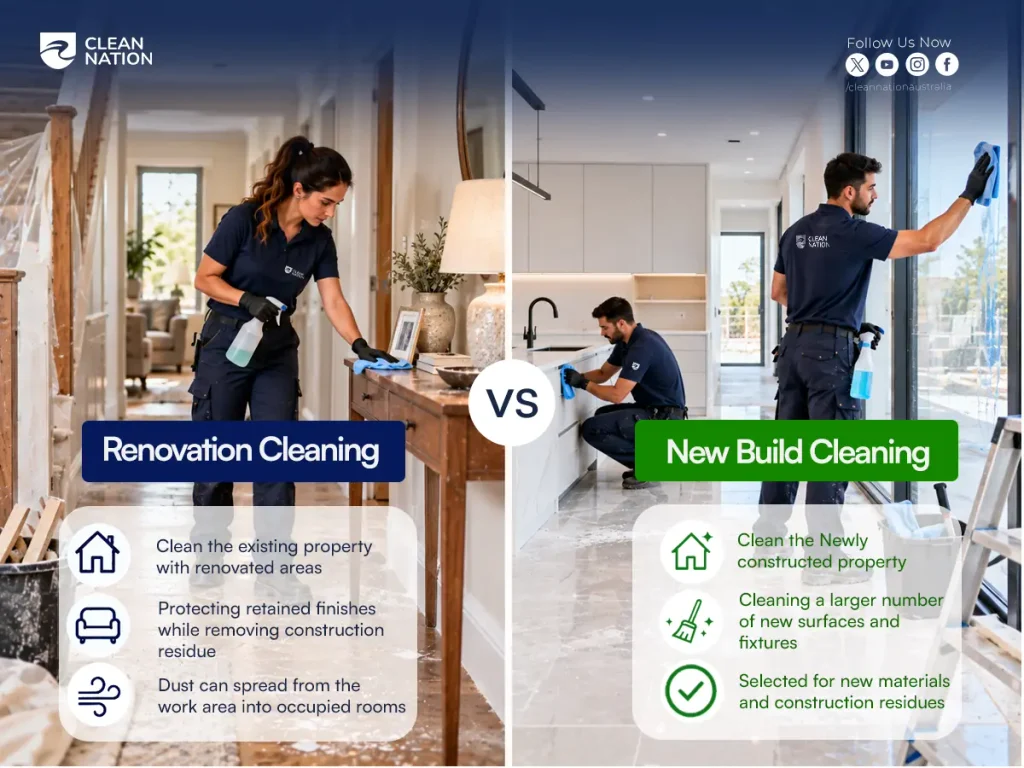
Renovation Cleaning vs New Build Cleaning
Both services deal with mess left after building work, but the extent of the cleaning and the conditions within the property can be quite different.
| Cleaning factor | Renovation cleaning | New build cleaning |
| Property condition | Existing property with renovated areas | Newly constructed property |
| Cleaning coverage | Renovated sections and affected surrounding areas | Usually the complete new building |
| Main challenge | Protecting retained finishes while removing construction residue | Cleaning a larger number of new surfaces and fixtures |
| Dust distribution | Can spread from the work area into occupied rooms | Often spread throughout the construction site |
| Furniture and belongings | May need to be protected or worked around | Usually fewer personal belongings on site |
| Cleaning methods | Adapted to existing and newly installed materials | Selected for new materials and construction residues |
| Scheduling | May need to accommodate occupants or ongoing business operations | Usually coordinated around construction completion and handover |
| Cost considerations | Surface sensitivity, access, furnishings and dust spread | Property size, construction residue, detailing and handover requirements |
The important distinction isn’t simply which service involves more cleaning. A small renovation may demand careful work around delicate finishes, while a large new build can require extensive cleaning across multiple rooms or floors.
1. Cleaning Scope and Property Coverage
The first difference is how much of the property needs attention.
For a renovation, the main work may be confined to a kitchen, bathroom or extension. However, the cleaning area can extend beyond the space where construction took place.
Consider a kitchen renovation in an occupied house. The new cabinets, splashback and flooring need detailed cleaning, but dust may also have reached adjoining rooms through doorways and shared air movement.
A new build usually requires a more comprehensive clean because most of the property has been exposed to construction activity.
Cleaning teams need to assess the full interior, including window tracks, cabinetry, skirting boards, floors and fixtures that may appear clean from a distance but still contain fine residue.
The cleaning scope should reflect the areas affected by building work, not just the rooms that look dirty.
2. Construction Dust and Building Residue
Both types of projects create dust, but the way it spreads can differ.
Renovation work often generates concentrated dust around demolition, drilling, sanding and installation. Fine particles can travel into adjoining rooms and settle on existing furniture, shelves and window coverings.
New construction creates dust across multiple building stages, including plastering, cutting, drilling and flooring installation. Different trades may also leave adhesive residue, silicone smears, grout haze and paint marks on newly installed finishes.
Dust removal needs particular care where work has involved concrete, bricks, tiles or other silica-containing materials.
Safe Work Australia advises against dry sweeping, compressed air and general-purpose vacuum cleaners where respirable crystalline silica may be present. Appropriate controls can include wet methods and correctly rated industrial dust extraction equipment.
The type of dust and the materials involved should therefore be assessed before cleaning starts.
3. Protecting Existing and Newly Installed Surfaces
Surface protection is one of the biggest differences between renovation and new build cleaning.
An older home may contain timber flooring, natural stone, painted walls, original fittings and furniture that need careful handling. Some surfaces may already have scratches, worn coatings or previous damage.
A renovation cleaner must distinguish between old finishes and newly installed materials before selecting cleaning products and tools.
For example, removing adhesive residue from new tiles requires a different approach from cleaning an existing timber floor beside them. Strong chemicals or abrasive equipment can damage certain finishes if used incorrectly.
New buildings also require careful treatment. Freshly installed glass, polished concrete, stone benchtops, stainless steel and other finishes can be damaged by unsuitable cleaning methods.
Neither service should rely on one cleaning product or technique for every surface. The material, its condition and the manufacturer’s care instructions all matter.
4. Access, Furniture and Occupancy
Renovation cleaning sometimes takes place while part of the property remains occupied.
Homeowners may continue using bedrooms or living areas while a kitchen or bathroom is being renovated. In commercial premises, staff or customers may still be using sections of the building.
This creates additional considerations for cleaners, including access restrictions, furniture protection and working around areas that must remain operational.
The cleaning plan may need to separate completed areas from rooms where people are still living or working.
Newly built properties are more commonly vacant before handover, allowing cleaning teams to move between rooms with fewer personal belongings in the way.
However, access can still be restricted by finishing trades, incomplete installations or site safety requirements.
In either situation, cleaning should begin only when the relevant areas are safe and authorised for entry.
How Do the Cleaning Methods Differ?
The basic principle is similar: assess the site, control dust, remove construction residue and detail the surfaces.
The difference lies in how the work is organised.
Renovation Cleaning: Working Around Existing Conditions
A renovation cleaning plan should identify the areas affected by construction and any retained materials that need special care.
For example, after a bathroom renovation, the work may include removing grout residue from new tiles, cleaning fittings and carefully wiping nearby painted doors or older cabinetry.
Dust may also need attention in adjoining rooms.
The team must avoid spreading contamination into spaces that have already been cleaned, particularly where occupants are returning to use parts of the property.
New Build Cleaning: Systematic Whole-Property Detailing
New build cleaning is often organised by rooms, floors or completed construction zones.
Once the site is ready, cleaners can work through the building in a planned order, removing settled dust and detailing fittings, floors, glass and internal surfaces.
Larger projects may need separate initial, detailed and final presentation cleans.
The number of cleaning visits depends on the site condition, construction schedule and agreed scope. A smaller completed property may have different requirements from a multi-storey residential development or commercial building.
For both cleaning types, specialist treatment of hazardous materials or unresolved building defects must be handled separately by suitably qualified personnel.

When Should Renovation and New Build Cleaning Be Scheduled?
Cleaning too early can result in repeated work if tradespeople return to drill, sand, paint or install fittings.
For a renovation, the main detailed clean is usually best scheduled after dust-producing work has finished, major materials have been removed and the affected rooms are accessible.
This can be especially important when homeowners plan to move furniture back into renovated spaces.
For a new build, the cleaning schedule is commonly aligned with the construction programme and the final handover date.
Initial debris removal may take place earlier, followed by detailed cleaning and any necessary final touch-ups once finishing work is complete.
The key is to confirm whether other trades will return after the cleaning appointment. If further construction activity is expected, the property may need additional dust removal before it is ready for use.
Does Renovation Cleaning Cost More Than New Build Cleaning?
Neither cleaning type is automatically more expensive.
The final cost depends on the size of the cleaning area, the condition of the site, the surfaces involved and the labour required.
A renovation clean may cover fewer square metres but require additional time to protect furniture, work around occupants and clean sensitive existing finishes.
A new build clean may involve a larger overall area, more windows, newly installed fittings and extensive construction dust.
Other factors that can affect a quote include:
- Residue type: Heavy grout haze, adhesive marks or paint splatters may require additional work.
- Surface materials: Delicate timber, stone or specialist finishes can need more careful treatment.
- Access: Restricted rooms, multiple storeys and difficult-to-reach areas may increase labour requirements.
- Cleaning stage: An initial construction clean has a different scope from a detailed handover clean.
- Extra services: External windows, pressure cleaning and specialised floor treatment may need separate arrangements.
A written quotation should explain which rooms, surfaces and tasks are included.
Comparing cleaning quotes only by floor area or hourly rate can be misleading when the properties have very different conditions.
What Should You Include When Requesting a Cleaning Quote?
One of the easiest ways to avoid confusion is to provide the cleaning company with a clear description of the finished building work.
Before requesting a quote, prepare the following details:
- Project type: Explain whether the property is a renovation, extension, commercial fit-out or complete new build.
- Affected areas: Identify the rooms where work took place and any adjoining spaces affected by dust.
- Surface materials: Mention timber flooring, natural stone, glass, existing cabinetry or other finishes requiring care.
- Site condition: Describe leftover dust, paint marks, grout residue, protective films and any remaining materials.
- Access arrangements: Confirm whether the property is vacant, occupied or subject to construction-site access restrictions.
- Required completion date: Explain when the property needs to be ready for inspection, handover or occupation.
Photos can help a cleaning provider understand the condition of the property before preparing an estimate.
You should also clarify whether construction waste removal, exterior cleaning and specialist surface treatments are part of the requested service.
These details make it easier to agree on a realistic scope before the cleaning work begins.
Which Cleaning Service Does Your Property Need?
The right service depends primarily on the type of building work completed and which parts of the property have been affected.
Choose renovation cleaning if you have upgraded part of an existing home, refurbished an office, completed a bathroom or kitchen renovation, or extended a property while retaining original rooms and finishes.
Choose new build cleaning if the property has been constructed from the ground up and requires a detailed clean before its first occupants move in.
Some projects fall between these categories.
For example, a major house extension may require renovation cleaning around existing rooms and more extensive new-build-style cleaning throughout the newly constructed area.
In these situations, a combined cleaning scope is often more useful than trying to fit the entire job into one service label.
Clean Nation provides construction and builders cleaning for residential and commercial projects across Australia. The cleaning requirements can be discussed according to the property’s condition, construction work and intended handover.
Final Thoughts
Renovation cleaning and new build cleaning share many tasks, but they require different approaches to property coverage, surface protection and scheduling.
Renovation cleaning often demands greater attention to existing finishes, furniture and dust spreading beyond the work area. New build cleaning generally involves a wider cleaning scope across newly installed surfaces before inspection or occupancy.
The most useful starting point is a clear assessment of what construction work took place, which areas were affected and how the property needs to be presented.
Need cleaning after a renovation or new construction project? Contact Clean Nation or call +61 480 810 142 to discuss your project and request a cleaning quote.
Frequently Asked Questions
Can renovation cleaning be completed while people are living in the house?
It may be possible to clean completed sections of an occupied home, provided access is safe and building work does not expose occupants or cleaners to uncontrolled hazards. The arrangement should consider room access, ventilation, dust containment and whether cleaning activities will interfere with normal household use.
Can construction dust spread through an air-conditioning system during renovation?
Fine dust can enter return-air openings and move through parts of a ducted system, depending on the installation and whether it was operating during construction. If contamination is suspected, ask a qualified HVAC technician to inspect the relevant filters, components and ductwork rather than assuming ordinary surface cleaning will resolve it.
Can a newly built property need another clean after the final inspection?
Yes. Defect repairs, additional trade visits, furniture deliveries or inspection traffic can leave fresh dust, fingerprints and marks. A targeted touch-up clean may be appropriate after these activities, depending on the property’s condition.
Does renovation cleaning include professional carpet cleaning?
Not necessarily. Some cleaning quotes cover surface dust removal but exclude carpet extraction, upholstery cleaning and other specialist treatments. If carpets were exposed to renovation dust, explain their condition and ask whether appropriate carpet cleaning is included in the quotation.
Who is responsible for arranging the final clean after building work?
Responsibility depends on the construction contract and agreed scope of works. Some builders arrange cleaning before handover, while other agreements leave particular cleaning tasks to the property owner. Check the contract and confirm the expected cleaning standard before booking an additional service.