

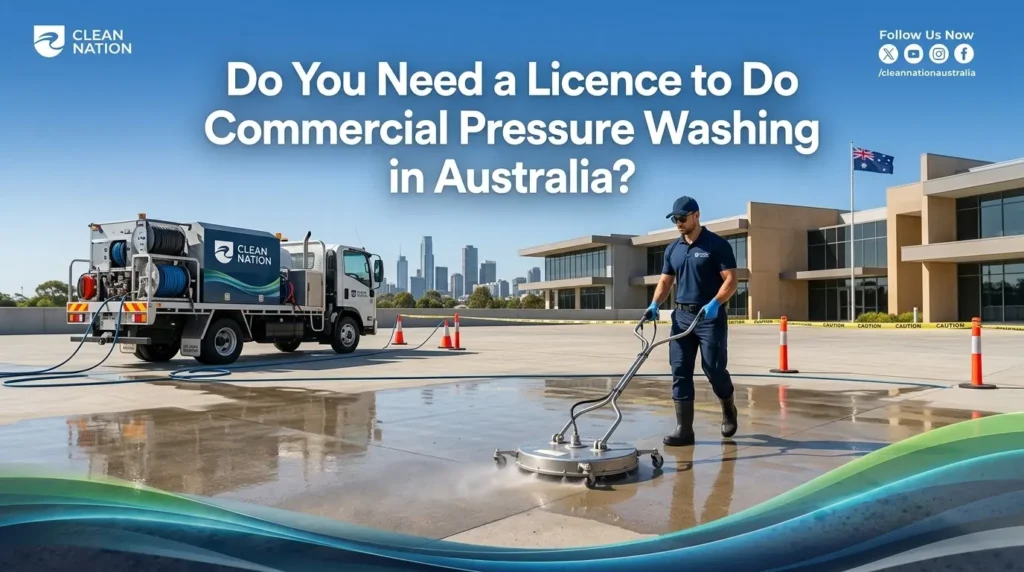
Commercial pressure washing in Australia does not have one universal licensing requirement. Whether you need a licence depends on your state or territory, type of work, contract scope, business structure and how workers are engaged. Some jurisdictions, such as NSW, specifically regulate pressure washing under maintenance and cleaning work, so checking local licensing, insurance, WHS and council requirements is essential before taking commercial jobs.
Is Pressure Washing a Licensed Trade?
Pressure washing is a cleaning method rather than one universal nationally regulated trade. However, that does not mean every pressure-washing business is automatically exempt from licensing.
The distinction becomes important when pressure cleaning forms part of regulated building, trade or specialist work. For example, the NSW Government specifically identifies pressure washing, graffiti removal and brick cleaning under its minor maintenance and cleaning work category.
Why Does Your State or Territory Matter?
Business licensing in Australia is administered through different state, territory and local government frameworks. A requirement that applies to a pressure cleaning business in NSW may not apply in exactly the same way in Queensland, Victoria, South Australia, Western Australia, Tasmania, the ACT or the Northern Territory.
The Australian Business Licence and Information Service (ABLIS) brings together information on Australian, state, territory and local government licences, permits, approvals and regulations. Businesses can use its guided search to identify requirements based on their activity and location.
Does NSW Require a Licence for Commercial Pressure Washing?
NSW is particularly important for this topic because the NSW Government specifically identifies pressure washing, graffiti removal and brick cleaning within its minor maintenance and cleaning work licensing requirements. The current NSW guidance says a contractor licence is required for residential building or trade work, including minor maintenance and cleaning, where the value of labour and materials exceeds $5,000 including GST.
The rules are therefore more specific than simply asking whether someone owns or operates a pressure washer. The nature of the work, whether it falls within the relevant category and the value and circumstances of the contract all need to be considered.
Pressure Washing and Minor Maintenance Work in NSW
NSW defines minor maintenance and cleaning as non-structural maintenance, including minor repairs, or cleaning of existing works, structures or buildings. Its licensing information specifically includes pressure washing, graffiti removal and brick cleaning as a category for which particular qualifications and experience may be required.
For pressure washing and related work, NSW lists qualification pathways and endorsements connected with construction materials, estimation and costing, and graffiti removal/protective coatings. Anyone planning to apply should verify the current qualification pathway with NSW Government and an appropriate registered training organisation before enrolling in training.
When Can a Contractor Licence Become Relevant?
In NSW, a contractor licence becomes particularly important where the work falls within regulated building or trade categories and meets the applicable value threshold. The current NSW Government guidance states that building or trade work valued at more than $5,000 in labour and materials including GST requires a contractor licence.
Companies and partnerships also have separate licensing obligations when they contract, subcontract or advertise to perform applicable residential building, trade or specialist work. A company or partnership licence can require a nominated qualified supervisor.
What About Commercial Pressure Washing in Victoria?
Victoria requires a slightly different approach because commercial cleaning can intersect with the state’s labour-hire licensing system. The key question is not simply whether the service involves a pressure washer; it can depend on whether the business is supplying workers to clean commercial premises.
The Victorian Labour Hire Authority currently states that most businesses supplying cleaners to commercial premises must hold a labour-hire licence, while businesses using those services must use licensed providers. Limited circumstances can apply where a licence is not required.
When Does Commercial Cleaning Become Labour Hire?
A pressure washing business may need to consider labour-hire rules when its business model involves supplying workers to another business rather than simply providing a cleaning service under its own management.
This distinction matters for commercial contracts. A business that provides an agreed pressure cleaning service is not necessarily operating under the same arrangement as a labour-hire provider that supplies workers to a client. The exact contractual relationship should therefore be checked against Victorian requirements.
Does a Sole Trader Need a Labour-Hire Licence?
This depends on how the business operates. The Victorian Labour Hire Authority provides specific guidance and exceptions within its commercial cleaning framework, so a sole trader should not assume that working at a commercial property automatically makes them a labour-hire provider.
If you personally perform the pressure cleaning service rather than supplying workers to another business, the circumstances can be different. Always check the current Victorian Labour Hire Authority guidance before accepting commercial cleaning work.
What Registrations Does a Commercial Pressure Washing Business Need?
A professional pressure cleaning business may have several administrative obligations even where a particular job does not require a specific professional licence. These requirements should not be confused with one another.
An ABN, business name registration and GST registration serve different purposes from a contractor licence, professional qualification or local permit. Your exact obligations depend on your business structure, turnover, activities and circumstances.
Australian Business Number (ABN)
An Australian Business Number (ABN) identifies your business when dealing with customers, government agencies and other businesses. It is commonly relevant when establishing a pressure cleaning business as a sole trader, partnership, company or other structure.
Having an ABN, however, does not automatically mean that you hold every licence required for regulated work. Licensing and business registration are separate compliance matters.
Business Name Registration
If you trade under a name different from your own legal name, you may need to register that business name. This allows customers and commercial clients to identify the entity operating the pressure cleaning business.
Business name registration should not be presented as a substitute for a trade or contractor licence where one is legally required.
GST Registration
GST is another separate consideration. A pressure cleaning business may need to register for Goods and Services Tax (GST) when it meets the applicable Australian Taxation Office requirements.
GST registration does not grant permission to perform regulated work. It is a tax obligation rather than a pressure-washing licence.
Do You Need Public Liability Insurance for Commercial Pressure Washing?
Public liability insurance is not the same thing as a government-issued pressure washing licence, but it is an important risk-management consideration for commercial operators.
Pressure cleaning involves water, machinery, hoses, chemicals and surfaces that can be damaged if the equipment is used incorrectly. A commercial client may also require evidence of insurance before allowing a contractor onto its premises.
Why Public Liability Matters ?
A pressure washer can accidentally damage windows, painted surfaces, vehicles, signage, electrical fixtures, landscaping, paving or building materials. A person could also be injured by equipment, hoses, slippery surfaces or cleaning operations.
Public liability insurance can provide cover for certain third-party injury and property damage risks, subject to the policy’s terms, exclusions and limits.
Do Commercial Clients Require Proof of Insurance?
Many commercial property managers, facility managers, strata companies and businesses may request evidence of appropriate insurance before approving a contractor.
Depending on the contract, they may ask for a certificate of currency, public liability coverage details and other compliance documents. Always check the client’s contract requirements before starting work.
Do You Need Council Approval for Pressure Washing?
State licensing is only one part of compliance. Local councils can have their own requirements relating to business activities, public areas, wastewater, drainage, signage, access and environmental protection.
For example, cleaning a private commercial property is different from conducting pressure washing on a footpath, public area or council-controlled location. If the work affects public space or drainage, additional requirements may apply.
Commercial Premises and Council Rules
Before beginning a large commercial project, check whether the relevant local council has requirements affecting:
- public footpaths
- road access
- parking
- signage
- wastewater
- stormwater
- noise
- operating hours
- use of public land
Council requirements can vary, so do not assume that approval in one local government area automatically applies elsewhere.
What Are the Wastewater and Environmental Requirements?
Pressure washing produces wastewater containing dirt, oils, detergents, mould residue, chemicals and other contaminants depending on the surface being cleaned.
Commercial operators should plan where this water will go before starting the job. Allowing contaminated runoff to enter inappropriate drainage systems can create environmental and compliance problems.
Where Can Pressure Washing Runoff Go?
The correct wastewater-management approach depends on the location, contaminants and local requirements. Operators may need to contain, collect, filter, recover or appropriately dispose of wastewater rather than allowing dirty runoff to flow uncontrolled into stormwater infrastructure.
This becomes particularly important when cleaning car parks, industrial areas, commercial kitchens, fuel-contaminated surfaces or heavily soiled concrete.
Can Cleaning Chemicals Affect Compliance?
Pressure washing may involve detergents, degreasers, mould treatments, algae removers and other cleaning chemicals. The products should be selected, stored, handled and disposed of according to their requirements.
Chemical runoff can create additional environmental risks, so commercial operators should consider both the cleaning result and what happens to the wastewater after the surface has been cleaned.
Do Pressure Washing Workers Need Special Safety Training?
A pressure washing licence and equipment competency are not necessarily the same thing. Even where a specific pressure-washing licence is not required, workers still need to understand how to operate equipment safely and manage workplace hazards.
Commercial projects can introduce additional risks involving working at heights, electrical equipment, chemical exposure, traffic, confined areas, slippery surfaces and high-pressure water.
Pressure Washer Equipment Training
Operators should understand:
- pressure and PSI selection
- nozzle selection
- spray distance
- hose management
- equipment inspection
- chemical handling
- surface-specific cleaning
- emergency procedures
- PPE requirements
Training should reflect the equipment and risks involved rather than assuming that operating a domestic pressure washer provides adequate commercial competency.
Working at Heights
Roof cleaning and elevated commercial surfaces can introduce fall hazards. A pressure washing operator may need to consider ladders, roof access, elevated work platforms, fall protection and site-specific safety procedures.
Working-at-height requirements are separate from ordinary pressure-washing licensing and should be assessed according to the actual work environment.
High-Risk Work
High-risk work licences apply to specified categories of equipment and activities rather than automatically covering pressure washing. For example, Victoria’s high-risk work licensing system covers activities involving equipment such as forklifts, cranes, hoists, certain elevated work platforms and other specified plants.
If a pressure cleaning project requires separately regulated equipment or high-risk activities, the relevant licence may be required for that activity.
Do You Need a Contractor Licence for Commercial Pressure Washing?
A contractor licence should not be treated as a universal requirement for every pressure cleaning job across Australia. Whether one applies depends on the jurisdiction and the actual work being performed.
The distinction becomes especially important when pressure cleaning is combined with building maintenance, repairs, specialist work, construction activities, electrical work, plumbing, drainage, gasfitting or air-conditioning work.
General Cleaning vs Regulated Trade Work
Cleaning an existing surface and carrying out regulated trade work are different activities.
For example, pressure cleaning a commercial concrete driveway is fundamentally different from performing plumbing, electrical wiring, drainage or structural building work at the same property. If a pressure cleaning contractor expands into another regulated trade, the relevant trade licensing requirements can apply.
The NSW Government confirms that plumbing, draining and gasfitting work requires the appropriate licence or certificate regardless of whether the work is residential, commercial or industrial.
When Additional Licensing May Apply
Additional licensing can become relevant when the scope of a project moves beyond ordinary cleaning into regulated construction or specialist activities.
Before including repairs, electrical work, plumbing, drainage, gasfitting, air-conditioning or other specialist services in a pressure cleaning quote, confirm whether the activity requires a separate licence.
Licence, Registration, Certification and Insurance: What’s the Difference?
These terms are often used interchangeably, but they describe different parts of business compliance.
| Requirement | Purpose |
| Licence | Legal authority to perform certain regulated activities |
| ABN | Identifies the business for government and commercial purposes |
| Business Registration | Registers the business or trading name |
| Certification | Demonstrates particular training, competency or qualification |
| Insurance | Helps manage covered financial risks |
| Permit/Approval | Authorises a specific activity, location or circumstance |
For a commercial pressure cleaning business, having an ABN and public liability insurance does not automatically replace a licence where a state or territory requires one.
How Can You Check If Your Pressure Washing Business Needs a Licence?
The safest way to determine your obligations is to check the rules for your specific location and service, rather than relying on a generic online article.
Start by:
- Identifying the Australian state or territory where you will operate.
- Listing the exact pressure cleaning services you provide.
- Determining whether you are cleaning surfaces or also performing repairs or trade work.
- Checking whether you employ workers or supply workers to commercial clients.
- Reviewing local council requirements.
- Checking wastewater and environmental obligations.
- Confirming insurance requirements.
- Searching your business activity through ABLIS.
- Confirming unclear requirements with the relevant government authority before taking regulated work.
ABLIS is particularly useful because it brings together Australian, state, territory and local government information on licences, permits, approvals, regulations and codes of practice.
What Should a Commercial Pressure Washing Company Have Before Taking Jobs?
A professional commercial pressure cleaning business should have its compliance requirements organised before accepting work. Depending on its services and location, this may include:
- appropriate business registration
- ABN
- relevant contractor or specialist licence where required
- public liability insurance
- trained pressure washing operators
- safe work procedures
- appropriate PPE
- equipment inspection procedures
- chemical handling procedures
- wastewater-management processes
- council approvals where applicable
- site inductions
- relevant worker qualifications
- written quotes and scope of work
- current compliance documentation
Commercial clients may also have their own contractor onboarding requirements, including insurance certificates, safety documents, licences, inductions and environmental procedures.
What Happens If You Work Without a Required Licence?
Operating without a licence can create serious consequences when a licence is legally required. The exact penalty depends on the jurisdiction and the type of unlicensed activity.
In NSW, for example, the current government guidance states that unlicensed building or trade work covered by the relevant legislation can attract penalties of up to $22,000 for an individual or $110,000 for a company.
There can also be commercial consequences beyond a government fine, including contract disputes, loss of clients, insurance issues and reputational damage.
Financial Penalties
Penalties depend on the specific legislation and offence. This is why pressure cleaning businesses should verify their requirements before accepting work rather than assuming that general cleaning is automatically exempt from licensing.
Contract and Insurance Problems
Commercial clients may require contractors to demonstrate relevant licences, insurance and safety documentation. If a business performs work that legally requires authorisation without holding it, this can create additional contractual and financial exposure.
Insurance policies should also be reviewed carefully because coverage depends on the policy terms and the activities being undertaken.
Business Reputation
Commercial property managers and facility operators often prefer contractors who can demonstrate structured compliance, safe work procedures and appropriate documentation.
A licensing or compliance issue can therefore affect more than one project. It can make it harder to win future contracts where businesses require evidence of professional standards.
Commercial Pressure Washing Compliance Checklist
Before taking a commercial pressure washing project, check:
- ☐ State or territory licensing requirements
- ☐ ABLIS search results
- ☐ Business registration
- ☐ ABN requirements
- ☐ Relevant contractor licence
- ☐ Public liability insurance
- ☐ Worker and WHS requirements
- ☐ Equipment competency
- ☐ Working-at-height requirements
- ☐ Chemical handling
- ☐ Wastewater management
- ☐ Council requirements
- ☐ Site induction requirements
- ☐ Client compliance documentation
- ☐ Any additional regulated trade requirements
Frequently Asked Questions
Following are the faq’s;
Do you need a licence for commercial pressure washing in Australia?
It depends on the state or territory and the type of work. There is no single nationwide pressure-washing licence covering every situation. NSW, for example, specifically regulates pressure washing within its minor maintenance and cleaning work framework.
Do you need a pressure washing licence in NSW?
NSW specifically includes pressure washing, graffiti removal and brick cleaning in its minor maintenance and cleaning work category. For applicable residential building or trade work over $5,000 in labour and materials including GST, a contractor licence is required.
Do commercial cleaners need a licence in Victoria?
Some do. Victoria states that most businesses supplying cleaners to commercial premises must hold a labour-hire licence, although limited exceptions can apply. The exact business arrangement should be checked with the Victorian Labour Hire Authority.
Do you need an ABN to start a pressure washing business?
An ABN is a business registration consideration rather than a pressure-washing licence. Whether you need one depends on your business circumstances, structure and activities. An ABN also does not replace any licence required for regulated work.
Does commercial pressure washing require public liability insurance?
Insurance requirements can depend on the business and contract, but public liability insurance is an important consideration for commercial pressure cleaners because the work can involve property damage and third-party injury risks. Commercial clients may also require proof of coverage.
Do pressure washers need a White Card?
Not automatically simply because they operate a pressure washer. A White Card relates to construction-industry induction requirements, so whether it applies depends on the worksite and activities being performed.
Do you need council approval for pressure washing?
Not necessarily for every job. Local requirements can depend on the location, public-space use, wastewater, drainage, signage and other circumstances. Check the relevant local council before undertaking work that affects public areas or drainage.
Where can I check Australian pressure washing licence requirements?
ABLIS is a useful starting point because it provides information about Australian, state, territory and local government licences, permits, approvals and regulations. Search using your specific business activity and location.
What is the difference between a pressure washing licence and a contractor licence?
A pressure-washing requirement can fall within a broader licensing category rather than being a universal standalone licence. A contractor licence authorizes particular regulated work under the relevant jurisdiction’s rules. The applicable category depends on the work and location.
Final Takeaway
So, do you need a licence for commercial pressure washing in Australia? There is no single answer that applies to every pressure cleaning business. Requirements can vary according to the state or territory, the exact work being performed, contract circumstances and whether the business is providing cleaning services or supplying workers. Before starting or expanding a commercial pressure cleaning business, check ABLIS, your state or territory authority and your local council. Also treat licensing, ABN registration, insurance, WHS, environmental management and worker requirements as separate compliance matters. That approach helps you operate legally, protect clients and build a commercial cleaning business that is prepared for larger contracts.