



A construction project can look finished while still being a long way from ready to live in, inspect or hand over. New floors may be installed and the painting may be complete, yet fine building dust can remain inside cupboards, along skirting boards and across window tracks. Add adhesive from protective labels, paint spots, grout haze, silicone marks and dusty glass, and the final clean can become a significant part of the handover process.
Across Australia, post-construction cleaning can cost a few hundred dollars for a small renovation and several thousand dollars for a large new home, premium build or commercial project. No single national price exists because the amount of work depends on much more than the number of rooms.
Current Australian pricing guides commonly place residential builders cleaning somewhere around 6–12 per square metre, with several specialist providers using 8–12 per square metre for full residential handover cleans. Project rates can start around 300–500 for smaller renovations and rise beyond 1,500–2,000 for larger or more detailed work.
Clean Nation has its own published pricing guides as well. Its Australia-wide construction cleaning page currently lists approximately 35–60 per cleaner per hour or 8–16 per square metre. Its New South Wales page uses a broader guide of approximately 35–85 per hour or 3–15 per square metre, reflecting the wider range of project scopes that can occur across NSW.
Understanding why these figures vary is more useful than choosing one number and treating it as the price of every builders clean.
Post-Construction Cleaning Prices in Australia – What the Market Shows
Australian cleaning companies generally price post-construction work in three ways: by the hour, by floor area or as a fixed project.
Square-metre pricing makes early budgeting easier because builders and homeowners usually know a property’s approximate size. Hourly pricing can suit smaller renovations where the extent of cleaning is uncertain, while a fixed quote is often more practical for large handover cleans with a clearly defined scope.
A broad comparison of current Australian market guides looks like this:
| Project or pricing method | Indicative Australian market range |
| Small renovation clean | Around 300–500+ |
| Kitchen, bathroom or medium renovation | Around 400–700+ |
| Full-house renovation | Around 600–1,200+ |
| Complete new build | Around 800–2,000+ |
| Residential builders clean | Commonly around 6–12/m² |
| Full professional handover clean | Often around 8–12/m² |
| Complex/custom residential clean | Can move beyond standard ranges |
| Commercial construction clean | Usually project-specific |
These figures should be treated as market guides rather than fixed quotations. CleaningSearch, for example, places small renovation work around 300–500, full-house renovations around 600–1,200+ and complete new builds around 800–2,000+, while Going Rate uses an indicative residential range of roughly 6–12/m². Build Clean publishes a narrower full-handover benchmark of 8–12/m².
The spread between those figures is not necessarily a contradiction. A basic post-renovation clean, a detailed builders clean and a final handover clean can contain very different amounts of work.
How Clean Nation’s Construction Cleaning Costs Compare
For someone specifically considering Clean Nation rather than simply researching the Australian market, the company’s own published rates are more relevant than competitor averages.
Clean Nation’s national construction and builders cleaning page currently gives an indicative range of:
| Clean Nation pricing method | Published guide |
| Hourly construction cleaning | 35–60 per cleaner/hour |
| Square-metre construction cleaning | 8–16/m² |
| Larger or complex projects | Based on project scope |
The national service covers rough cleaning, renovation cleaning, detailed builders cleaning, handover preparation, high-level and external work, project-based cleaning and final presentation cleans.
That distinction matters because paying $8 per square metre for a relatively straightforward completed home is different from paying toward the upper end of the range for a property with extensive glazing, multiple levels, heavy residue and detailed premium finishes.
Readers looking beyond construction work can also explore professional cleaning services across Australia to see Clean Nation’s wider residential, commercial and industrial cleaning coverage. The homepage confirms that the company services homes and businesses in major Australian cities including Sydney, Melbourne and Brisbane.
Why Clean Nation’s NSW Pricing Range Is Different
Clean Nation’s New South Wales construction page currently publishes a broader builders-clean guide of approximately 35–85 per hour or 3–15 per square metre. It separately notes post-construction cleaning from around 3–15/m² depending on the project.
This should not be mixed with the national 8–16/m² figure and presented as one universal rate.
The NSW page covers jobs ranging from construction dust extraction and internal detailing to window cleaning, final builders cleans and handover preparation. A light-scope job at one end of NSW will not necessarily be comparable with an extensive Sydney construction project requiring large amounts of glazing and detailed residue removal.
For NSW projects, post-construction cleaning in New South Wales provides the location-specific service information and current published pricing context.
What Would a 200 m² Post-Construction Clean Cost?
Using square-metre pricing makes it easier to understand how quickly the total changes.
If a provider charges $8 per square metre, a 200 m² project would equal approximately $1,600.
At $10 per square metre, the same property reaches $2,000.
At $12 per square metre, the estimate becomes $2,400.
Using Clean Nation’s national published range of 8–16/m², a purely mathematical estimate for a 200 m² property could therefore fall between $1,600 and $3,200.
That does not mean every Clean Nation 200 m² project will cost somewhere in that exact band. The published rate is an indicative pricing framework, while the actual scope, condition, access and finish requirements determine where a project sits.
The same principle applies to general Australian builder clean-up. Floor area provides a useful starting point, but it does not tell the whole story.
Two Properties Can Be the Same Size and Cost Very Different Amounts
Imagine two newly completed 180 m² houses.
The first has already had packaging and trade waste removed. There is a light layer of construction dust, most protective labels are gone and the windows need standard detailing.
The second is also 180 m², but plaster dust has settled through the cabinetry, grout haze remains on tiled areas, paint marks are visible around frames and floor-to-ceiling glazing still has stickers and adhesive residue.
Charging both properties exactly the same amount purely because they share a floor area would ignore a large difference in labour.
This is why specialist construction-cleaning providers typically consider build type, site condition, glazing, access, finishes and the cleaning stage alongside the number of square metres.
Construction Dust Can Add More Work Than Expected
Building dust behaves differently from ordinary household dust.
Cutting plasterboard, timber, concrete, tiles and other construction materials can create fine particles that reach shelves, tracks, edges, fixtures and spaces that appear protected. Once people continue walking through the property, the dust can be disturbed and redistributed.
Some construction processes also generate respirable crystalline silica. Safe Work Australia states that crystalline silica dust can be produced when silica-containing materials such as concrete, bricks, stone and tiles are cut, drilled, polished or ground, and that exposure to respirable silica can cause serious health effects.
Cleaning a site with heavy fine dust can therefore involve more than running a vacuum across the floors. Detailed extraction and repeated surface cleaning may be required before the property reaches its intended presentation standard.
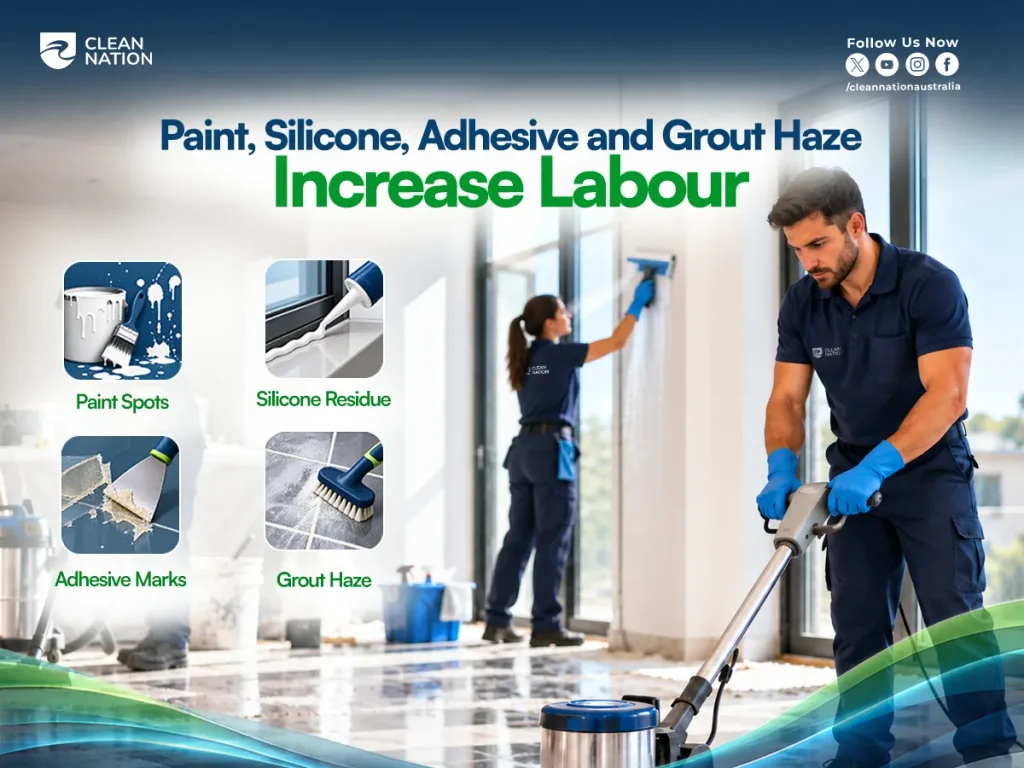
Paint, Silicone, Adhesive and Grout Haze Increase Labour
The final stages of construction often leave small marks rather than large piles of dirt.
Protective stickers remain on windows and appliances. Silicone can appear around bathroom fixtures. Adhesive may remain on frames. Grout haze can make new tiles look dull, and small paint spots can be visible across glass or hard flooring.
Removing these marks takes more time because new finishes need to be protected.
A cleaner cannot simply use an aggressive chemical or scraper on every surface. Glass, timber, natural stone, stainless steel, tiles and coated joinery can all respond differently to cleaning products and tools.
The more detailed residue removal the project needs, the less useful a basic floor-area estimate becomes.
Windows Can Change the Price of a Builders Clean
Glazing is one of the easiest parts of a project to underestimate.
A standard single-storey home with straightforward windows is very different from a custom property containing full-height glass, balcony doors, skylights, glass balustrades and upper-level external windows.
Some Australian builders’ clean pricing guides include standard window cleaning within their per-square-metre range, while difficult access or specialist glazing may be treated separately. Build Clean, for example, states that its standard full builders clean includes internal and external window cleaning, while restricted glazing requiring alternative access methods can attract extra cost.
When comparing quotes, always check whether “windows included” means internal glass only or whether it also covers external panes, tracks, frames and sills.
Premium Finishes Require More Care
Construction cleaning is not simply about removing as much dirt as possible as quickly as possible.
New timber floors, stone benchtops, high-gloss cabinetry, stainless steel, polished tiles and speciality fittings may require surface-specific products and careful handling.
This becomes particularly important on custom homes and high-end developments. Build Clean’s current Australian guide, for example, places standard project homes around 8–9/m² and premium custom homes around 10–12/m², with the type of finish among the factors influencing the rate.
The extra cost is not necessarily for “more dirt”. Part of it can come from the additional care needed to achieve a clean result without creating defects on new materials.
Site Access Can Affect the Final Cleaning Bill
Consider the difference between unloading cleaning equipment directly from a driveway and carrying it through a basement loading area, security desk and booked lift.
Both teams may eventually clean the same amount of floor space, but one loses considerably more time moving people and equipment.
Parking limitations, restricted access hours, stairs, lift bookings and site inductions can all influence labour. Commercial construction sites may have additional requirements around access, scheduling and working around other contractors.
Providing this information before asking for a quote makes the estimate more realistic.
What Does Post-Construction Cleaning Cost in Sydney?
Sydney pricing broadly sits within the Australian market, but individual projects can be affected by city-specific access and property conditions.
Current Sydney guides commonly show full builders cleaning around 6–12 per square metre, with some specialist providers using 8–12/m² as their standard professional handover range. Everyday Clean currently lists smaller renovation jobs from roughly $350, standard 2–3 bedroom projects around 750–1,200 and larger or more detailed work around 1,200–1,800+.
Another Sydney guide uses a wider early-budget range of approximately 5–15/m², noting that many standard residential jobs still fall around 8–12/m².
That gives Sydney customers a useful market reference, but the exact site still matters more than the postcode.
A suburban renovation with driveway parking and standard windows may be straightforward. A CBD fit-out, strata apartment or high-rise project can involve controlled entry, parking restrictions, booked lifts and extensive glazing.
Clean Nation’s NSW pricing guide is therefore useful alongside the broader Sydney market rather than being replaced by it.
Commercial fit-outs requiring ongoing workplace support can also connect naturally with commercial cleaning services in Sydney once the construction phase has finished.
Does a Builders Clean Happen Only Once?
Not always.
Large projects can require several cleaning stages, and this is another reason two quotes can look very different.
An early or rough clean may remove loose debris and prepare work areas for following trades. Cleaning during construction can help control accumulated dust and waste. A detailed builders clean takes place much closer to completion, when surfaces, fixtures, windows and floors can be properly finished.
The property may then receive a final handover or sparkle clean after defect work and last-minute trade visits.
Clean Nation’s national service describes rough cleaning, ongoing construction cleaning, detailed cleaning, inspection-ready work and handover preparation as separate parts of the construction-cleaning lifecycle.
If one company quotes only for the final clean and another quotes for progress cleaning plus final handover, comparing their total prices without comparing the scope will give a misleading result.
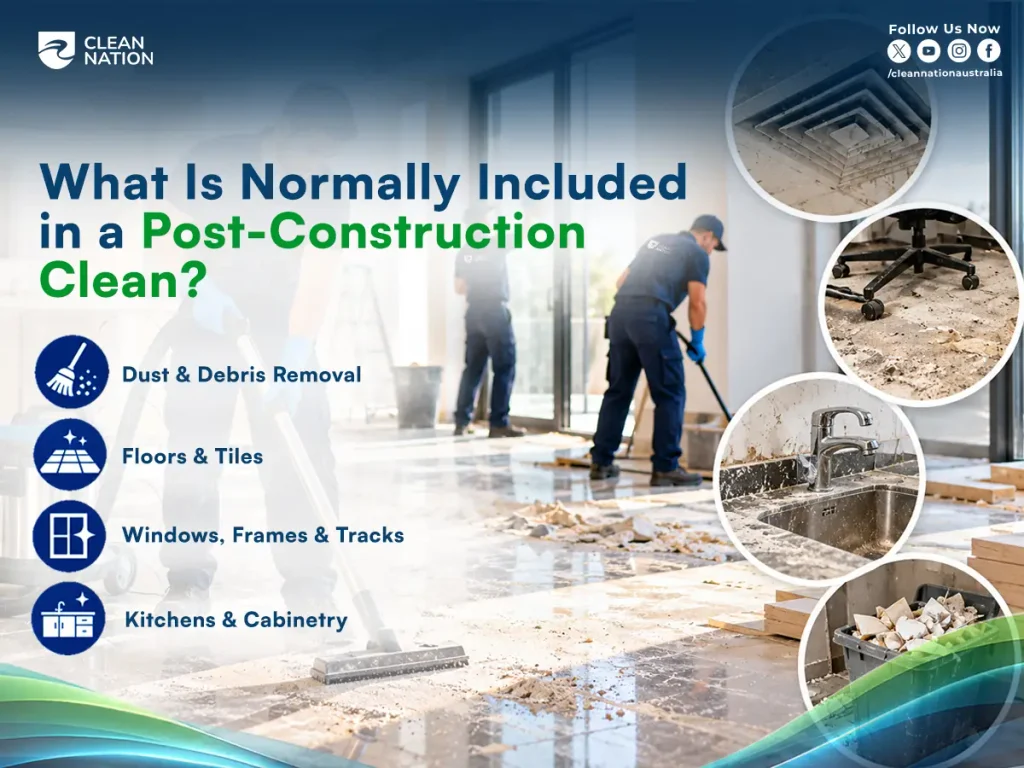
What Is Normally Included in a Post-Construction Clean?
The exact checklist should always come from the cleaner’s written scope, but a full builders clean commonly deals with dust and residue across completed internal surfaces.
That can include cabinetry, benchtops, doors, frames, skirting boards, tiled surfaces, sanitary fittings, mirrors, switches, floors and accessible glazing. Depending on the agreed service, cleaners may also detail window frames and tracks and remove appropriate construction marks from finished surfaces.
Clean Nation’s construction offering extends across renovation cleaning, surface preparation, detailed builders cleaning, high-level and external areas, inspection preparation and final presentation work.
Anyone specifically researching that service can review construction and builders cleaning services in Australia for Clean Nation’s current scope and pricing guide.
What Might Not Be Included?
A builders clean should not automatically be assumed to include every task visible on a building site.
Bulk waste removal, skip-bin management, specialist floor restoration, sealing, carpet steam cleaning, pressure washing, façade cleaning, difficult high-access glazing and repeat cleaning after other trades return may need separate pricing.
White goods are another example. Some providers treat internal oven, dishwasher and refrigerator cleaning as separate work rather than part of their standard construction-cleaning checklist.
This is why the cheapest headline rate does not always produce the lowest final bill.
One quote may cover internal cleaning only while another includes windows, tracks, balconies and a return visit after defects. Unless both scopes are comparable, the total price alone tells you very little.
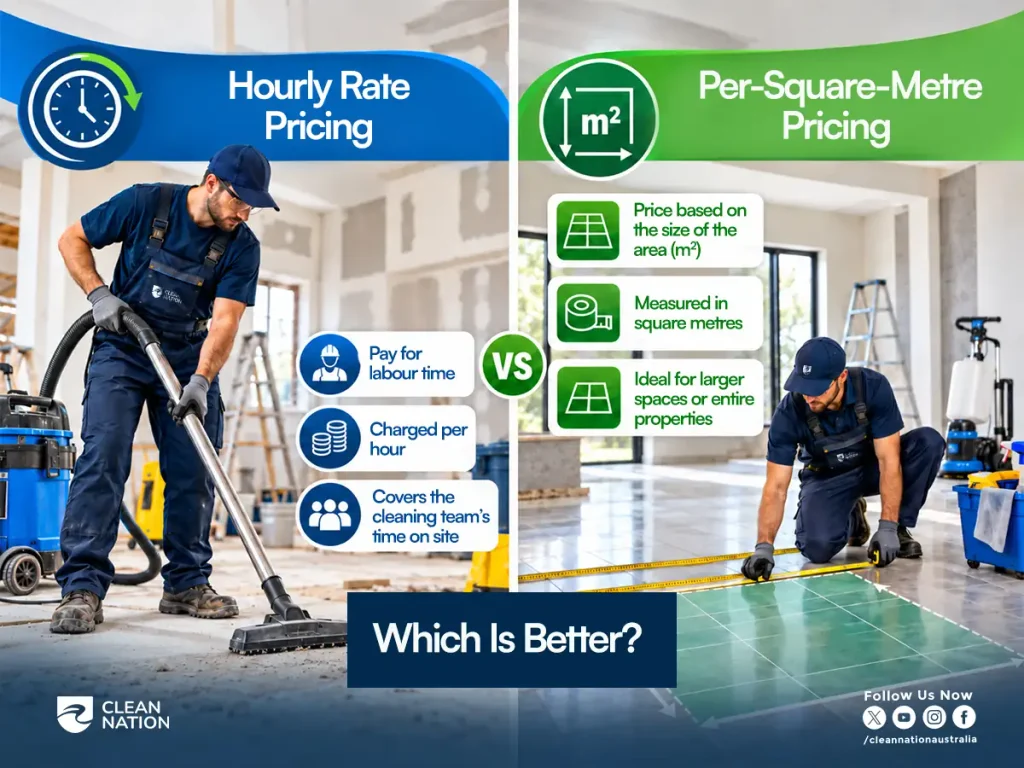
Hourly Rate or Per-Square-Metre Pricing – Which Is Better?
Neither model is automatically better.
Hourly pricing can work well for a smaller renovation where the area is limited but the amount of detailing is uncertain. If a kitchen needs cabinet cleaning, dust extraction and several hours of adhesive removal, charging by time can make sense.
Per-square-metre pricing works well when the whole property needs a relatively consistent builders-clean scope and the floor area is known.
A fixed project quote is often strongest for larger residential handovers and commercial construction because it allows the provider to consider floor space, condition, access, glazing and deadline together.
Whichever model is used, check whether an hourly price is per cleaner. A $50 hourly rate for one cleaner and a $50 hourly rate per cleaner for a four-person crew clearly produce very different totals.
How to Reduce Post-Construction Cleaning Costs Without Cutting Corners
The cheapest way to reduce cleaning costs is often to make sure cleaners are not being paid to do work that should already have been handled by the trades.
Bulk packaging, timber offcuts, unused materials and large pieces of construction waste should ideally be removed before the final cleaning team arrives. Going Rate makes a similar point in its current Australian guide: using cleaners to remove large amounts of building rubbish can be an expensive use of hourly cleaning labour.
Timing also matters. Completing detailed cleaning before sanding, cutting, drilling or major defect work has finished can result in cleaned rooms becoming dusty again.
Keep protective materials on vulnerable finishes until dusty work is complete where appropriate, organise site access beforehand and provide cleaners with recent photographs.
A well-prepared property can reduce wasted labour without lowering the quality of the final clean.
What Information Helps Produce a More Accurate Quote?
Floor area is useful, but cleaners need context.
Provide the property type, approximate square metres, number of storeys and whether the work involves a new build, renovation or commercial fit-out. Mention how much glazing the property has and whether both sides of the windows need cleaning.
Describe remaining dust, paint, grout, silicone and adhesive. Explain whether bulk waste has already been removed.
Access details matter too. Tell the provider about parking, lifts, loading docks, stair access, security requirements and any restrictions on working hours.
Finally, provide the target inspection or handover date. Large construction cleans need to fit around the building program, and cleaners cannot produce a lasting final finish while dusty trades continue working throughout the property.
Photos, plans or a walkthrough video can make the quotation even more accurate. Australian builders-clean providers commonly request this information before confirming a final scope.
How to Compare Builders-Clean Quotes Properly
Start with the scope rather than the price.
If one company quotes $1,500 and another quotes $2,000, first check whether both include the same rooms, glass, window tracks, cabinetry, bathrooms, kitchens, garage areas and external living spaces.
Check whether residue removal is included and what type. Ask how difficult stains or paint marks are handled.
Find out whether the quote includes one cleaning visit or a final touch-up after defect work.
Look at access charges, high-level work and weekend or after-hours requirements. Ask how extra work is approved if the condition of the site changes before the cleaners arrive.
Once the scope is comparable, the price becomes far more meaningful.

Is Professional Post-Construction Cleaning Worth the Cost?
A small bathroom renovation may be manageable without a specialist team. The calculation becomes different when dust has spread through an entire house or when a new build needs to meet a handover deadline.
Construction residue takes time to remove, and working on newly installed materials requires care. The challenge is not simply making a room “look cleaner”; it is systematically removing fine dust and finishing residue without damaging new surfaces.
Builders and project managers also have another cost to consider: time. Spending additional days dealing with cleaning close to practical completion can interfere with inspections, client walkthroughs, furniture delivery or occupancy.
For larger projects, professional construction cleaning is therefore less about replacing ordinary housekeeping and more about completing the transition from an active building site to a finished property.
What Should You Budget for Your Project?
For an early Australian budget, the current market suggests that many residential builders cleans fall somewhere around the 6–12/m² area, while specialist full-handover providers commonly publish rates around 8–12/m². Smaller renovations may begin in the few-hundred-dollar range, while detailed houses and larger projects can run well beyond $1,000.
For Clean Nation specifically, use the company’s published pricing rather than substituting competitor averages. Its national construction page currently guides customers toward approximately 35–60 per cleaner per hour or 8–16/m², while its NSW construction page publishes a wider 35–85/hour and 3–15/m² guide.
The figures are different because post-construction cleaning is not a standardised product. A light renovation clean, detailed residential handover, premium custom home and commercial fit-out can all sit under the same broad service name while requiring very different amounts of work.
The most reliable budget therefore combines floor area + site condition + glazing + access + cleaning stage + finish level, rather than relying on one national average.
For projects approaching completion, Clean Nation’s construction-cleaning service can be used for renovation cleaning, builders cleans, handover preparation and final presentation across Australia. A clear scope before work begins gives both the customer and cleaning team a better idea of what is included and what the final project is likely to cost.
Frequently Asked Questions
Does post-construction cleaning cost more if the property is furnished?
It can. Furniture and stored items can reduce access to floors, walls, cabinetry and other surfaces, while cleaners may also need additional time to work safely around them. Where possible, completing the builders clean before the property is fully furnished usually provides easier access to newly finished areas.
Can a construction-cleaning quote change after it has been provided?
It may change if the condition or agreed scope changes significantly before the cleaning date. For example, additional trade work, heavier-than-expected residue, extra glazing or newly requested areas can increase the amount of labour. Providing current photos and a clear written scope reduces the risk of unexpected differences.
Is window cleaning automatically included in a builders clean?
Not with every provider. Some full-handover services include standard internal and external glazing, while others price windows separately. High-access glass may also require specialist equipment. Ask specifically about panes, frames, sills and tracks before comparing quotes.
Is a final builders clean different from a sparkle clean?
It can be. The detailed builders clean generally removes construction dust and residue after the main building work is complete. A sparkle or handover clean is usually the last presentation-focused visit, dealing with fresh dust, fingerprints and minor marks before inspection or client handover.
Should construction cleaning be booked before all trades leave?
The project can be booked in advance, but the detailed final clean is generally most effective after the major dust-producing work has finished. Progress cleaning can be used earlier if the project needs ongoing control of debris and dust, while the final clean should be coordinated with the actual handover program.