



To remove stains from a mattress, first check the care label and identify the stain. Blot fresh spills without rubbing. Use cold water for blood, an enzyme cleaner for urine, and a mild, upholstery-safe cleaner for sweat or food stains. Apply as little liquid as possible and let the mattress dry completely before using it again.
This guide explains how to get stains out of a mattress safely, including old yellow marks, urine, blood, vomit and drink spills. You’ll also learn which cleaning methods to avoid and when a stain may need professional treatment.
How Can You Get Stains Out of a Mattress Without Damage?
The best way to remove a mattress stain depends on what caused it and how long it has been there.
Fresh stains are generally easier to remove because the liquid has had less time to soak into the fabric and inner layers.
However, using the wrong product can spread the stain, bleach the fabric or leave the mattress damp.
Start by identifying the stain.
| Mattress Stain | Suitable First Treatment | What to Avoid |
| Fresh urine | Blot, then use an approved enzyme cleaner | Soaking the mattress |
| Blood | Cold water and gentle blotting | Hot water and rubbing |
| Yellow sweat marks | Mild detergent or approved upholstery cleaner | Strong bleach |
| Vomit | Remove solids, blot and use a suitable cleaner | Rubbing contamination deeper |
| Coffee or tea | Blot and use a lightly damp cloth with mild detergent | Pouring water onto the stain |
| Red wine | Blot immediately and use an approved stain remover | Scrubbing or spreading the liquid |
| Old stains | Material-safe specialist treatment | Repeated strong chemicals |
Important: Not every visible mark can be removed completely. Old stains may have changed the fabric colour or reached the mattress filling.
What Do You Need Before Cleaning a Mattress?
Most light mattress stains can be treated using basic household cleaning tools.
Gather the following items:
- Clean white towels or microfibre cloths.
- Vacuum cleaner with a soft upholstery attachment.
- Cold water.
- Mild, colour-free dishwashing liquid, if the care label permits it.
- Mattress-safe upholstery or enzyme cleaner.
- Rubber gloves for bodily fluid stains.
- Bicarb soda, where permitted for odour treatment.
- Fan or dehumidifier for drying.
A white cleaning cloth makes it easier to see whether the stain is transferring from the mattress.
Avoid coloured cloths that could leave dye on light upholstery.
Check the Mattress Type First
Mattresses are made from different materials, including memory foam, latex, innerspring, hybrid and pillow-top constructions.
Some have removable, washable covers. Others only allow spot cleaning.
Always check the manufacturer’s care instructions before applying water, detergent or stain remover.
Memory foam and some latex mattresses can hold moisture deep inside their layers. Excess water may be difficult to remove.
If your mattress has a removable cover, only machine-wash it when the manufacturer allows it.
A washable outer cover does not mean the mattress core can be washed.
What Should You Do First With Any Mattress Stain?
Before choosing a cleaning product, take these four steps.
Step 1: Remove the Bedding
Take off the sheets, mattress protector and any wet bedding.
Check whether the liquid has passed through the protector.
Wash suitable bedding according to its care label.
Do not leave wet sheets sitting on the mattress while preparing cleaning products.
Step 2: Blot the Stain Immediately
Place a clean, dry towel over the affected area.
Press gently to absorb the liquid.
Replace the towel as it becomes wet.
Work from the outside of the mark towards the centre to avoid spreading it.
Never scrub a fresh mattress stain. Rubbing can push liquid deeper into the upholstery.
Step 3: Test the Cleaner
Choose a product suitable for the mattress fabric and stain type.
Test it on a small, less visible section of the same material.
Allow the area to dry and check for fading, colour transfer or damage.
Do not continue if the product changes the fabric.
Step 4: Use as Little Liquid as Possible
Apply an approved cleaner to a cloth where the product instructions allow.
Gently blot the stain instead of pouring liquid directly onto the mattress.
Follow the recommended contact time.
Remove excess product using the method stated on the label.
A mattress cannot be rinsed and dried as easily as a washable sheet.
That is why controlled spot cleaning is usually safer than soaking the surface.
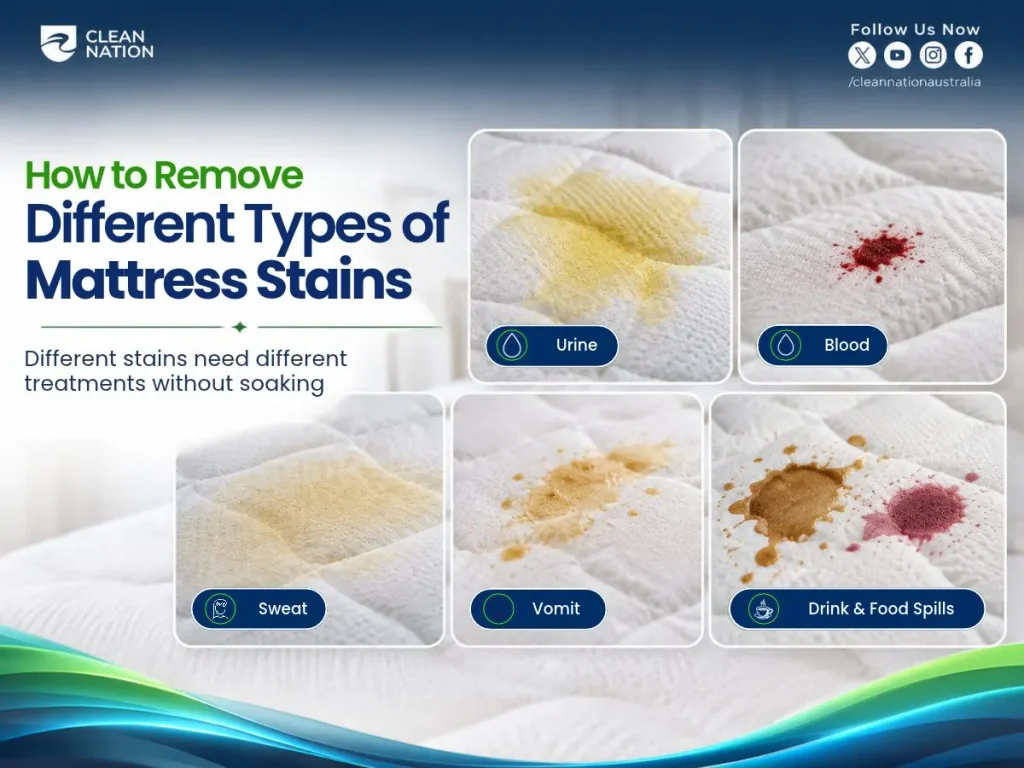
How to Remove Different Types of Mattress Stains
Different stains need different treatments.
The following methods focus on removing suitable surface marks without saturating the mattress.
How to Get Urine Stains Out of a Mattress
Urine can leave yellow marks and an unpleasant smell.
The problem becomes harder to treat when the liquid reaches the mattress filling.
For a fresh accident:
- Remove wet sheets and the mattress protector.
- Blot the urine with clean, absorbent towels.
- Choose an enzyme cleaner labelled as suitable for the mattress material and urine.
- Test the product on a hidden area.
- Apply only the permitted amount and allow the recommended contact time.
- Blot away excess product as directed.
- Let the mattress dry completely.
Enzyme cleaners are designed to break down certain organic residues.
However, not all enzyme cleaners are suitable for every mattress material.
If urine has reached deep inside a memory foam mattress, surface treatment may not remove the entire source of the smell.
Avoid adding more and more cleaning liquid in an attempt to reach the filling.
Can You Remove Old Urine Stains?
Older urine marks can be more difficult because the liquid has already dried and may have changed the fabric colour.
An approved enzyme cleaner may help reduce remaining residue.
However, a stain that has reached the inner layers may require professional assessment.
If the smell returns after cleaning, do not rely only on a fragranced spray.
The remaining odour may indicate contamination beneath the surface.
How to Remove Blood Stains From a Mattress
Blood stains should be treated with cold water.
Hot water can cause blood proteins to set into fabric, making the stain harder to remove.
For fresh blood:
- Wear gloves when appropriate.
- Dampen a clean white cloth with cold water.
- Gently blot the affected area.
- Replace the cloth as blood transfers onto it.
- Use a mattress-safe enzyme cleaner if the stain remains and the care instructions permit it.
- Blot away product residue and dry the area.
Avoid vigorous rubbing.
For older stains, some cleaning guides recommend a small amount of 3% hydrogen peroxide.
However, hydrogen peroxide can bleach coloured upholstery and may damage certain mattress materials, including some foam.
Do not use peroxide unless the manufacturer confirms it is suitable. Test it first, and never mix it with other cleaning chemicals.
If the stain remains after an appropriate treatment, specialist cleaning may be safer than repeated home remedies.
How to Remove Sweat and Yellow Mattress Stains
Yellow mattress stains often develop from sweat, skin oils and everyday use.
These marks may appear slowly over several months.
For light marks, begin by vacuuming the dry surface.
If the mattress manufacturer allows damp spot cleaning:
- Mix a small amount of mild detergent with water.
- Apply a little of the solution to a clean cloth.
- Gently blot the yellow area.
- Remove residue with another lightly damp cloth if permitted.
- Allow the mattress to dry fully.
Some enzyme-based upholstery cleaners may be suitable for body-oil and sweat stains.
Follow the product instructions rather than using an unknown DIY mixture.
Older yellow marks may improve without disappearing completely.
This does not always mean the mattress is still dirty. Long-term discolouration can remain after removable residue has been cleaned.
How to Clean Vomit Stains From a Mattress
Vomit requires prompt attention because it can leave both visible residue and an unpleasant smell.
Wear disposable gloves and remove contaminated bedding.
Carefully lift solid material using paper towels or another disposable tool.
Place the waste in a suitable bag and dispose of it.
Next, blot the affected area to absorb any remaining liquid.
Use a mattress-safe upholstery or enzyme cleaner approved for the material and type of contamination.
Follow the label’s application and removal instructions.
Do not scrub the stain or saturate the mattress.
If vomit has soaked deeply into the filling, particularly during an infectious illness, routine surface cleaning may not be enough to make it hygienic.
Seek specialist advice about cleaning or replacing the affected mattress.
How to Remove Coffee, Wine and Food Stains
Drink spills can leave coloured patches, while food may leave oil or sticky residue.
Start by removing loose food and blotting fresh liquid immediately.
For suitable mattress fabrics, a small amount of mild detergent diluted in water may help with light food and drink marks.
Apply it using a soft cloth.
Blot gently from the outside towards the centre.
Remove any remaining cleaner as directed and let the area dry.
Red wine and coffee stains may be harder to remove once dry.
If the mark remains, use a suitable upholstery stain remover rather than repeatedly applying household chemicals.
Do not assume a stain remover designed for clothes is safe for mattress fabric.
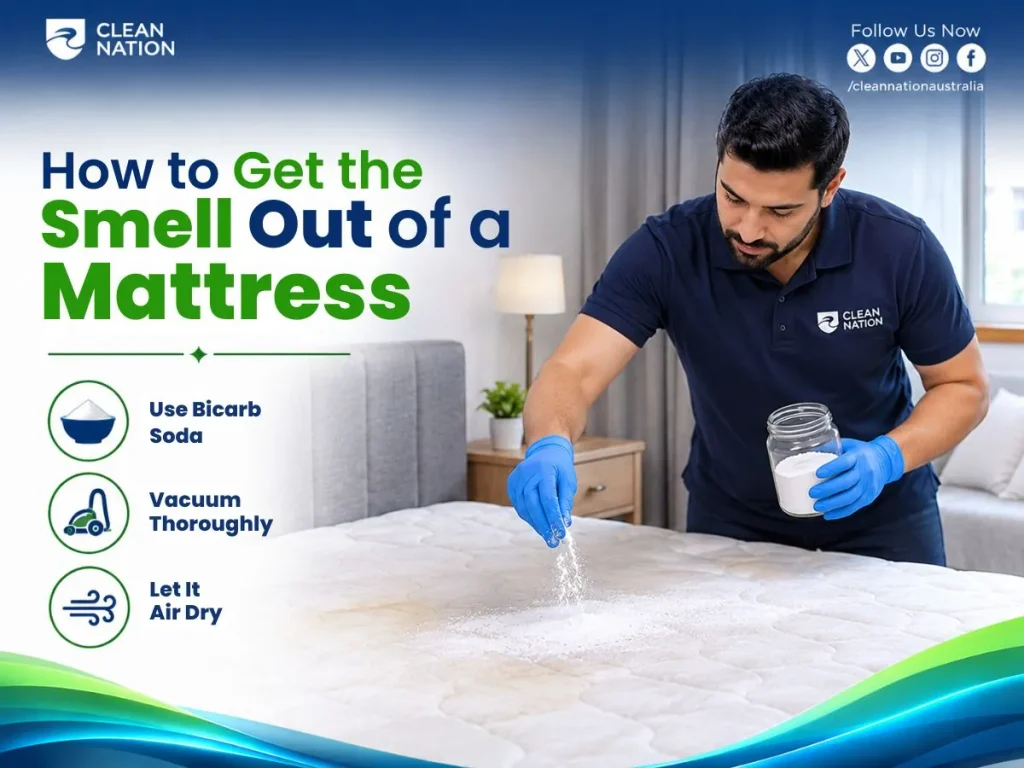
How to Get the Smell Out of a Mattress
A mattress may develop an unpleasant smell from sweat, body oils, spills or accidents.
However, removing a smell is not the same as removing the material causing it.
Start by treating the source of the odour.
For example, urine should be treated using a suitable method before applying a general deodoriser.
Can Bicarb Soda Help With Mattress Smells?
Bicarb soda, also called baking soda, is commonly used for mild household odours.
Some mattress manufacturers recommend it as part of routine care.
If your mattress and vacuum manufacturer permit the method:
- Make sure the mattress surface is dry.
- Apply a light layer of bicarb soda.
- Leave it for the time recommended by the care instructions.
- Vacuum thoroughly using suitable equipment.
- Check whether any odour remains.
Avoid applying a thick layer of powder.
Fine particles can affect some vacuum filters, while remaining powder may collect in seams and fabric.
Bicarb soda does not reliably remove urine or other contamination from deep inside a mattress.
For comparison, our guide on how to deodorise a carpet explains why odours in absorbent materials often return when the source remains untreated.
What If the Mattress Still Smells?
If the smell returns after suitable cleaning and drying, investigate further.
Possible causes include:
- Residue inside the mattress filling.
- Moisture trapped beneath the cover.
- Old urine or food spills.
- Mould caused by prolonged dampness.
Do not keep applying fragrance or additional cleaning liquid.
A mattress that remains smelly because of deep contamination may need professional assessment or replacement.
How Do You Dry a Mattress Properly After Cleaning?
Drying is one of the most important parts of mattress stain removal.
A mattress may feel dry on the surface while moisture remains inside its foam or padding.
This is especially important for memory foam and thick pillow-top mattresses.
Step 1: Remove Excess Moisture
Press clean, dry towels onto the treated area.
Repeat until the towel is no longer absorbing noticeable moisture.
Do not twist, compress aggressively or dismantle the mattress.
Step 2: Improve Airflow
Open windows when outdoor conditions are suitable.
Use a fan to move air across the mattress.
A dehumidifier may help in a humid room.
In Brisbane and other humid parts of Australia, outdoor moisture levels can slow drying even when the room feels warm.
Air conditioning with a dehumidifying function may also help.
Step 3: Allow Enough Drying Time
There is no single drying time for every mattress.
A small, lightly treated surface may dry relatively quickly, while deeper cleaning can take much longer.
Australian consumer organisation CHOICE recommends allowing up to 24 hours for a thorough mattress clean.
The actual time depends on the mattress construction, amount of moisture, airflow and humidity.
Do not use a hair dryer, portable heater or other direct heat source to force the mattress dry.
Direct sunlight should only be used if the mattress manufacturer allows it. Some mattress covers and foam materials can be damaged by prolonged sun exposure.
Do not put sheets back on or sleep on the mattress until it is completely dry.
If the filling remains damp or develops a musty smell, seek professional advice.
What Should You Never Do When Cleaning Mattress Stains?
Some common cleaning mistakes can turn a small stain into permanent damage.
| Mistake | Why It Causes Problems |
| Using hot water on blood | May set protein-based stains |
| Soaking memory foam | Can trap moisture inside the filling |
| Scrubbing aggressively | Spreads stains and damages fabric |
| Using bleach | May discolour upholstery and damage materials |
| Mixing vinegar and bleach | Can release dangerous fumes |
| Using unsuitable peroxide | Can bleach or damage certain fabrics |
| Applying too much detergent | Leaves difficult-to-remove residue |
| Covering a damp mattress | Traps moisture and increases mould risk |
| Using steam without checking care instructions | Heat and moisture may damage the mattress |
Never mix bleach with vinegar, ammonia or other cleaning chemicals.
If you suspect chemical exposure in Australia, contact the Poisons Information Centre on 13 11 26. For a serious emergency, call 000.
How Often Should You Clean a Mattress?
Regular mattress care can help reduce dust, dirt and everyday build-up.
CHOICE recommends thoroughly cleaning a mattress about twice a year.
However, individual mattress manufacturers may have different care schedules.
| Maintenance Task | Suggested Frequency |
| Wash sheets and pillowcases | Weekly |
| Vacuum mattress surface and seams | According to the manufacturer’s care schedule |
| Check for fresh stains | Whenever changing bedding |
| Clean removable mattress protector | According to its care label |
| Thorough mattress clean | Around twice a year, or as advised by the manufacturer |
| Treat accidental spills | Immediately |
For households managing dust mite allergies, Victoria’s Better Health Channel recommends dust mite-resistant bedding covers and washing those covers every two months.
It also advises washing suitable sheets and pillowcases weekly in water hotter than 60°C for dust mite control.
Always check fabric labels before using high washing temperatures.
Use a Suitable Mattress Protector
A good mattress protector helps stop sweat, drinks and other spills from reaching the mattress.
Choose a waterproof protector if accidental liquid spills are a concern.
A waterproof protector and a dust mite-resistant cover serve different purposes, although some products may offer both features.
Wash the protector according to its instructions and replace it if its waterproof layer becomes damaged.
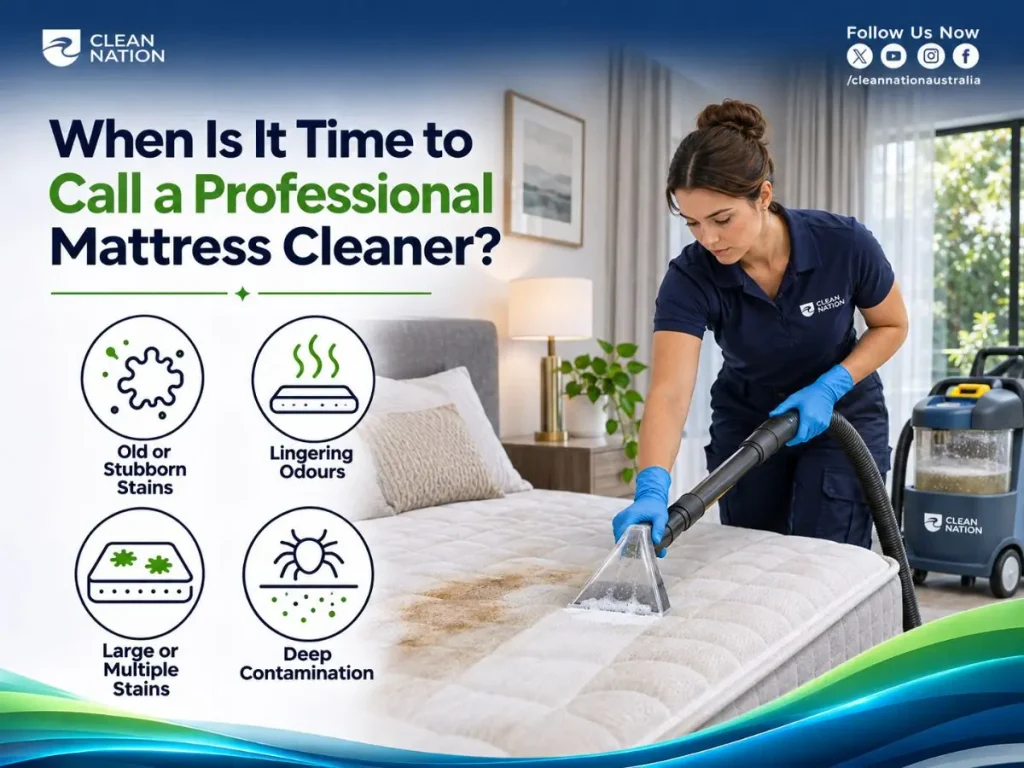
When Is It Time to Call a Professional Mattress Cleaner?
Home spot cleaning can help with small, fresh stains.
However, some problems need a more detailed assessment.
Consider professional help when:
- Old urine stains keep producing an unpleasant smell.
- Several stains cover a large area.
- Blood or drink stains remain after suitable cleaning.
- The mattress needs cleaning but its material is difficult to identify.
- Previous DIY treatments have left residue or discolouration.
Professional cleaners may use stain-specific products, controlled moisture and extraction equipment where these methods are suitable for the mattress.
However, not every mattress should be steam cleaned.
The technician should check the mattress construction, care instructions and stain type before choosing a treatment.
Clean Nation provides mattress cleaning services across Australia for suitable residential and commercial mattresses.
A professional service may improve removable stains and odours, but permanent discolouration and deeply absorbed contamination cannot always be reversed.
How Much Does Professional Mattress Cleaning Cost in Australia?
Mattress cleaning prices depend on the mattress size, location, stain type and required treatment.
Clean Nation’s national mattress cleaning page gives an indicative range of approximately 60–160 for general services.
For a clearer size-based example, Clean Nation publishes the following prices for Melbourne.
| Mattress Size | Clean Nation’s Published Melbourne Price |
| Cot/children’s mattress | $43 |
| Single mattress | $58 |
| Double mattress | $70 |
| Queen mattress | $78 |
| King mattress | $91 |
These are published Melbourne standard-clean rates, not nationwide prices or guaranteed quotes for difficult stains.
Heavy urine contamination, additional stain treatment and other specialist work may affect the final quote.
Check whether the price includes the required treatment, applicable GST and any additional charges.
For local information, visit Clean Nation’s mattress cleaning services in Melbourne page.
When Should You Replace a Stained Mattress?
Not every mattress stain means the mattress must be replaced.
A small, removable surface mark may be suitable for cleaning.
However, replacement may be the safer or more practical option when the mattress has serious internal contamination.
Consider replacing a mattress if:
- It has visible or suspected mould within the filling.
- Urine or other contamination has soaked deeply into the core and cannot be treated safely.
- The mattress remains damp despite appropriate drying efforts.
- There is persistent contamination from floodwater or sewage.
- The material is badly damaged, sagging or no longer supportive.
Mattresses are porous, which means moisture and contamination can remain inside the filling.
Surface cleaning cannot always reach these areas.
CHOICE identifies around 8–10 years as a typical mattress lifespan, but age alone does not determine whether replacement is necessary.
Construction quality, support, hygiene and overall condition also matter.
If mould is suspected, avoid disturbing contaminated material and seek appropriate advice before attempting further cleaning.
Frequently Asked Questions
1. Can I Use a Steam Cleaner at Home on a Mattress?
Only if the mattress manufacturer permits it and the equipment is suitable. Steam and hot-water extraction can introduce heat and moisture into the filling. Memory foam and other sensitive materials may not tolerate this method. When in doubt, use approved spot cleaning or ask a professional.
2. Is It Safe to Sleep on a Mattress That Is Slightly Damp?
No. Moisture trapped beneath bedding can encourage mould and unpleasant smells. Even if the fabric feels almost dry, the filling may still contain moisture. Use another sleeping surface until the mattress is fully dry.
3. Will a Mattress Protector Prevent Every Stain?
A suitable waterproof protector can greatly reduce the chance of liquid reaching the mattress, but it may not prevent every spill. Check its condition and fit regularly. A dust mite-resistant cover is designed for allergen control and is not necessarily waterproof.
4. Can Bed Bugs or Mould Be Removed Using These Stain-Cleaning Methods?
No. Ordinary stain removal is not a reliable treatment for bed bugs or mould inside a mattress. Bed bugs require an appropriate pest-control response. Deep mould contamination may make replacement necessary. Seek specialist advice rather than applying more household chemicals.
5. Can Mattress Stains Affect the Manufacturer’s Warranty?
They can. Some manufacturers exclude stained or soiled mattresses from returns or warranty claims, particularly during sleep trials. The exact conditions vary between brands. Check your mattress warranty and care instructions before using stain-removal products.
Keep Your Mattress Cleaner for Longer
The safest way to deal with mattress stains is to act quickly, use the right product for the stain and avoid excess moisture.
Keep a suitable mattress protector on the bed, clean fresh spills promptly and follow the manufacturer’s care instructions.
If a stain remains after careful treatment, avoid repeated scrubbing or strong chemicals.
For professional stain assessment and mattress cleaning, contact Clean Nation on +61 480 810 142 or request a cleaning quote online.