


A post-construction clean can take a few hours for a small renovation, one to two days for an average home, and several days for a large new build or commercial project.
The exact cleaning time depends on much more than floor area. Construction dust, leftover debris, windows, new finishes, the number of cleaners, site access and whether other trades are still working can all change the schedule.
For most Australian projects, the best way to estimate how long a post-construction clean takes is to assess the property after the major building work has finished and before the final handover date is locked in.
Post-Construction Cleaning Time at a Glance
The following ranges are useful for planning rather than fixed guarantees.
| Project Type | Typical Cleaning Time |
| Single room or minor renovation | 4–8 hours |
| 1–2 bedroom apartment | 4–8 hours |
| 3–4 bedroom home | 1–2 days |
| Large home or new build | 2–3+ days |
| Small commercial fit-out | 1–3 days |
| Large commercial building | Several days or phased cleaning |
A relatively clean three-bedroom renovation may be completed within a day by an appropriately sized cleaning crew, while another property of exactly the same size can take considerably longer if there is heavy plaster dust, adhesive residue, paint marks or extensive glazing.
For this reason, floor area should be treated as only the starting point when estimating a builder’s clean.
Why Does Post-Construction Cleaning Take Longer Than Regular Cleaning?
Regular home or office cleaning mainly deals with everyday dust, fingerprints, spills and normal surface dirt.
Post-construction cleaning deals with a very different type of mess.
New builds, renovations and commercial fit-outs can leave behind:
- plaster and gyprock dust
- sawdust and fine construction particles
- paint splashes
- silicone residue
- adhesive and tape marks
- grout haze
- labels and protective film
- building material off-cuts
- dust inside cabinets and tracks
- residue on newly installed floors and fixtures
Fine construction dust also spreads far beyond the areas where work actually took place. It can collect on skirting boards, window tracks, cabinetry, fittings, ledges and other detailed surfaces.
That extra detailing is why a professional construction and builders cleaning service normally requires considerably more time than routine cleaning.
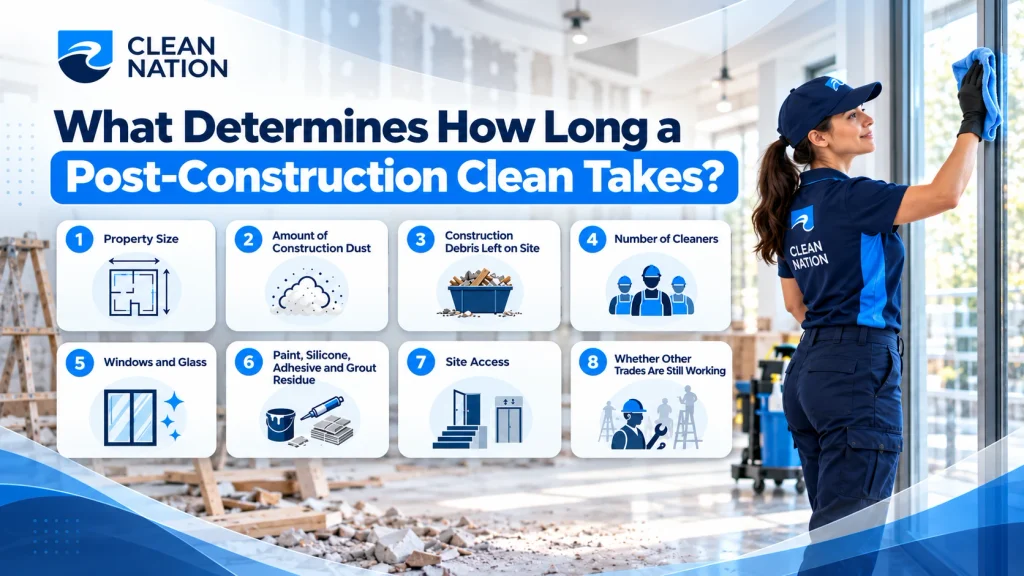
What Determines How Long a Post-Construction Clean Takes?
Two construction sites with the same floor area can require very different cleaning schedules.
1. Property Size
Larger properties naturally contain more floors, walls, windows, rooms, fittings and surfaces to clean.
However, square metres alone do not provide an accurate timeframe.
A simple open-plan warehouse can sometimes be cleaned more quickly than a smaller high-end home containing detailed joinery, multiple bathrooms, large glass panels and delicate finishes.
2. Amount of Construction Dust
Dust level is one of the biggest factors affecting post-construction cleaning time.
A site where builders and trades regularly removed rubbish and controlled dust during construction gives the final cleaning crew a significant head start.
A property covered in fine plaster, sawdust and renovation dust can require repeated vacuuming and wiping before surfaces remain clean.
Fine construction particles can also resettle after the first pass, which is one reason larger projects may require a final touch-up clean close to handover.
3. Construction Debris Left on Site
Professional cleaners can spend much more time on a site if packaging, timber pieces, protective materials, rubbish or leftover building products have not already been cleared.
A builders clean usually progresses faster when large construction waste has been removed before detailed cleaning begins.
That allows the cleaning crew to focus on dust extraction, surface cleaning, glass, flooring and final presentation rather than basic site clearing.
4. Number of Cleaners
Crew size can dramatically change the total time spent on site.
For example, a job that could take a single cleaner two days may potentially be completed within one working day by a properly coordinated multi-person team.
Simply adding cleaners does not make every project proportionally faster, though.
Some spaces only allow a limited number of people to work safely at once, while specialist tasks such as detailed glass cleaning, high-level cleaning or floor treatment may need to be completed in sequence.
5. Windows and Glass
Newly installed windows often require much more than a quick wipe.
Cleaners may need to deal with:
- construction dust
- fingerprints
- stickers
- protective film
- adhesive residue
- paint marks
- dusty tracks
- window frames and sills
Properties containing large sliding doors, glass partitions, shopfronts or floor-to-ceiling glazing can therefore take significantly longer than similar-sized properties with fewer glass surfaces.
6. Paint, Silicone, Adhesive and Grout Residue
Post-build cleaning often involves residue that cannot simply be vacuumed or wiped away.
Paint droplets, silicone, grout haze, tape adhesive and construction marks may need individual attention using a cleaning method suitable for the underlying material.
New finishes must also be treated carefully.
Aggressive scraping or unsuitable chemicals can damage glass, stone, timber, tiles, painted surfaces and fixtures, so professional cleaners generally work more carefully around newly installed materials.
7. Site Access
Access is easy to overlook when planning a cleaning timeline.
Cleaning may take longer when equipment needs to move through:
- apartment lifts
- stairwells
- restricted entrances
- secured construction areas
- loading docks
- multi-storey buildings
In apartment and commercial projects, cleaners may also need building access, parking arrangements, lift bookings or site inductions before work can begin.
Good access planning can save substantial time on larger projects.
8. Whether Other Trades Are Still Working
One of the easiest ways to extend a post-construction clean is to start it too early.
Painters, electricians, carpenters, flooring contractors and other trades can generate fresh dust, footprints, packaging and surface marks after an area has already been cleaned.
This often leads to duplicated work.
Ideally, the detailed final clean should start after dusty construction work has finished and major trades have left the areas being cleaned.
How Long Does Each Stage of Post-Construction Cleaning Take?
Many construction cleaning projects are easier to understand when separated into stages rather than treated as one long clean.
Stage 1: Rough Clean
The rough clean deals with the heavier construction mess.
Depending on the project, this may include:
- clearing loose waste
- removing packaging
- collecting building off-cuts
- sweeping heavy dust
- initial vacuuming
- preparing rooms for detailed cleaning
A small residential rough clean might take several hours, while large building projects can require substantially longer or be cleaned in separate zones.
The condition in which contractors leave the site heavily affects this stage.
Stage 2: Detailed Final Clean
The final clean is normally the most labour-intensive stage.
This is where cleaners work through surfaces and rooms in greater detail, including:
- walls and ledges
- doors and frames
- skirting boards
- cupboards and cabinetry
- kitchens
- bathrooms
- fixtures and fittings
- windows and tracks
- floors
- glass
- remaining construction residue
Professional construction cleaning generally works from higher surfaces downward so falling dust does not contaminate areas that have already been finished.
A standard residential property may require most of a working day or longer at this stage, depending on the crew and site condition.
Clean Nation also provides dedicated post-construction cleaning in NSW for residential, commercial and building projects requiring detailed final cleaning before use or handover.
Stage 3: Touch-Up or Handover Clean
Even after the major builder’s clean has finished, small amounts of dust can reappear.
Trades may also return for defect work, adjustments or last-minute installations.
A touch-up clean focuses on final presentation rather than repeating the whole post-construction cleaning process.
Typical work may include:
- removing fresh dust
- correcting fingerprints
- polishing glass
- touching up fixtures
- cleaning marks left by final trades
- checking presentation areas
- preparing the property for inspection
This stage may only take a few hours on a home, although large commercial developments can require more extensive final detailing.
How Long Does a Post-Construction Clean Take for a House?
For an average Australian house, allow roughly one to two days for a professional post-construction clean where significant renovation or building work has occurred.
A small renovation can be much quicker.
For example, cleaning after a single renovated bathroom or kitchen may be completed within several hours where the rest of the home has been properly protected from dust.
A complete new home is different.
Dust may be present on cabinetry, flooring, glass, wardrobes, bathrooms, fittings, window tracks and numerous horizontal surfaces throughout the building.
Larger homes with extensive glazing or custom finishes can easily move into the two-to-three-day range.
Homeowners comparing post-build cleaning with general residential services can also view Clean Nation’s Sydney house cleaning service to understand how ordinary household cleaning differs from construction-related cleaning.
How Long Does Post-Renovation Cleaning Take?
A renovation clean can take anywhere from several hours to several days.
The biggest variable is how much of the property was affected.
A renovated bathroom contained behind closed doors is very different from a full home renovation involving wall removal, sanding, painting, new cabinetry and flooring.
Even when construction occurs in only part of the property, airborne dust can migrate through hallways, adjoining rooms and ventilation pathways.
For major renovations, allow time for more than visible surface cleaning.
Window tracks, cupboard interiors, skirting, fittings and nearby rooms may also need attention.
How Long Does Commercial Post-Construction Cleaning Take?
Commercial projects often require more scheduling than residential jobs.
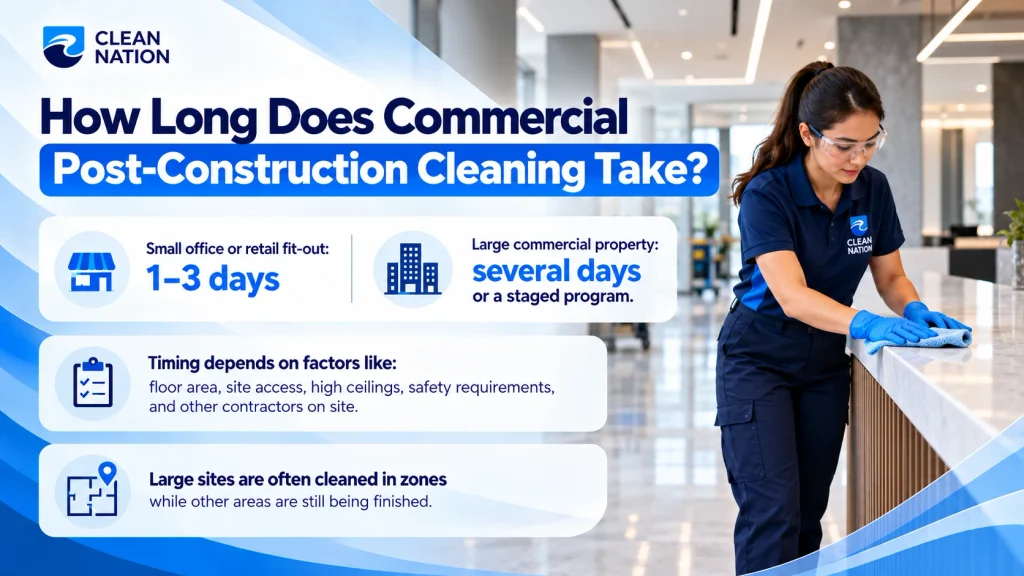
A small office or retail fit-out may require approximately one to three days, while a large commercial property can need several days or a staged program.
Commercial cleaning time can be affected by:
- total floor area
- number of amenities
- floor-to-ceiling glass
- high ceilings
- elevators
- loading access
- floor treatment
- multiple levels
- safety requirements
- restricted work areas
- handover deadlines
- other contractors working on site
Large construction sites are commonly divided into zones so completed sections can be cleaned while other parts of the project are still being finished.
For Sydney commercial projects, Clean Nation’s commercial cleaning services in Sydney include construction and builders cleaning for newly completed and renovated workplaces.
How Long Does a Post-Construction Clean Take in Sydney?
The actual cleaning process in Sydney is governed by the same core factors as elsewhere in Australia: property size, dust level, construction scope, surfaces, access and crew size.
However, site logistics can make a noticeable difference.
Apartment buildings, high-density developments, CBD commercial fit-outs and multi-storey properties may involve lift bookings, loading access, restricted parking or building-management requirements.
Those arrangements do not necessarily increase the physical cleaning required, but poor coordination can reduce productive cleaning time.
For Sydney projects, access details should therefore be confirmed before the crew arrives rather than on cleaning day.
Can a Builders Clean Be Completed in One Day?
Yes, some post-construction cleans can be completed in one day.
It is most realistic when:
- the property is relatively small
- major construction rubbish has already been removed
- trades have finished
- the site has reasonable access
- electricity and water are available
- the dust level is manageable
- the crew size suits the project
- no specialist floor work is required
A one-day turnaround becomes much less realistic when the site still contains extensive debris, heavy construction dust, large quantities of glass or active contractors.
Trying to force a multi-day job into one day can also lead to rushed detailing and missed dust.
The goal should be an inspection-ready property, not simply the shortest possible cleaning time.
Can More Cleaners Make Post-Construction Cleaning Faster?
Usually, yes.
A larger professional crew can divide the site into cleaning zones and complete compatible tasks at the same time.
For example, while one cleaner works on bathrooms, another may detail cabinetry while another handles dust extraction.
However, there is a point where increasing crew size stops producing the same productivity gain.
Narrow rooms, lifts, specialist equipment and sequential cleaning tasks can restrict how many people can work effectively.
A site assessment is therefore more useful than simply asking for the largest possible crew.
When Should You Schedule a Post-Construction Clean?
Schedule the clean once you have a reasonably reliable construction completion or handover date.
The detailed cleaning itself should ideally happen after:
- sanding is finished
- painting is substantially complete
- major installations are finished
- flooring work is complete
- heavy construction waste is removed
- dusty trades have left the area
Large projects should not wait until the evening before handover to organise cleaning.
Building delays are common, and leaving no scheduling buffer means even a minor construction delay can affect the clean and final inspection.
Where possible, leave time between the main final clean and handover for defect work and a final touch-up.
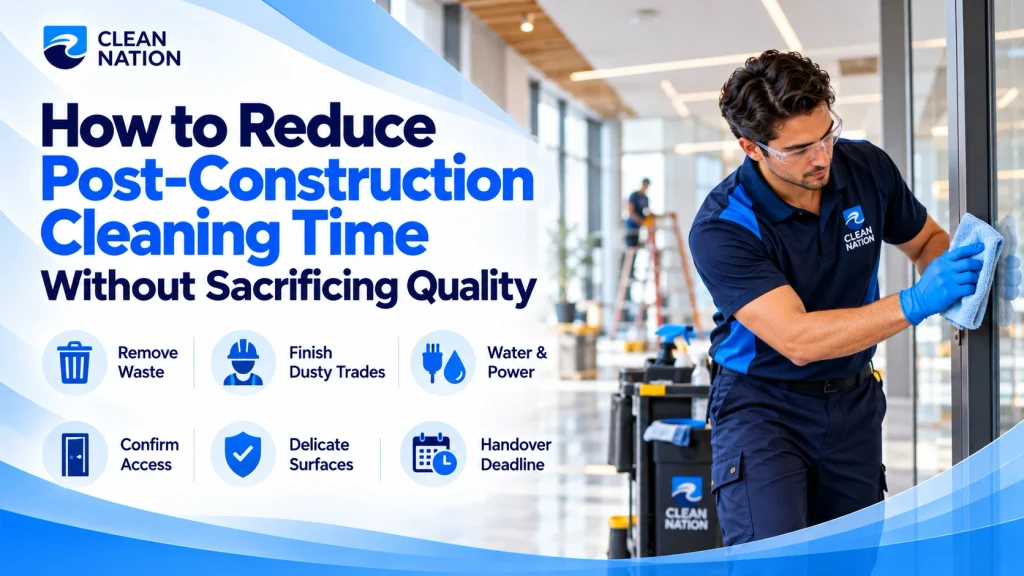
How to Reduce Post-Construction Cleaning Time Without Sacrificing Quality
Preparation before the cleaners arrive can make a substantial difference.
Remove Large Building Waste
Dispose of major off-cuts, boxes, protective packaging and unwanted construction materials before detailed cleaning begins.
Finish Dusty Trades First
Try to complete sanding, cutting, drilling and other dust-generating work before the final clean.
Keep Water and Electricity Available
Professional vacuums, extraction equipment and other cleaning machinery may require power, while many cleaning tasks require reliable water access.
Confirm Site Access
Arrange keys, security access, lift bookings, parking and building-management approval in advance.
Identify Delicate New Surfaces
Tell the cleaning company about natural stone, timber, specialty glass, new coatings and other materials requiring specific treatment.
Provide the Handover Deadline
Knowing the inspection or handover date allows the cleaning company to plan the crew, cleaning stages and any necessary touch-up work around the actual project schedule.
How Much Time Should You Leave Before Handover?
Avoid scheduling the major final clean at the exact last possible moment.
For a small residential renovation, cleaning shortly before move-in may be practical.
For new builds, commercial fit-outs and large projects, leaving a buffer between cleaning and formal handover is safer.
A simple project schedule could look like this:
- Major construction work finishes.
- Large debris is removed.
- Rough clean is completed if required.
- Detailed builders clean takes place.
- Builder or project manager conducts an inspection.
- Defect work is completed.
- Final touch-up clean is performed.
- Property is handed over.
This sequence reduces the chance of cleaners repeatedly cleaning areas that contractors make dusty again.
How Do You Get an Accurate Cleaning Time Estimate?
The most reliable timeframe comes from a proper scope assessment.
Before estimating the duration, the cleaning company should ideally know:
- property type
- approximate size
- number of rooms or work areas
- renovation or construction scope
- site condition
- amount of debris
- level of construction dust
- quantity of glass
- floor materials
- access conditions
- additional cleaning requirements
- handover date
Photos can help with smaller projects, while larger commercial and construction sites may benefit from an on-site inspection.
Without understanding these details, any exact hourly estimate is largely a guess.
Is Professional Post-Construction Cleaning Worth It?
Post-construction cleaning involves more than making a newly built space look tidy.
The cleaning crew must remove fine construction dust and residue without damaging newly installed finishes while preparing the property for inspection, occupancy or handover.
Specialised work can also involve industrial vacuuming, detailed glass cleaning, residue removal and repeated surface cleaning.
For builders, homeowners and project managers, professional cleaning can therefore help close the gap between “construction complete” and genuinely handover-ready.
Clean Nation provides professional cleaning services across Australia for residential, commercial and industrial properties, including dedicated construction and builders cleaning.

Final Answer – How Long Should You Allow?
As a practical guide, allow:
- 4–8 hours for a minor renovation or small property
- 1–2 days for many standard residential projects
- 2–3+ days for large homes and major new builds
- 1–3 days for many small-to-medium commercial fit-outs
- Several days or a phased schedule for large commercial developments
These are planning ranges, not guarantees.
The most accurate post-construction cleaning time depends on the property size, dust and debris levels, finish complexity, access, crew size, and how much construction activity remains.
If the property has a fixed inspection or handover deadline, organise the builder’s clean early enough to allow time for detailed cleaning and any final touch-up work.
Frequently Asked Questions
Does construction dust need time to settle before the final clean?
Fine dust can continue moving and resettling after construction activity stops. On dusty projects, a detailed clean followed by a later touch-up can produce a better handover finish than relying on one rushed visit immediately after active trades leave.
Should furniture be installed before or after a builder’s clean?
Where practical, complete the main detailed clean before bringing in large amounts of furniture. Empty rooms give cleaners better access to floors, skirting boards, cabinetry and other surfaces. A lighter touch-up may then be useful after furniture installation.
Does post-construction window cleaning add much time?
It can. Windows covered in dust, stickers, adhesive, paint spots or dirty tracks require substantially more detailing than normal glass cleaning. Properties with large quantities of glazing should allow additional cleaning time.
Can different areas of a large construction site be cleaned at different times?
Yes. Large commercial developments and multi-stage projects can be divided into completed zones. Phased cleaning allows finished sections to progress toward inspection while construction continues elsewhere, provided cleaned zones can be protected from new dust and traffic.
Do cleaners need to inspect the property before giving a timeframe?
Not every small project requires a physical inspection, but photos, floor area and clear scope information should normally be provided. Large, complex or heavily soiled construction sites are easier to estimate accurately after a walkthrough because the condition of the site can affect both crew size and cleaning duration.