

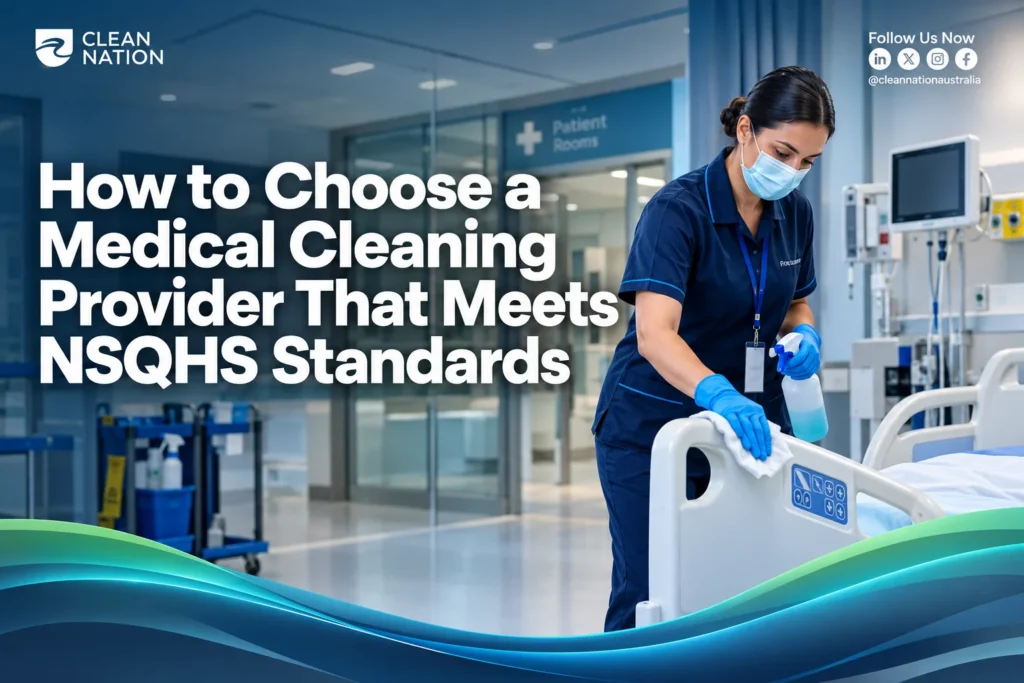
Ask ten medical cleaning companies whether they’re “NSQHS compliant” and most will say yes. That answer should make you cautious. The NSQHS Standards don’t accredit cleaning companies. They assess your health service, and your cleaning provider is one of the systems that assessment looks at.
That changes how you should choose a medical cleaning provider. You’re not hunting for a badge. You’re looking for a provider who can hand you the evidence an accreditor, or your own practice standards, will ask for: which products were used, who was trained, what was cleaned, how often, and how you know it worked.
This guide shows you exactly what that evidence looks like, the questions that separate healthcare specialists from general cleaners, the red flags to walk away from, and how to compare quotes without falling for the lowest price. It’s written for practice managers, facility managers and clinic owners across Australia.
Can a Cleaning Company Actually Be “NSQHS Compliant”?
Not in the way the phrase suggests. The National Safety and Quality Health Service (NSQHS) Standards are developed by the Australian Commission on Safety and Quality in Health Care (ACSQHC) and assessed at the level of the health service organisation. Public and private hospitals, day hospitals and most public dental practices are required by health regulators to be accredited to them. A cleaning contractor isn’t accredited. Your facility is.
Cleaning sits inside Standard 3, Preventing and Controlling Infections. Action 3.13 expects your service to have processes that keep the environment clean, safe and hygienic, in line with the Australian Guidelines for the Prevention and Control of Infection in Healthcare and your state or territory’s requirements. In practice, those processes need to:
- Respond to environmental risks, including novel infections.
- Require cleaning and disinfection with products listed on the Australian Register of Therapeutic Goods (ARTG), used according to the manufacturer’s instructions and recommended frequencies.
- Give the workforce access to training on cleaning for routine and outbreak situations.
- Audit how effective cleaning is, and whether your environmental cleaning policy is being followed.
- Use those audit results to improve.
If you outsource cleaning, your provider does much of that work, but you still answer for it at assessment. So the useful question isn’t “Are you NSQHS compliant?” It’s “Can you help us prove Action 3.13?”
Not every medical facility is assessed this way. GP practices are generally accredited against the RACGP Standards for general practices. Accreditation under the national GP scheme currently still uses the 5th edition, and RACGP has released a 6th edition that practices are encouraged to start implementing. Dental, allied health and aged care each have their own frameworks too. A good provider asks which framework applies to you before they quote. If you’re unsure, ask your accrediting agency.
The Evidence a Good Medical Cleaning Provider Should Be Able to Show You
The ACSQHC’s own examples of evidence for Action 3.13 read like a checklist for your cleaning contractor. Use the table below as your minimum standard when you shortlist providers.
| What assessors look for | What to ask your provider for | Why it matters |
|---|---|---|
| A contract with external cleaning providers that reflects your policies | A written scope that references your environmental cleaning policy | A vague scope is where accreditation gaps start |
| A list of approved cleaning and disinfection products | A product list showing what each product is used for and its ARTG listing | Action 3.13 expects ARTG-listed products |
| Safety data sheets or a chemical register | Current SDS for every product used on your site | Cleaners and staff need each product’s hazards and safe handling on record |
| Manufacturer’s instructions for use | The written method for each product: dilution, contact time, suitable surfaces | A disinfectant performs to its tested claim only when used as labelled |
| Cleaning checklists, schedules and methodologies | A zone-by-zone schedule with a frequency for every room type | Proves risk-based cleaning is planned, not assumed |
| Training programs that include contractors | Training records for each cleaner, including outbreak and novel-infection procedures | Training on routine and outbreak cleaning is part of the action |
| Audit results and improvement plans | Inspection reports, corrective actions and how quickly they’re closed | The action expects audits and use of the results |
| Incident and risk management records | A clear process for reporting and escalating incidents | ACSQHC lists incident systems as evidence of improvement |
| Workforce screening and immunisation records | Whatever documentation your own policy requires for contractors | Action 3.15 covers immunisation requirements for placing contractors |
No provider will hand over all of this on day one. But a specialist can tell you how they’d produce each item, and how fast. A general cleaner usually can’t.
10 Questions to Ask Before You Sign a Medical Cleaning Contract
These questions pull together what the strongest guides from other healthcare cleaning companies recommend, sharpened for accreditation. Put them to every provider on your shortlist and compare the answers side by side.
- Which medical facilities do you already clean, and can I speak to one? Real healthcare experience shows in the detail. Ask about facilities like yours: a GP clinic and a day procedure unit are very different jobs.
- Which disinfectants will you use, on which surfaces, and are they ARTG-listed for those claims? You want product names and claims, not the phrase “hospital-grade.”
- How are your cleaners trained, and who signs off their competence? Look for infection control, correct PPE use, cross-contamination prevention and sharps awareness, not just a general induction.
- How are cleaners supervised and inspected? Ask who checks the work, how often, and what happens when something’s missed.
- Will you write a program specific to our site? A proper program divides your facility into zones by infection risk and sets a frequency for each.
- What will you report to us each month? Cleaning logs, inspection scores and corrective actions are what you’ll need on assessment day.
- What happens during an outbreak, or when we need an urgent clean? You need a named contact and a realistic response time, not a call centre queue.
- What vetting, screening and immunisation applies to the people on my site? Ask what they do, then match it to what your own policy requires.
- What insurance do you hold? Ask for a certificate of currency and check it against your lease, insurer and contract requirements.
- Can we start with a trial or review period? Agree it in writing, with a mid-point check and clear exit terms.
One more thing about certificates. ISO 9001, 14001 and 45001 show that a company manages quality, environmental and safety systems. They don’t show how to reset a procedure room between patients. Treat them as a bonus, never as a substitute for the answers above.
Red Flags That Should End the Conversation
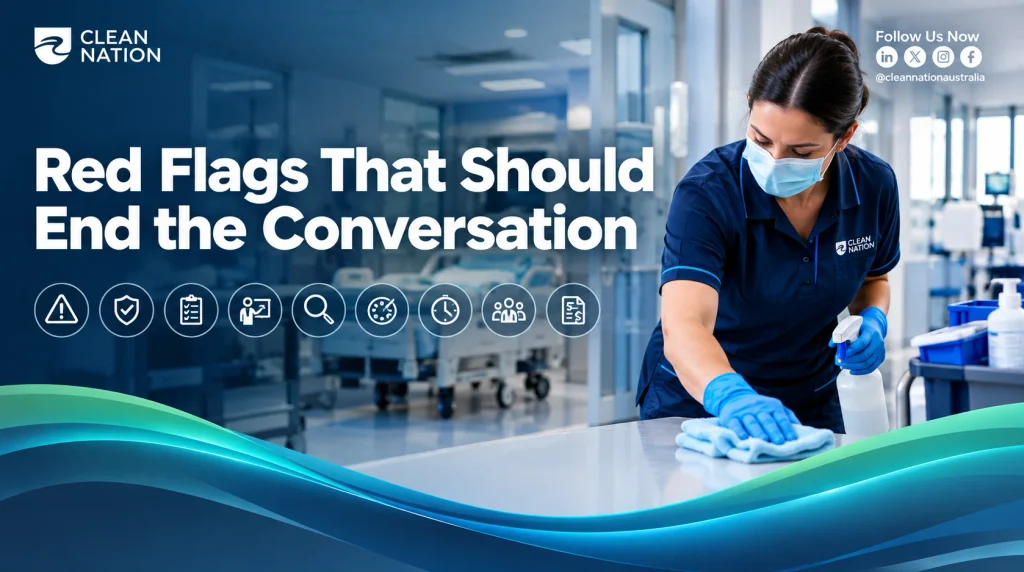
Some warning signs matter more than any price. Walk away, or press hard for proof, if you hear any of these:
- “Hospital-grade” with no product name. If they can’t name the product, the claim it makes and its ARTG listing, the phrase is marketing.
- “We’re NSQHS certified” or “NSQHS approved.” The Standards assess health services. They don’t certify cleaners.
- One checklist for every site. A dental surgery, a day procedure room and a physio studio don’t carry the same risk.
- Only a standard commercial induction. Cleaning a medical room takes infection control training that an office cleaner doesn’t get by default.
- No inspection, no reporting. If nobody checks the work, nobody can prove it happened.
- “Colour-coding is required by law.” There’s no single national colour scheme. States and health services publish their own charts, and some describe it as best practice, not a legal requirement.
- A fixed contact time for every product. Contact times come from the manufacturer’s label and vary by product and claim.
- No references and no trial. A provider sure of its work has no reason to dodge either.
- A quote that’s only an hourly rate. No scope, no schedule and no reporting means you can’t compare it with anyone else’s.
How to Compare Quotes Without Choosing the Cheapest
The lowest quote is usually the one with the thinnest scope. Compare like with like: hours per visit, visit frequency, tasks per zone, products supplied, supervision, reporting, after-hours access and consumables. If two quotes differ sharply, find out what the cheaper one leaves out. It’s often training time, supervision or the right products.
For context, we publish starting ranges on our medical facilities page: around $55 to $65 per hour per cleaner for standard cleaning, $65 to $75 per hour for deeper cleaning and disinfection, and around $500 to $1,500 per month for small clinics on a regular service. Your actual price depends on facility size, visit frequency, access hours and the risk level of your rooms, which is why we quote after we understand your site.
Then protect yourself after you sign. Agree a review period in writing, audit the first month against the schedule you were promised, and hand over your existing schedules when switching providers so no zone falls through the gap.
Match Your Provider to Your Facility Type
The right provider prioritises what your assessor cares about. Use this as a guide when you brief them:
| Facility type | Framework that usually applies | What to prioritise in your provider |
|---|---|---|
| Hospital, day procedure service, most public dental practices | NSQHS Standards (accreditation required by health regulators) | Evidence for Action 3.13 audits, outbreak training, contractor screening documents, regular reporting |
| GP practice | RACGP Standards for general practices (5th edition currently used for accreditation) | A clear schedule and records your practice can show at assessment, plus sound product knowledge |
| Allied health and specialist clinics | Varies by profession and state health requirements | Risk-based zones, high-touch surface routines and written records |
| Aged care | Aged Care Quality Standards, plus infection control requirements | Outbreak readiness and trained, consistent staff |
Why Facilities Choose CleanNation for Medical Cleaning
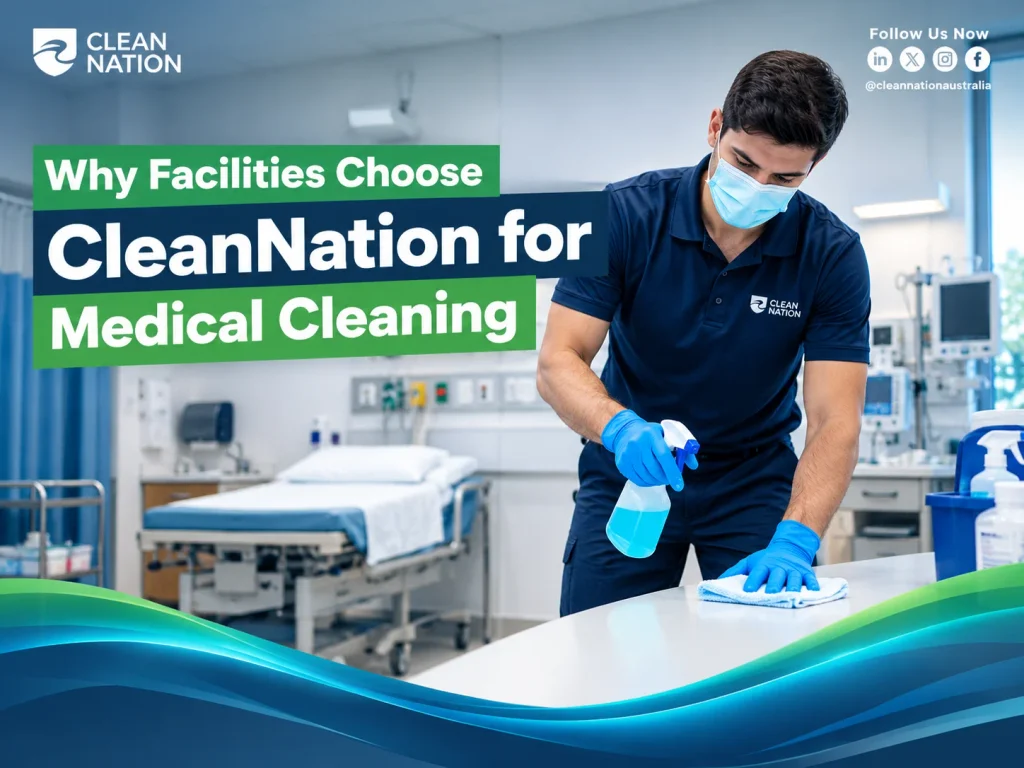
Our medical cleaning services are built to answer the questions in this guide. Our medical facilities cleaning teams use hospital-grade disinfectants and equipment, and our cleaners are trained on infection control procedures and safety measures. High-touch areas are cleaned many times a day, deep cleans run weekly or monthly, and cleaning happens every day, not sometimes.
We cover clinics, GP practices, dental surgeries, aged care, pathology and laboratory sites across Brisbane, Perth, Geelong, the Gold Coast, Newcastle, Sydney, Melbourne, Adelaide, Canberra, Tasmania, the Northern Territory and the ACT. Setup is usually within 24 to 48 hours, depending on location. If your clinic sits inside a larger building, our commercial cleaning services can cover the common areas under the same provider.
So put every question in this guide to us before you sign, and judge us on the answers. If we can’t answer one, don’t hire us.
Frequently Asked Questions
Is there such a thing as an NSQHS-certified cleaning company?
No. NSQHS accreditation applies to health service organisations, not to their contractors. A provider can support your accreditation by supplying the evidence your assessor asks for, but any company calling itself “NSQHS certified” is using the term loosely.
Does my GP clinic need a cleaner that meets NSQHS standards?
Not directly. GP practices are generally accredited against the RACGP Standards for general practices, not the NSQHS Standards. Many practices still borrow NSQHS thinking, such as audits, ARTG-listed products and training records, because it’s sound infection control. Ask your accrediting agency which standard applies to you.
How do I check whether a disinfectant is ARTG-listed?
Search the ARTG on the Therapeutic Goods Administration (TGA) website by product name, sponsor or ID. Disinfectants that make specific claims must be on the ARTG before they can be supplied. Ask your provider for the product name and the claim it relies on, then check it yourself.
What certifications should a medical cleaning company have?
Ask what each certificate actually covers. ISO 9001, 14001 and 45001 relate to management systems. What matters most for infection control is documented, up-to-date staff training, plus product and schedule records you can show an assessor.
Do cleaners in a medical facility need immunisation and police checks?
It depends on your policy and contract. NSQHS-assessed services need a risk-based immunisation and screening policy under Action 3.15, and its evidence includes requirements for placing contractors. Ask your provider what they do, then match it to what your facility requires.
What happens when the NSQHS third edition arrives?
The ACSQHC is revising the Standards over several years and says to keep using the second edition in the meantime. Ask any provider how they keep training and documentation current, and include a review clause in your contract so changes don’t catch you out.
What should a medical cleaning contract include?
At a minimum: a site-specific scope, the product list, zone schedules, training requirements, reporting and audit access, incident response, a review period and clear exit terms.
Conclusion
Choosing a medical cleaning provider isn’t about finding the company with the most confident claims. It’s about finding the one that can show its working: the products, the training, the schedules, the audits. That’s what your accreditor sees, and it’s what protects your patients.
Ask for evidence. Compare scope before price. Walk away from vague promises. If you manage a clinic, day procedure service, dental practice or allied health centre anywhere in Australia, get a free quote from CleanNation’s medical cleaning team and see what an evidence-first cleaning program looks like for your site.