

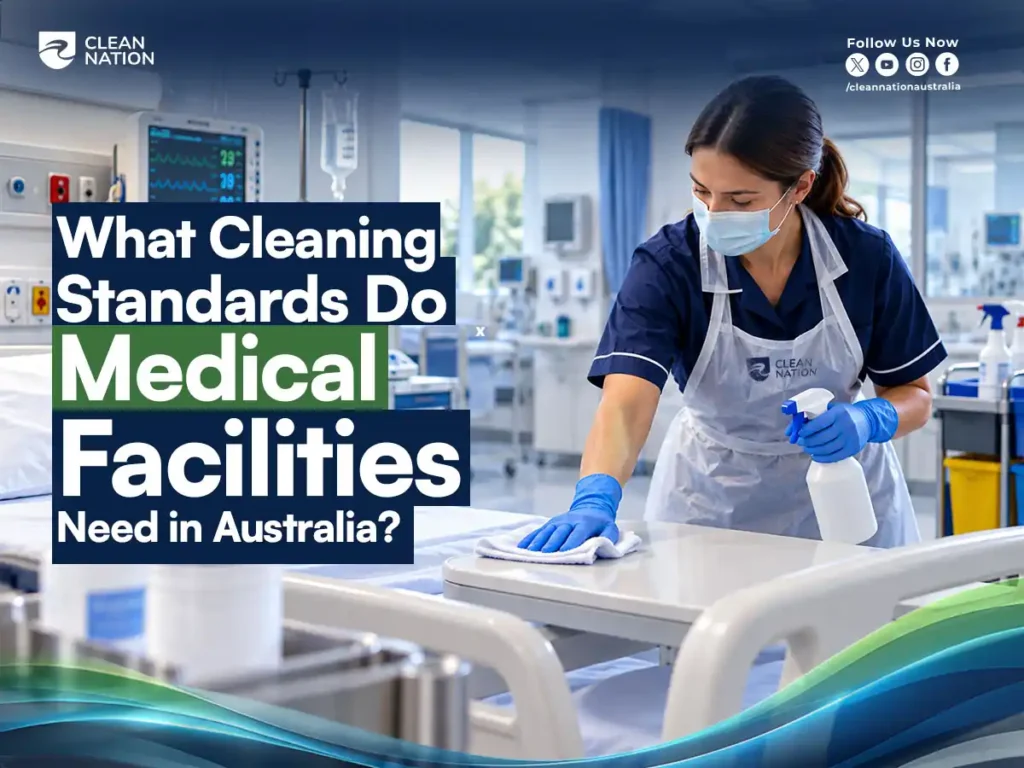
A GP clinic that looks spotless can still fail a medical facility cleaning standard that actually matters. Appearance and infection control are judged on completely different criteria: a waiting room with gleaming floors tells you nothing about what’s still viable on the arm of a chair, and a reception desk wiped with the wrong product tells an auditor nothing about whether it was actually disinfected.
Medical facility cleaning standards in Australia are built around that distinction. Rather than one single rulebook, practices, clinics, day surgeries and hospitals sit inside a layered framework of national guidelines, facility-specific accreditation standards, and product-level regulation and which parts apply depends heavily on what kind of facility you’re running.
This guide walks through that framework properly: who actually sets the requirements, how they differ by facility type, what risk-based cleaning means in practice, which disinfectants qualify as hospital-grade, and what a practice manager should actually be checking before signing a cleaning contract.
Why “Looks Clean” and “Meets Standard” Aren’t the Same Thing
Environmental cleaning in a healthcare setting is treated as a control measure against healthcare-associated infections, not a housekeeping task. The NHMRC’s Australian Guidelines for the Prevention and Control of Infection in Healthcare frame environmental cleaning as one layer of standard precautions the everyday infection-control basics every healthcare worker is expected to follow, alongside hand hygiene and correct PPE use.
That framing is why medical centre cleaning standards focus on risk rather than appearance. A surface can look immaculate and still carry pathogens capable of transmission; a cleaning process only counts as compliant if it’s been carried out with the right product, the right method, and increasingly evidence that it happened at all.
The Bodies That Actually Set Medical Cleaning Requirements
No single regulator owns “medical cleaning standards” in Australia. Several bodies each cover a different part of the picture:
- NHMRC — publishes the national infection prevention and control guidelines that underpin environmental cleaning practice across the health system. These are guidance, not facility-specific legislation, but they’re the reference point almost every other standard builds on.
- RACGP — sets the Standards for General Practices and the accompanying Infection Prevention and Control Guidelines that accredited general practices are assessed against.
- The Australian Commission on Safety and Quality in Health Care (ACSQHC) — administers the National Safety and Quality Health Service (NSQHS) Standards, including Standard 3: Preventing and Controlling Healthcare-Associated Infection.
- Therapeutic Goods Administration (TGA) — regulates the disinfectant products themselves, not facilities, deciding what can legally be marketed and sold as a hospital-grade or medical-grade disinfectant in Australia.
- State and territory health departments — layer additional guidance on top of the national framework, particularly for public health facilities (for example, NSW Health’s Clinical Excellence Commission and SA Health both publish their own cleaning standards documents).
- Safe Work Australia and state WHS regulators — govern how cleaning staff handle hazards on the job, including sharps and clinical waste.
Does Every Medical Facility Follow the Same Rules?
No and this is where a lot of generic advice online gets it wrong. Which standards actually apply depends on the type of facility and how it’s accredited:
- General practices accredited through RACGP (or an approved alternative like AGPAL’s Quality Practice Accreditation program) are assessed against the RACGP Standards for General Practices and its Infection Prevention and Control Guidelines.
- Public and private hospitals, day procedure services, and public dental services are required to hold accreditation against the NSQHS Standards, including Standard 3. General practice is not included in this mandatory NSQHS requirement, though a practice can choose to align with it voluntarily.
- Allied health practices (physiotherapy, podiatry, psychology and similar) generally aren’t bound by RACGP or NSQHS directly, but professional bodies and state health regulations still expect documented, risk-appropriate infection control.
- Pathology collection centres, imaging clinics, aged care facilities and dental practices each answer to their own combination of professional accreditation, state health requirements and, in aged care’s case, the Aged Care Quality Standards.
The practical takeaway: a cleaning provider working across this sector needs to understand which framework applies to your facility specifically, rather than applying one generic “medical cleaning” checklist to every site.
Cleaning vs Disinfecting: The Distinction Every Standard Relies On
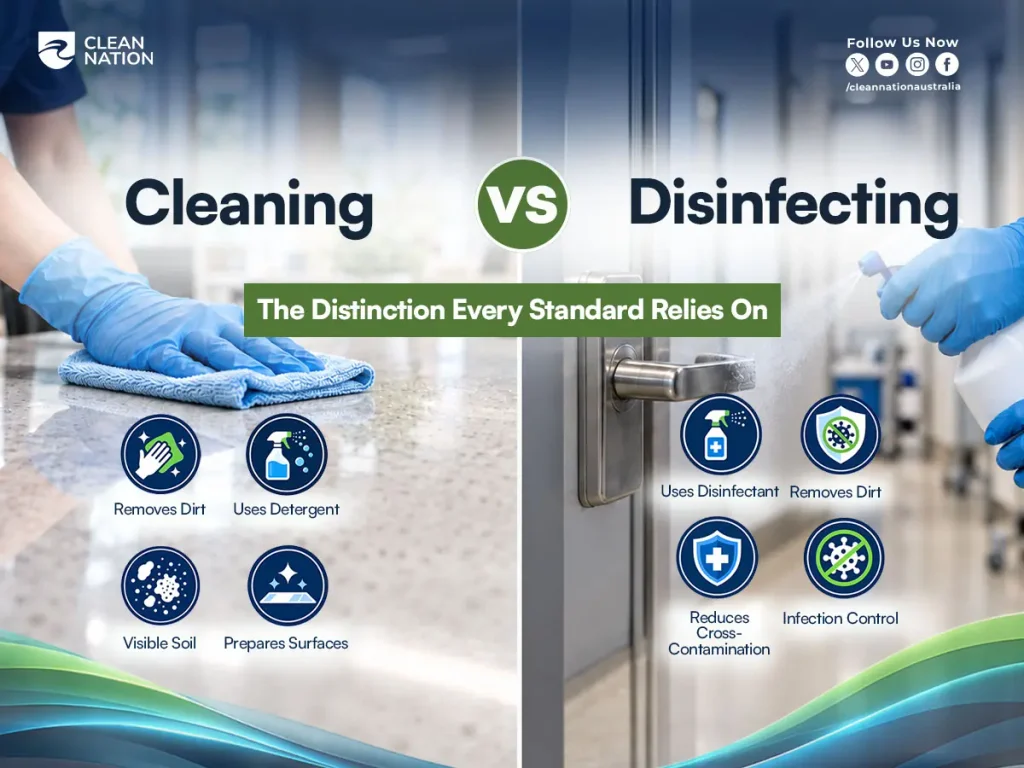
Every framework above rests on the same underlying principle: cleaning and disinfecting are two separate actions, done in that order.
Cleaning physically removes dirt, dust, and organic matter using detergent and friction. Disinfecting then targets the microorganisms left on that now-clean surface. Applying a disinfectant to a surface that still has visible soil on it undermines the product’s effectiveness, because organic matter can physically shield pathogens from the active ingredient. This is why environmental cleaning protocols in Australian infection control guidance consistently separate “clean” from “clean and disinfect” as distinct steps rather than treating them as one action.
Risk-Based Cleaning: How Areas Are Classified
Rather than cleaning every square metre of a facility the same way, Australian infection control guidance groups areas by infection risk, so cleaning effort is concentrated where it actually matters.
Higher-risk clinical areas
Treatment rooms, procedure rooms and anywhere instruments are used or bodily fluids may be present. These areas typically warrant disinfection between patients, not just at the end of the day, because the risk of transmission resets with every new patient contact.
Medium-risk areas
Waiting rooms, reception desks, consulting rooms and shared toilets. Direct clinical contact is lower here, but these are the highest-traffic surfaces in the building door handles, chair arms, EFTPOS terminals, pens and they need disinfection at a frequency that reflects how often they’re touched, not a single overnight wipe-down.
Lower-risk support areas
Staff offices, storage areas and spaces with no patient contact. Standard cleaning applies, and while the infection-control stakes are lower, these areas still sit inside the facility’s overall documented cleaning schedule.
What Makes a Disinfectant “Hospital-Grade” in Australia
Not every disinfectant marketed as “hospital-grade” is regulated the same way. Under TGA rules, the deciding factor is what claim the product makes:
- Products making a specific biocidal claim — virucidal, sporicidal, tuberculocidal, fungicidal, or similar must be listed on the Australian Register of Therapeutic Goods (ARTG) before they can legally be supplied, backed by testing data submitted to the TGA.
- Products making general or non-specific claims (broad antibacterial action without a specific pathogen claim) aren’t required to be ARTG-listed, but they still have to meet the relevant Therapeutic Goods Order requirements covering labelling and performance.
In practice, this means the safest question to ask a provider isn’t simply “is it hospital-grade?” it’s “what specific claims does this product make, and is it ARTG-listed for them?” A provider who can answer that with a product name and claim is operating to a materially different standard than one reciting “hospital-grade” as a marketing term.
Contact Time Matters More Than the Product Name
A disinfectant only performs to its tested standard if it’s left wet on the surface for the manufacturer’s stated contact (or “dwell”) time. Wiping a product on and off within a few seconds is a common shortcut under time pressure and means the surface was never actually exposed to the disinfectant long enough to achieve the claimed effect.
There’s no single Australia-wide number here. Contact times are set by the manufacturer and vary by product and by the specific claim being relied on commonly anywhere from under a minute to around ten minutes. The label and the safety data sheet, not a generic industry rule of thumb, are what a compliant cleaning process is actually built around.
Colour-Coded Cleaning Equipment: Common Practice, Not One National Rule
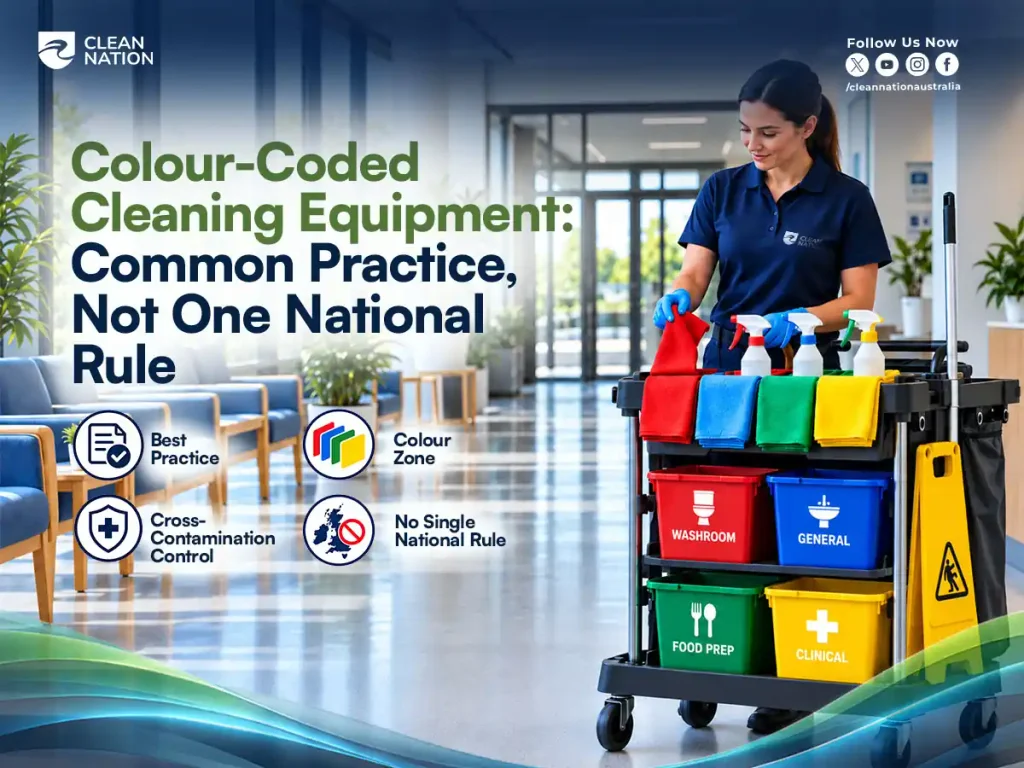
Colour-coding cloths, mops and buckets by area so equipment used in a toilet never ends up in a treatment room is a widely adopted way of putting the NHMRC’s cross-contamination principles into practice. It isn’t, however, a single mandatory national colour scheme.
Individual states and health services publish their own colour-coding charts (NSW’s Clinical Excellence Commission, for example, has a published colour-coding reference), and some state health departments are explicit that adopting a colour-coding system is a matter of best practice rather than a legislated requirement. A facility’s cleaning provider should be able to explain which system they use and why but a practice shouldn’t assume every provider is required by law to use identical colours.
Reusable Medical Devices: What AS 5369:2023 Changed
If a facility reprocesses reusable medical devices anything from speculums to surgical instruments the relevant Australian Standard changed in December 2023. AS 5369:2023 now supersedes both AS/NZS 4187:2014 and AS/NZS 4815:2006, and broadened the scope to cover reprocessing not just in hospitals and health service organisations, but in office-based practices and even non-health settings that reprocess reusable devices.
Unlike its predecessor, AS 5369:2023 doesn’t specify a single mandatory transition deadline organisations are expected to run a risk-based gap analysis and set their own implementation plan. RACGP has separately updated the reprocessing section of its Infection Prevention and Control Guidelines to align with AS 5369, giving RACGP-accredited practices transitional time to bring their reprocessing processes into line. If your facility reprocesses instruments on-site, this is one of the more consequential recent changes to check your provider actually understands.
Cleaning Frequency: Daily, Terminal and Scheduled Deep Cleans
A functioning medical centre cleaning program runs on more than one rhythm at once:
- Daily environmental cleaning — the routine pass covering floors, general surfaces and bins, plus repeated high-touch surface disinfection in medium and high-risk areas throughout the operating day.
- Terminal cleaning — a more thorough clean of a treatment or procedure room at the end of the day (or between specific patients where risk warrants it), covering surfaces, fixtures and equipment that the daily pass doesn’t reach. It’s designed to bring the room’s contamination level back down to baseline before it’s used again not to render it sterile.
- Scheduled deep cleaning — a weekly or periodic clean of areas the daily and terminal routines don’t cover, such as behind furniture or inside vents, generally scheduled around a risk assessment rather than a fixed date.
Clinical Waste and Sharps: A Strictly Regulated Requirement
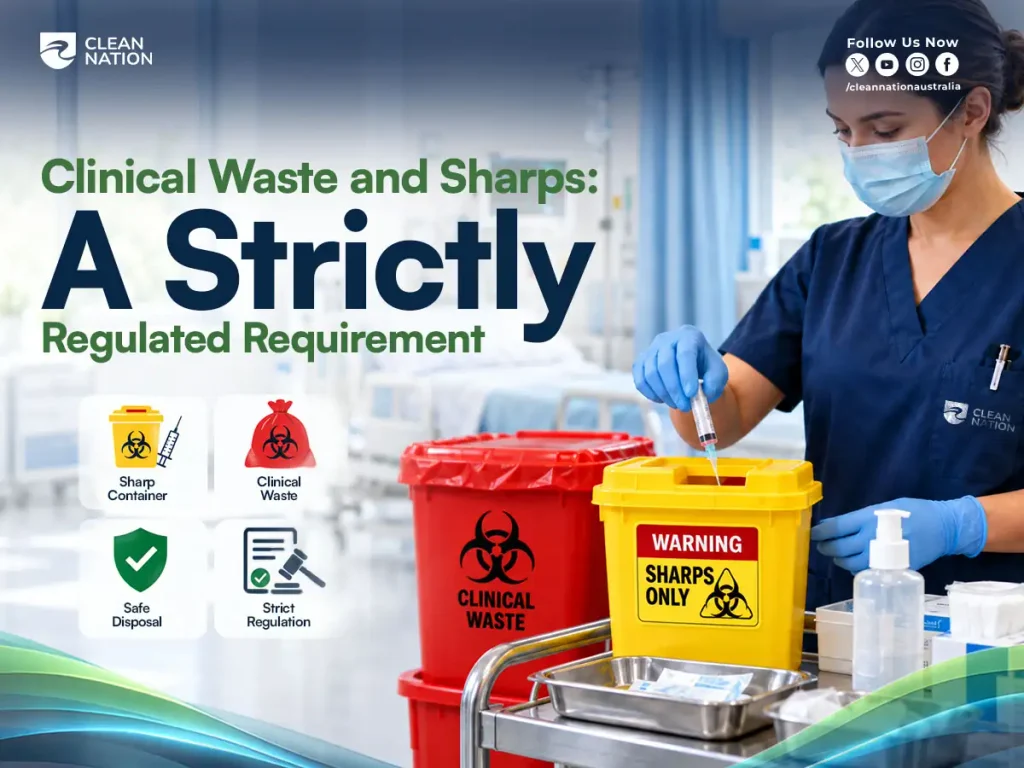
Sharps and clinical waste sit under their own layer of regulation, sharps container specifications, state clinical/biohazard waste rules, and workplace health and safety requirements around handling. Cleaning staff working around sharps need training in safe identification, segregation and disposal, and correct PPE, because getting this wrong isn’t a re-clean issue it’s a workplace safety incident.
Staff Training and the Documentation Auditors Actually Ask For
Every standard above is only as credible as the paperwork behind it. Accreditation reviewers, whether RACGP, NSQHS, or a state health auditor don’t simply take a practice’s word that cleaning is happening correctly.
What they typically look for includes:
- A documented cleaning schedule covering tasks, frequency, and who’s responsible for every zone in the facility.
- Staff training records showing cleaners understand infection control principles, correct PPE use, and the specific products they’re using not just a general induction.
- Evidence of monitoring, which the ACSQHC’s own guidance on environmental cleaning auditing describes as a combination of methods: direct observation of cleaning being carried out, review of cleaning logs, staff interviews, and in NSQHS-audited settings, tools such as ATP testing or microbiological sampling used as one part of a broader verification approach rather than a routine requirement applied to every site.
How Cleaning Compliance Connects to Accreditation and Funding
It’s worth being precise about a claim that gets oversimplified a lot: RACGP accreditation is a prerequisite for participating in the Practice Incentives Program (PIP) the incentive payments administered by Services Australia that sit on top of standard Medicare billing. Accreditation is not, in itself, a condition of a GP’s ability to bill Medicare at all. Around two-thirds of Australian general practices are accredited, largely because of the PIP payments accreditation unlocks but inadequate cleaning isn’t going to strip a practice’s Medicare billing eligibility outright. What it puts at risk is accreditation status itself, and the funding and reputational consequences that follow from losing it.
Choosing a Medical Cleaning Provider: What to Check Before You Sign
Not every company advertising “medical cleaning” is set up to deliver it against the standard your facility actually needs to meet. Before signing a contract, it’s worth getting a straight answer on:
- Which disinfectant products they use, what specific claims those products make, and whether they’re ARTG-listed for those claims.
- Whether their staff are trained specifically in infection control, cross-contamination prevention and sharps handling not just general cleaning.
- Whether they’ll provide a documented, zone-by-zone cleaning schedule that matches the accreditation framework your facility is assessed against.
- Whether they understand the difference between RACGP, NSQHS and state-based requirements, and which one applies to your facility type.
- Whether they can produce cleaning logs, training records or audit evidence on request not after the fact, when an accreditation visit is already booked.
At CleanNation, this is the standard our medical facilities cleaning teams are built around hospital-appropriate products matched to their actual claims, staff trained in infection control and sharps handling, and documented cleaning schedules a practice manager can hand straight to an auditor. Whether you’re running a single GP clinic, a multi-suite allied health centre or a day procedure service, we scope the cleaning program to the standard your facility is actually assessed against, not a generic template.
Frequently Asked Questions
How often should a medical centre be professionally cleaned?
High-touch surfaces in medium and high-risk areas need disinfection multiple times across the operating day, treatment and procedure rooms typically get a terminal clean at day’s end, and a broader deep clean is scheduled periodically based on a risk assessment rather than a fixed calendar interval.
What’s the difference between cleaning and disinfecting?
Cleaning physically removes dirt and organic matter using detergent and friction. Disinfecting then targets the microorganisms left behind. Standards require both, in that order, because disinfectant applied over visible soil doesn’t perform to its tested standard.
Do cleaners working in medical facilities need special training in Australia?
Yes. Beyond general cleaning skills, staff need to understand infection control principles, correct PPE use, cross-contamination prevention, and safe sharps and clinical waste handling, none of which is part of a standard commercial cleaning induction.
Does every medical facility have to meet NSQHS Standards?
No. NSQHS accreditation, including Standard 3, is mandatory for public and private hospitals, day procedure services and public dental services. General practices are assessed under RACGP’s own standards instead, though a practice can choose to align voluntarily with NSQHS principles.
What does AS 5369:2023 change for facilities that reprocess instruments on-site?
It replaces AS/NZS 4187:2014 as the current standard for reprocessing reusable medical devices and broadens its scope beyond hospitals to office-based practices and non-health settings. There’s no single fixed national deadline facilities are expected to run a risk-based transition plan, and RACGP has given its accredited practices its own timeframe to align.
Does losing accreditation stop a GP practice from billing Medicare? No. Accreditation is a requirement for accessing Practice Incentives Program (PIP) payments, which sit on top of standard Medicare billing; it isn’t itself a condition of Medicare eligibility. What’s at risk from non-compliance is accreditation status and the incentive funding tied to it.
The Bottom Line
Medical facility cleaning standards in Australia aren’t one rulebook they are a layered framework that changes depending on whether you’re running a GP clinic, a day procedure service, a dental practice or an allied health centre. Getting it right means matching your cleaning program to the accreditation standard your facility is actually assessed against, using disinfectants that are genuinely appropriate for their claims, and keeping the documentation an auditor will ask to see.
If your current provider can’t answer the questions in the checklist above with specifics, it’s worth finding one who can. CleanNation’s medical facilities cleaning services are built around the standard your facility needs to meet, not a generic script and we support the same compliance-driven approach across NDIS cleaning, childcare centre cleaning and schools and daycare cleaning. If you manage a clinic, allied health practice or medical facility anywhere in Australia, get a free quote and find out exactly what a compliant cleaning program looks like for your site.