

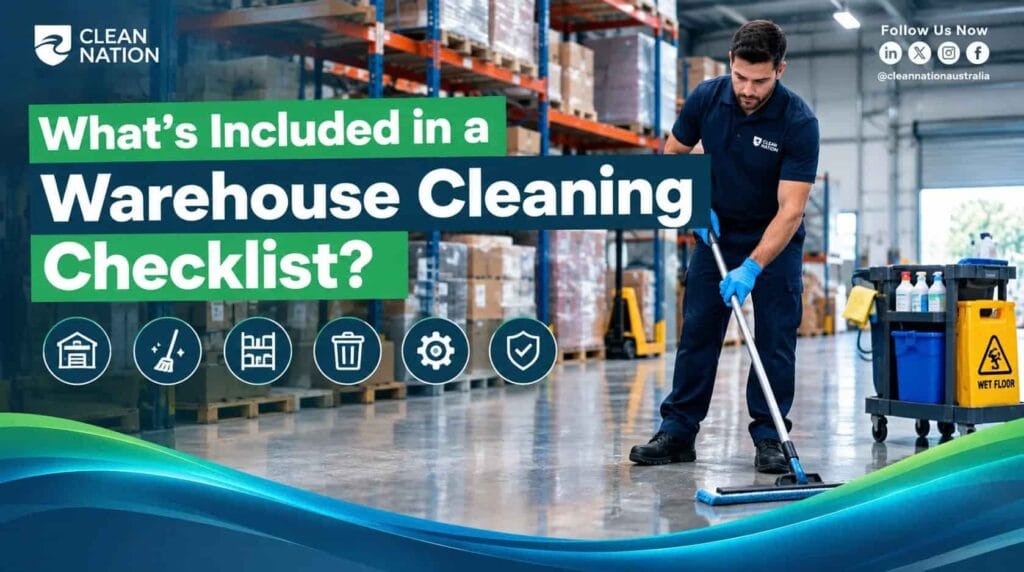
Ask five different warehouse managers what “cleaning” means for their site and you’ll get five different lists. One means sweeping the main aisle. Another means degreasing a forklift charging bay. A third means signing off on a rack inspection because an auditor is coming Thursday. A checklist that only covers the first version leaves the other two undone, and nobody notices until a spill sits too long or a rack inspection can’t be proven.
A proper warehouse cleaning checklist isn’t just a list of tasks. It’s a document that names the area, the task, how often it happens, who’s responsible, what safety step goes with it, and how it gets recorded as done. Miss any one of those and the checklist looks complete on paper while gaps stay hidden on the floor.
This guide walks through what belongs in a warehouse cleaning checklist: the fields it needs to actually work, the areas it should cover, the equipment behind it, how records and sign-off keep it honest, and how it should change depending on what your warehouse stores. If you need the full daily-to-annual schedule or a deep dive on WHS procedures, we have linked to our dedicated guides on those instead of repeating them here.
What Actually Makes a Warehouse Cleaning Checklist Work?
Most checklists fail for one reason: they list tasks without saying who owns them or how anyone would know they were done. A checklist that actually gets used in a working warehouse needs six fields for every line item, not just a task name.
| Field | What it captures | Why it matters |
|---|---|---|
| Zone or area | Where the task happens (main aisle, dock 3, rack row B) | Vague locations get skipped first |
| Task | Exactly what’s done (sweep, scrub, degrease, wipe down) | “Clean the floor” means something different to every cleaner |
| Frequency | Daily, weekly, monthly or as-needed | Without it, tasks drift to “whenever someone remembers” |
| Responsible person or team | Named cleaner, shift team or contractor | Shared responsibility usually means no responsibility |
| Safety note | PPE, signage or SDS reference tied to that task | Keeps the safety step attached to the job, not a separate document nobody reads |
| Completion record | Date, time, initials or a digital tick | Turns the checklist into evidence, not just intention |
A one-line task list can look tidy in a spreadsheet and still fail on the floor, because nobody can point to who missed what or when. Building the checklist around these six fields is what turns it from a wish list into something you can actually audit.
Warehouse Areas a Checklist Should Cover
A checklist built around one generic “warehouse floor” line item misses most of the building. Break it down by zone instead, because each one carries different mess, different traffic and different risk.
- Main floors, aisles and walkways — swept, mopped or scrubbed clear of dust, debris and spills so pedestrian and forklift paths stay clear.
- Pallet racking and storage areas — dusted and checked for debris buildup, damaged stretch wrap and anything blocking access.
- Loading docks and receiving/dispatch zones — cleared of packaging waste, pallet wrap and tracked-in dirt, since this is where the most outside contamination enters the building.
- Picking and packing stations — wiped down and cleared of offcuts, tape ends and packaging scraps that build up fast around high-activity benches.
- Machinery and equipment areas — forklifts, conveyors and pallet jacks kept free of built-up grime, without cleaning products touching parts that aren’t meant to get wet.
- Offices and administration areas — standard commercial cleaning: desks, floors, bins and shared equipment.
- Staff amenities, bathrooms and break rooms — cleaned to the same standard as any other workplace, but easy to overlook in a site focused on the warehouse floor itself.
- Waste and recycling areas — bins emptied on a schedule that matches how fast they actually fill, not a fixed calendar date.
- External entry points and hardstand areas — swept and checked, since dirt tracked in from outside is one of the biggest contributors to floor grime indoors.
Every one of these belongs on the checklist as its own line, not folded into a single “clean the warehouse” task.
How Often Each Area Needs Attention
A checklist has to say how often each task happens, or “frequency” becomes a guess. Here’s the general shape most warehouses work to treat it as a starting point, because your actual site traffic, what’s stored and your industry’s own rules should set the final schedule.
| Area or task | Typical frequency |
|---|---|
| Main aisles and walkways | Daily |
| Spills | Immediately, whenever they happen |
| Bins and waste areas | Daily or as they fill |
| Staff amenities | Daily |
| Loading docks | Daily, plus a more thorough clean on a set schedule |
| Racking and shelving | Weekly to monthly, depending on dust and stock turnover |
| Full floor scrubbing | Scheduled around traffic levels, not a fixed date |
| High-level surfaces (beams, lights, vents) | Periodic, usually quarterly or when a visual check flags it |
| External and hardstand areas | Periodic or as required |
This table is a quick reference, not the full picture. For the complete daily-to-annual breakdown, including what actually pushes a warehouse toward more frequent cleaning, see our guide on how often warehouses should be professionally cleaned.
Equipment a Proper Warehouse Clean Relies On
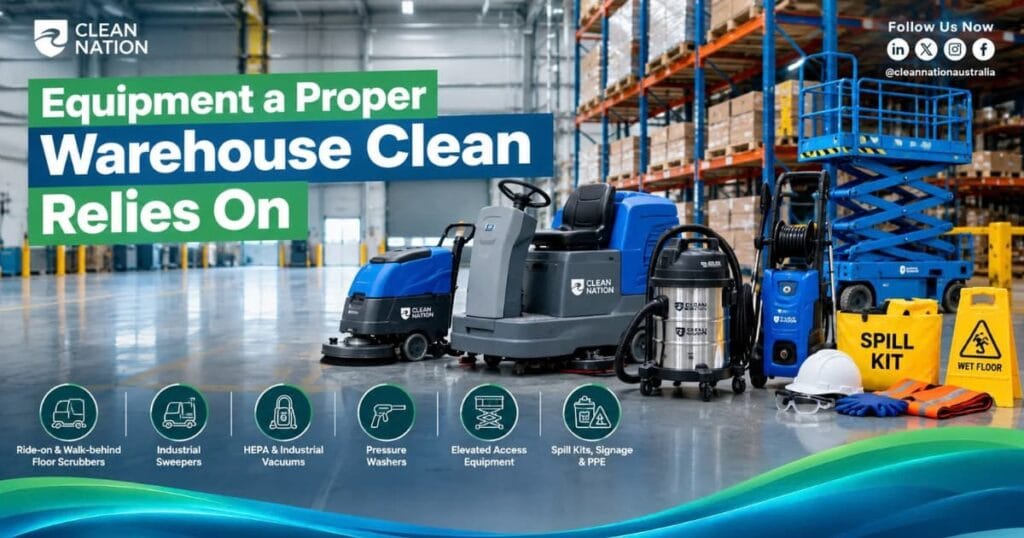
The tasks on a checklist only get done properly if the right equipment is behind them. A mop and a broom don’t cover a 2,000m² floor or reach a beam twelve metres up.
- Ride-on and walk-behind floor scrubbers for large open floor areas.
- Industrial sweepers for dust and loose debris across aisles.
- HEPA and industrial vacuums for dust control, especially where fine particulate is a concern.
- Pressure washers for docks, hardstands and heavily soiled external areas.
- Elevated access equipment (scissor lifts or similar) for racking, beams and high-level surfaces.
- Spill kits, signage and PPE kept on hand for the moment a task needs them, not stored away in a cupboard.
Not every warehouse needs every item on this list. A small storage facility and a full distribution centre don’t run the same equipment, which is part of why the checklist itself needs to flex by site.
Keeping the Checklist Honest – Records, Sign-Off and Audits
A checklist that’s never checked against reality is just a piece of paper. What separates a working checklist from a decorative one is the record it leaves behind.
- Assign each zone to a named person or team, not “whoever’s free.”
- Record the date and time each task was completed, not just that it eventually was.
- Note anything unusual: a hazard, a damaged rack, a recurring spill spot instead of only ticking the box.
- Have a supervisor sign off, so there’s a second check beyond the person who did the work.
- Use a digital checklist or photo record where it’s practical. A timestamped photo of a cleared dock or a scrubbed floor is far harder to dispute than a tick in a paper column.
This matters most when someone outside your team asks for proof: a client audit, an insurer, a food safety inspector or your own WHS review. “We clean it” isn’t an answer they can act on. A dated, signed record is.
One Checklist Doesn’t Fit Every Warehouse
A checklist built for a general storage facility won’t cover what a cold store or a food warehouse actually needs, and a logistics hub with constant dock turnover has different pressure points again.
- Logistics and distribution centres — high dock turnover means loading and receiving areas need more frequent attention than the rest of the building.
- Food warehouses — cleaning has to align with food safety requirements around contamination control, not just general tidiness.
- Cold storage facilities — condensation, ice build-up and temperature-safe cleaning products change what “clean” even means in these zones.
- Manufacturing warehouses — machinery areas and production-line offcuts need their own line items separate from general floor cleaning.
- General storage warehouses — usually the simplest checklist, built mainly around floors, racking and dust control.
Start from the standard checklist above, then add or weight the zones that matter most for what your warehouse actually stores and how it operates.
Where Safety Fits on the Checklist
Safety shouldn’t sit in a separate document nobody opens. Each relevant task on the checklist should carry its own safety note: the PPE needed, whether a spill kit or signage applies, and whether the task involves working at height or around vehicle traffic. A task written as “clean loading dock hi-vis and steel caps, watch for forklift movement” tells a cleaner more than “clean loading dock” ever will.
That said, this article is about what belongs in the checklist itself, not a full walkthrough of workplace safety procedures. For the detailed breakdown – PPE, SDS, spill response, working at heights, confined spaces and what WHS actually expects from a cleaning contractor in Australia see our industrial workspace cleaning safety checklist.
When a Checklist Isn’t Enough – Call a Professional
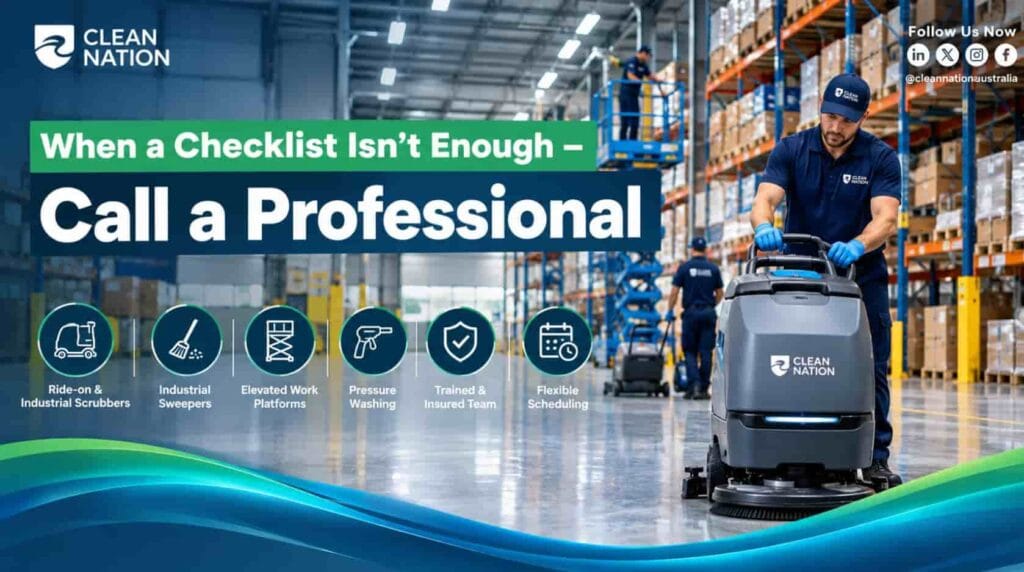
A checklist tells you what needs doing. It doesn’t do the work, and some of what’s on it isn’t a job for whoever’s rostered on that day. Full floor scrubbing across a large facility, high-level cleaning that needs an elevated work platform, degreasing built-up grime, or getting a site ready for an audit or a new tenant are jobs that call for the right machinery and a trained crew, not just a spare hour and a mop.
That’s where Clean Nation’s warehouse cleaning services come in ride-on scrubbers, industrial sweepers, elevated work platforms and pressure washing equipment, run by a police-checked, fully insured team working to a schedule built around your site rather than a generic template.
Frequently Asked Questions
Do I need a different checklist for each warehouse zone, or one master checklist?
One master checklist works best, as long as it’s broken into zones with their own frequency and owner. A single “clean the warehouse” line item is where checklists usually fall apart in practice.
Should a warehouse cleaning checklist be digital or paper-based?
Either can work, but digital checklists make it far easier to keep a timestamped record and spot a missed task before it becomes a pattern. Paper checklists still work for smaller sites, as long as someone actually reviews and files them.
Who should be responsible for filling out the checklist — the cleaner or a supervisor?
Both. The cleaner completes the task and records it; a supervisor’s sign-off is the second check that confirms it actually happened. Splitting the two roles is what makes the record trustworthy.
How often should the checklist itself be reviewed and updated?
Whenever your warehouse changes to a new storage type, a layout change, a new piece of machinery not just on a fixed annual date. A checklist that hasn’t been touched in years usually doesn’t match what’s actually stored on site anymore.
Is a generic template enough, or should the checklist be customized?
A generic template is a fine starting point, but it should be adjusted for your warehouse type. A cold store, a food warehouse and a general storage facility all need different zones weighted differently, even if the basic structure looks similar.
Does a cleaning checklist replace a WHS risk assessment?
No. The checklist records what was cleaned and when; a risk assessment identifies and controls hazards. They work together the checklist can flag a hazard for review, but it isn’t a substitute for the safety documentation your site is required to keep.
Conclusion
A warehouse cleaning checklist earns its place on the wall or in the app when it does more than list tasks. It names the zone, the task, the frequency, the person responsible, the safety step and the record that proves it happened. Build it zone by zone, keep the record honest, and adjust it for what your warehouse actually stores and it stops being paperwork and starts being the thing that keeps your site audit-ready on an ordinary Tuesday, not just the week before an inspection.
If your current checklist is more wish list than working document, get a free quote from Clean Nation’s warehouse cleaning team and see what a properly run cleaning program looks like for your site.