

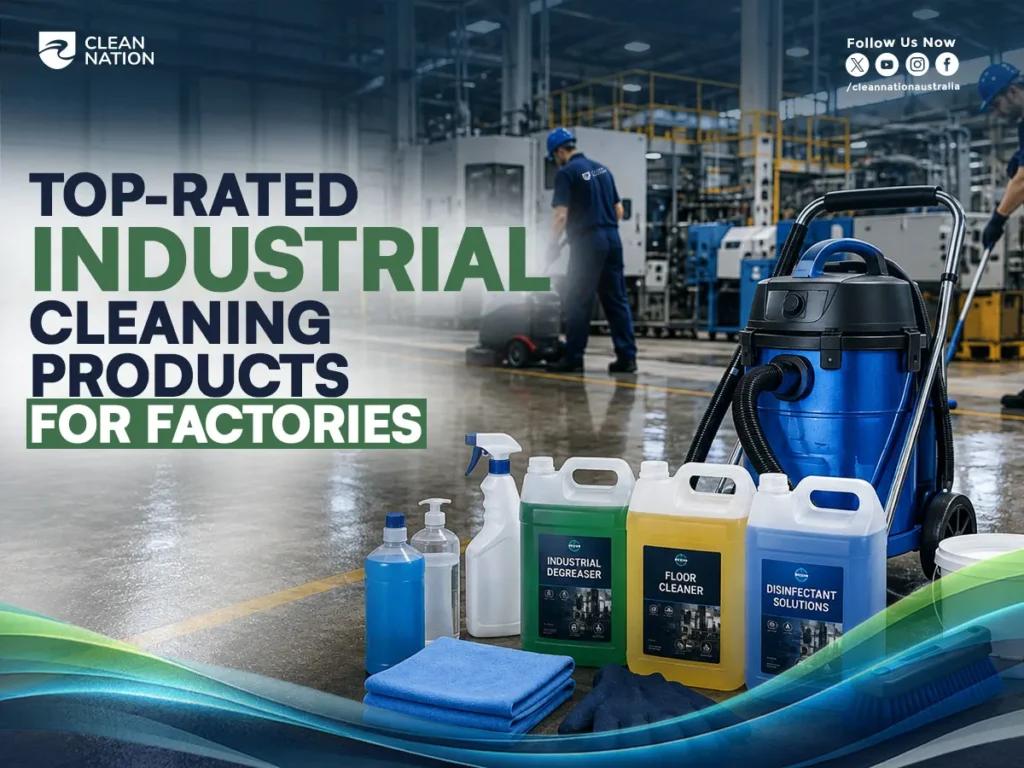
Top-rated industrial cleaning products for factories are built to handle the grease, grime, and contamination that household products simply can’t manage. Clean Nation’s range, including the Heavy Degreaser (HD1), Floor Cleaner (FC2), and Surface Disinfectant (SD), covers everything from degreasing and floor care to disinfection, hand hygiene, and washroom sanitation. As a trusted cleaning service in Australia, we help factories maintain workplace safety, meet compliance standards, and reduce equipment damage, with fast-acting, professional-grade formulas designed specifically for industrial environments.
Why Factories Need Professional Industrial Cleaning Products?
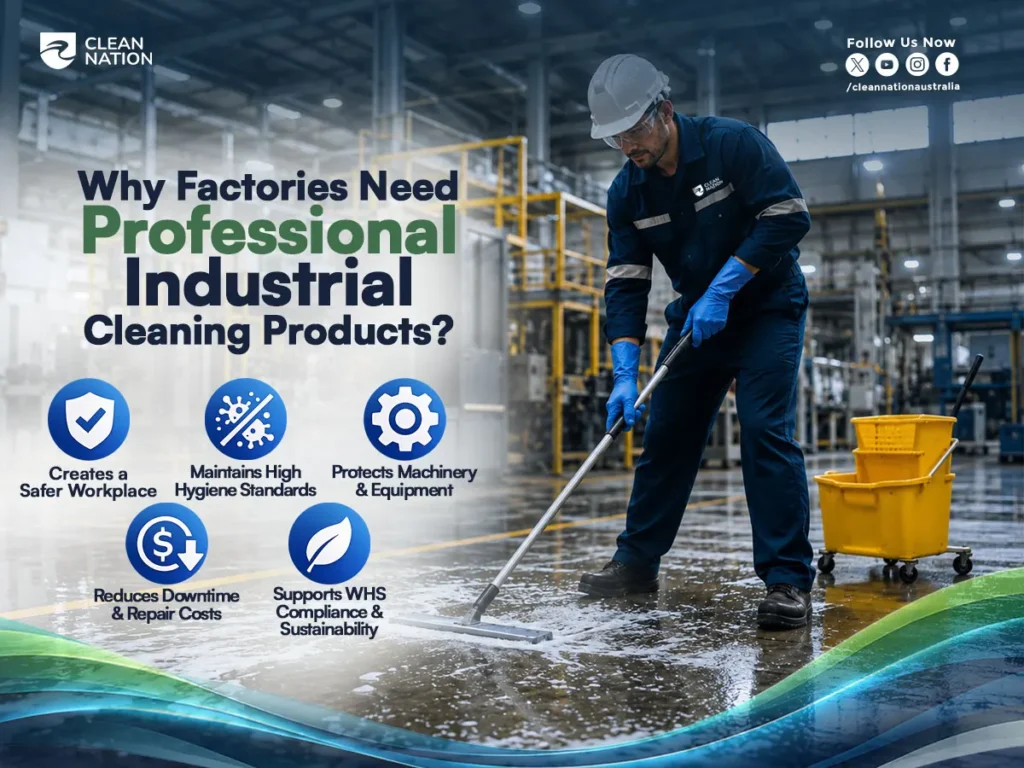
Factories and manufacturing facilities across Australia deal with a level of dirt, grease, and contamination that household cleaning products simply cannot handle. Machinery oil, metal shavings, chemical residue, and dust build up fast, and if they’re not managed properly, they create real risks for both people and equipment.
The cost of getting this wrong is higher than most facility managers realise. According to Safe Work Australia, slips, trips, and falls account for a significant share of serious workplace injury claims each year, many of them linked directly to poorly maintained floors. Beyond the human cost, unplanned equipment downtime caused by grease and residue build-up can run into thousands of dollars per incident once you factor in lost production time, repair costs, and rescheduling.
Contamination doesn’t just affect safety either. In facilities handling precision components, food, or packaging, residue and dust on surfaces can compromise product quality and lead to costly rework or rejected batches. This is exactly the kind of hidden cost that gets overlooked until it shows up on a compliance audit or a damaged production run.
Workplace hygiene standards in Australia are governed by strict WHS (Workplace Health and Safety) regulations, and regulators take non-compliance seriously, with penalties that can include fines and, in serious cases, enforceable improvement notices. This is where proper industrial hygiene practices come in. At Clean Nation, we supply cleaning products built specifically for demanding industrial environments, tools that cut through heavy grime without damaging equipment or exposing workers to unnecessary hazards.
Good workplace safety management isn’t a one-off task. It’s an ongoing part of running an industrial facility responsibly. Investing in the right occupational hygiene products helps businesses stay compliant, protect their teams, and avoid the downtime and quality issues that come from cutting corners.
Essential Industrial Cleaning Products Every Factory Needs
Not all cleaning products are built for factory life. Household sprays and generic supermarket chemicals just don’t cut it when you’re dealing with machine oil, concrete floors, and high-traffic production areas. At Clean Nation, we stock a full range of bulk-strength, commercial-grade products designed specifically for manufacturing facilities, from degreasers to disinfectants, all made to handle grime that regular chemicals can’t touch. If you’d rather leave the work to the professionals, our industrial cleaning services in Australia cover everything below and more.
Heavy-Duty Industrial Degreasers for Oil and Grease Removal
Machine oil and grease build up fast on factory floors and equipment, and if left untreated, it turns into stubborn carbon build-up that’s hard to shift. For this job, our Heavy Degreaser is the best option. It’s an alkaline degreaser made specifically for breaking down oily residue and heavy carbon deposits on machinery.
- Heavy Degreaser (HD1)
Industrial Floor Cleaners for Factory Floors
Factory floors take a beating from forklifts, foot traffic, and spills. For large floor areas and sealed concrete, our Floor Cleaner is the top pick. It’s built to handle high-traffic maintenance without breaking down like a diluted office-grade cleaner would.
- Floor Cleaner (FC2)
Industrial Disinfectants for Hygiene Control
Hygiene control matters just as much in a factory as anywhere else. For daily sanitisation and bacteria elimination, our Surface Disinfectant is the recommended product. It’s a white phenyl disinfectant that meets hospital-grade standards for infection control.
- Surface Disinfectant (SD)
Machine and Equipment Cleaning Solutions
Cleaning around machinery requires extra care, since the wrong chemical can damage seals, coatings, or electrical parts. For this, our Panel Cleaner is the safest and most effective choice, built with machine compatibility in mind for long-term equipment protection.
- Panel Cleaner
Industrial Hand Wash and Hygiene Products
Workers need reliable hand hygiene throughout the day. Our Antibacterial Hand Soap, available in liquid and foam formats, along with Hand Sanitiser for touch-free dispensers, are the best combination for consistent germ reduction on the factory floor.
- Antibacterial Hand Soap (Liquid)
- Antibacterial Hand Soap (Foam)
- Hand Sanitiser
Washroom Cleaning Products for Factories
Factory washrooms see heavy daily use, so they need something stronger than standard bathroom cleaners. Our Toilet Cleaner handles general washroom sanitation, while the Descaler Crystal is best for removing hard water deposits and keeping fittings scale-free.
- Toilet Cleaner (TC1)
- Descaler Crystal (DC1)
Glass and Surface Cleaners for Factory Areas
For viewing panels, stainless steel, and other reflective surfaces, our Glass Cleaner is the best choice. It gives a streak-free finish and removes fingerprints without leaving residue behind.
- Glass Cleaner (GC2)
Benefits of Using High-Quality Industrial Cleaning Products
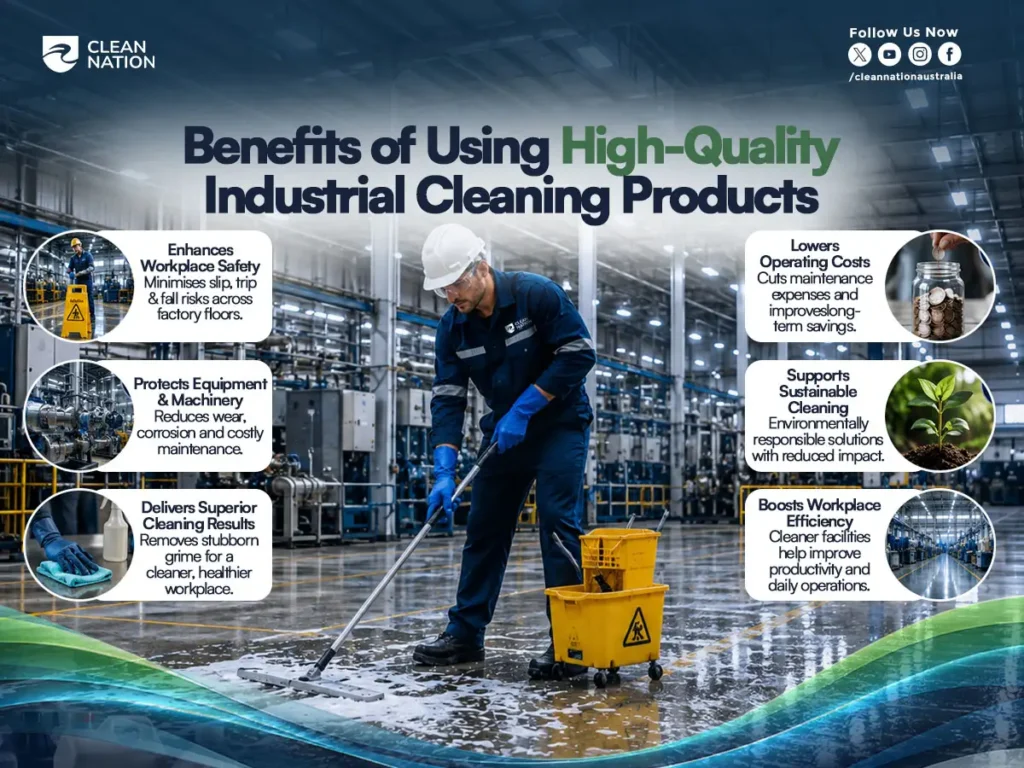
Using the right cleaning products isn’t just about appearances. It has a measurable impact on safety, equipment lifespan, and operating costs. Here’s what factories actually see when they switch to high-quality, professional-grade products.
Lower Maintenance and Repair Costs
Machinery exposed to unmanaged oil, grease, and residue wears down faster, corrodes more easily, and breaks down more often. Facilities using proper degreasers and machine-safe cleaners typically see fewer unplanned repairs and a longer working life from their equipment, which adds up to real savings over a financial year.
Longer Machinery Lifespan
Consistent use of the correct formula for each surface protects seals, coatings, and components from the slow damage caused by harsh or unsuitable chemicals, meaning equipment stays in service longer before replacement is needed.
Lower Chemical Consumption
Fast-acting, properly concentrated products mean less product is needed per clean and less re-cleaning is required when the first pass doesn’t fully remove contamination. Over time, this reduces overall chemical spend even though the per-unit cost of a professional-grade product is often higher than a generic one.
Stronger Audit and Compliance Performance
Facilities with a consistent, well-documented cleaning routine using compliant products tend to pass WHS and hygiene audits with fewer flagged issues, avoiding the cost and disruption of follow-up inspections or corrective action periods.
Improved Employee Productivity
A cleaner, safer facility means fewer disruptions from spills, slips, or unplanned equipment stoppages, and staff spend less time re-cleaning areas that weren’t properly treated the first time. That time goes back into actual production.
How to Choose the Right Industrial Cleaning Products for Your Factory?
With so many options on the market, cleaning product selection can feel overwhelming. Getting it right requires looking past the label and understanding a few technical factors that affect how well a product performs.
Consider the Type of Dirt and Contamination
Not all dirt is the same, and neither is the product needed to remove it. Heavy dust accumulation on shelving needs a different approach than baked-on grease on machinery. For industrial grease removal and carbon deposit removal, you need something stronger than a general-purpose cleaner. Mineral buildup around pipework or water systems calls for a different formula again.
Match Cleaning Products With Surface Materials
Using the wrong product on the wrong surface can cause more damage than the dirt itself. Concrete floors can usually handle stronger, industrial-strength cleaners, while stainless steel and tile surfaces often need surface-safe formulas to avoid scratching or discolouration.
Understand pH Levels and Chemical Compatibility
Every industrial cleaner sits somewhere on the pH scale, and this matters more than most buyers realise. Highly alkaline products are effective on grease and oil but can be too harsh for certain metals or painted surfaces, while acidic cleaners are better suited to mineral deposits and rust but can damage concrete sealant if left too long. Always check that a product’s pH is compatible with both the surface and any other chemicals used nearby, since mixing incompatible products can produce hazardous reactions.
Solvent-Based vs Water-Based Cleaners
Solvent-based degreasers tend to cut through heavy, baked-on grease faster and are often preferred for machinery, but they usually carry stronger handling and ventilation requirements. Water-based cleaners are gentler, generally lower in VOCs (volatile organic compounds), and better suited to daily use on floors and general surfaces. The right choice depends on the contamination level and how frequently the product will be used.
Food-Grade and Low-Residue Options
Facilities involved in food production, packaging, or pharmaceuticals need products that meet food-safe or low-residue standards. Standard industrial degreasers may leave behind chemical residue that isn’t appropriate near food contact surfaces, so it’s worth confirming certification before use in these environments.
Eco-Friendly and Biodegradable Formulas
More facilities are moving toward biodegradable, phosphate-free cleaning products, both for sustainability reporting and to reduce environmental impact from wastewater discharge. These formulas have improved significantly in recent years and can now match the performance of traditional chemicals in many applications.
Check Safety and Compliance Requirements
Every industrial cleaning chemical used in an Australian factory should come with a Safety Data Sheet (SDS), and staff need to follow proper chemical handling procedures and wear the right PPE. Safe Work Australia sets the framework for WHS obligations, and staying on top of SDS compliance isn’t just good practice; it’s a legal requirement.
Compare Concentrated vs Ready-to-Use Products
An ultra-concentrated formula usually works out cheaper per clean once you factor in proper dilution guidelines, and it’s easier to store in bulk. Ready-to-use products save time on mixing but typically cost more over a full year of use. Running a simple cost-per-clean calculation, factoring in dilution ratio, coverage area, and frequency of use, is the clearest way to compare true value between products.
Industrial Cleaning Equipment That Improves Cleaning Results
Products alone can only do so much. Pairing the right cleaning chemicals with the right equipment is what actually delivers consistent results, but choosing equipment isn’t just about picking the biggest or most expensive option. If you’re cleaning construction or industrial equipment, our guide on How to Clean Heavy Machinery? walks through the complete process, from removing heavy mud and grease to safely cleaning engine compartments and hydraulic components using the right equipment and techniques.
Floor Scrubbers and Sweepers
Best suited to facilities with large open floor areas and regular foot or vehicle traffic. A ride-on scrubber makes sense for warehouses over a few thousand square metres, while a walk-behind unit is usually more cost-effective for smaller production floors. Consider the ROI carefully: a scrubber that replaces two hours of manual mopping per day can pay for itself within a year in labour savings alone. Regular maintenance, brush replacement, and tank cleaning are essential to keep performance consistent.
Pressure Washers
Ideal for baked-on grime, loading docks, and heavily soiled outdoor equipment. Electric units are quieter and better suited to indoor use, while petrol or diesel models offer more power for outdoor or heavy-duty jobs. Weigh the upfront cost against how often the equipment will actually be used. For occasional deep cleans, hiring may be more cost-effective than purchasing.
Industrial Vacuum Cleaners
HEPA-filtered vacuums are essential in facilities where airborne dust or fine particulates are a health concern, particularly in metalworking, woodworking, or food processing environments. This kind of dust control matters just as much in heavier industrial settings; see our guide on How to Clean Coal Power Stations for how it applies to ash and coal dust removal at scale.
Steam Cleaning Equipment
Steam cleaning is particularly effective where chemical use needs to be minimised, such as food-contact areas or facilities aiming to reduce chemical consumption. It requires more time per clean than chemical methods but reduces ongoing product costs and is well suited to fabric, grout, and hard-to-reach areas.
Manual vs Automated Cleaning
For smaller facilities or low-traffic areas, manual cleaning with the right chemicals is often more cost-effective than investing in equipment. Automated equipment tends to make financial sense once labour hours spent on manual cleaning exceed the equipment’s cost over a 12- to 18-month period. It’s worth running this comparison before committing to a purchase.
Factory Cleaning Schedule for Better Maintenance
A good cleaning schedule isn’t something you figure out on the fly. It needs to cover every level of maintenance, from the end of each shift through to seasonal deep cleans, with clear responsibility for who does what.
End-of-Shift Cleaning
Before each shift ends, workstations should be wiped down, spills addressed, and waste bins emptied. This prevents residue from sitting overnight and hardening, which makes next-day cleaning faster and reduces the risk of slip hazards for the incoming shift.
Daily Cleaning Tasks
Daily maintenance covers high-traffic area sanitisation, spill management, dust removal around workstations and machinery, and degreasing wherever machine oil is a regular issue. Surface disinfection and general waste removal round out the daily checklist.
Weekly Maintenance Checklist
Weekly deep cleaning should include grease and carbon removal around machinery, grout restoration in high-traffic zones, and a full check of washroom and break area hygiene. This is also a good time to inspect floor sealant and note any areas showing early wear.
Monthly Inspections
Monthly tasks focus on preventive maintenance, reviewing equipment condition, checking cleaning product stock levels, and assessing whether the current schedule is actually keeping pace with production demands. This is also the point to review any WHS or hygiene flags raised during the month.
Quarterly Deep Cleaning
Every quarter, facilities should schedule a full deep clean covering areas not addressed in daily or weekly routines, such as overhead surfaces, ventilation intake points, and behind or underneath fixed machinery where residue accumulates unnoticed.
Seasonal Cleaning Considerations
Seasonal changes affect cleaning needs. Humid months increase mould and bacteria risk in washrooms and break areas, while dry, dusty periods increase the need for more frequent dust control. Adjusting product use and frequency seasonally helps keep hygiene standards consistent year-round.
Assigning Responsibility
A cleaning schedule only works if it’s clear who owns each task. Assigning specific roles, shift-end cleaning to shift staff, weekly deep cleans to a dedicated cleaning team, and monthly inspections to a facility manager- removes ambiguity and makes it easier to track whether the schedule is actually being followed.
Why Choose Clean Nation for Industrial Cleaning Solutions?
There are plenty of industrial cleaning suppliers out there, but the difference comes down to consistency, technical support, and a genuine understanding of what factories deal with day-to-day.
Clean Nation is an established supplier to Australian manufacturing and facility management businesses, working across industries including metal fabrication, food processing, and warehousing. Our products are manufactured to meet current Australian safety standards, with full SDS documentation provided for every chemical we supply.
Our team is available to provide guidance on dilution rates, product selection, and compliance requirements, not just product delivery. Our cleaning supply distribution is set up to keep facilities stocked reliably, so you’re not left scrambling for essentials mid-shift. Businesses looking for a dedicated industrial cleaning service in Sydney or industrial cleaning services in New South Wales can count on the same standards no matter the location.
If you’re after a reliable industrial cleaning supplier Australian businesses actually trust, we’d encourage you to ask any supplier for their SDS documentation, compliance certifications, and client references before committing, and we’re happy to provide ours on request.
Client Experience With Clean Nation
A mid-sized metal fabrication plant in Melbourne’s western suburbs, roughly 4,000 square metres with 45 staff across two shifts, had been relying on a general-purpose cleaner for machinery and floor areas around its welding bays. It wasn’t cutting through the carbon buildup properly, and the maintenance team was spending close to two hours a day on manual degreasing as a result. Floors near the machining stations stayed slightly sticky even after cleaning, and the facility had flagged floor condition as a risk during its most recent internal safety walkthrough.
Clean Nation supplied Heavy Degreaser (HD1) for machinery and workstation cleaning, along with Floor Cleaner (FC2) for the main production floor, and worked with the site’s facility manager to set a weekly deep-clean schedule around the welding bays alongside the existing daily routine.
Floor cleaning time near the welding bays dropped from roughly two hours to under an hour per day. The site passed its next WHS review with no floor-related flags, and the facility manager reported that machinery in that area needed panel cleaning less often, since less residue was building up between cleans.
“The floors actually feel clean now, not just less dirty. That’s made a real difference to how the team talks about safety on that section of the floor.” — Facility Manager (example quote, not attributed to a real person)
FAQs
What’s the difference between industrial cleaning products and regular commercial cleaning products?
Industrial cleaning products are formulated to handle heavier contamination like machine oil, grease, and carbon build-up, and they’re generally more concentrated than standard commercial cleaners. Commercial cleaning products are usually designed for offices or retail spaces with lighter, everyday dirt, so they don’t have the strength needed to deal with factory-level grime without leaving residue or breaking down too quickly.
How often should industrial cleaning products be restocked in a factory?
This depends on facility size and usage, but most factories reorder degreasers, disinfectants, and floor cleaners on a monthly basis, with high-use items like hand soap and sanitiser restocked more frequently. Setting up a regular ordering schedule with your supplier helps avoid running out of essential products mid-shift, which can disrupt daily cleaning routines.
Can industrial cleaning chemicals be used safely around food production areas?
Not all industrial chemicals are suitable for food-grade environments. Facilities involved in food production need products that meet specific food-safe or low-residue standards, since regular industrial degreasers and disinfectants may leave behind chemical residue that isn’t safe near food contact surfaces. It’s important to check product labelling and speak with your supplier about food-safe alternatives if this applies to your facility.
What should be included in staff training for handling industrial cleaning chemicals?
Staff should be trained on correct dilution ratios, proper PPE use, safe storage practices, and what to do in case of accidental spills or skin contact. Training should also cover how to read a Safety Data Sheet (SDS), since this outlines specific handling instructions and first aid measures for each product used on-site.
How do I know if my factory is using the wrong cleaning products for its floors?
Common signs include floors that stay sticky or slippery after cleaning, visible streaking or dulling of sealed concrete, or surfaces that wear down faster than expected. If cleaning results seem inconsistent or floors need re-cleaning more often than they should, it’s usually a sign the product isn’t matched properly to the surface or level of contamination.
Conclusion
Keeping a factory clean isn’t just about appearances; it’s about safety, compliance, and protecting your equipment over the long term. The right industrial cleaning products reduce downtime, lower maintenance costs, cut the risk of workplace injury, and help your facility pass WHS audits without last-minute scrambling.
At Clean Nation, we make it easier to get this right, from heavy-duty degreasers and hospital-grade disinfectants to floor cleaners and hand hygiene products, all backed by SDS documentation and a team that understands the pressures Australian factories face day to day.
Not sure which products your facility actually needs? Request a free product consultation, and we’ll recommend a tailored cleaning plan based on your facility’s size, industry, and current challenges- no obligation, just practical advice from people who know industrial cleaning. Get your free consultation today.