

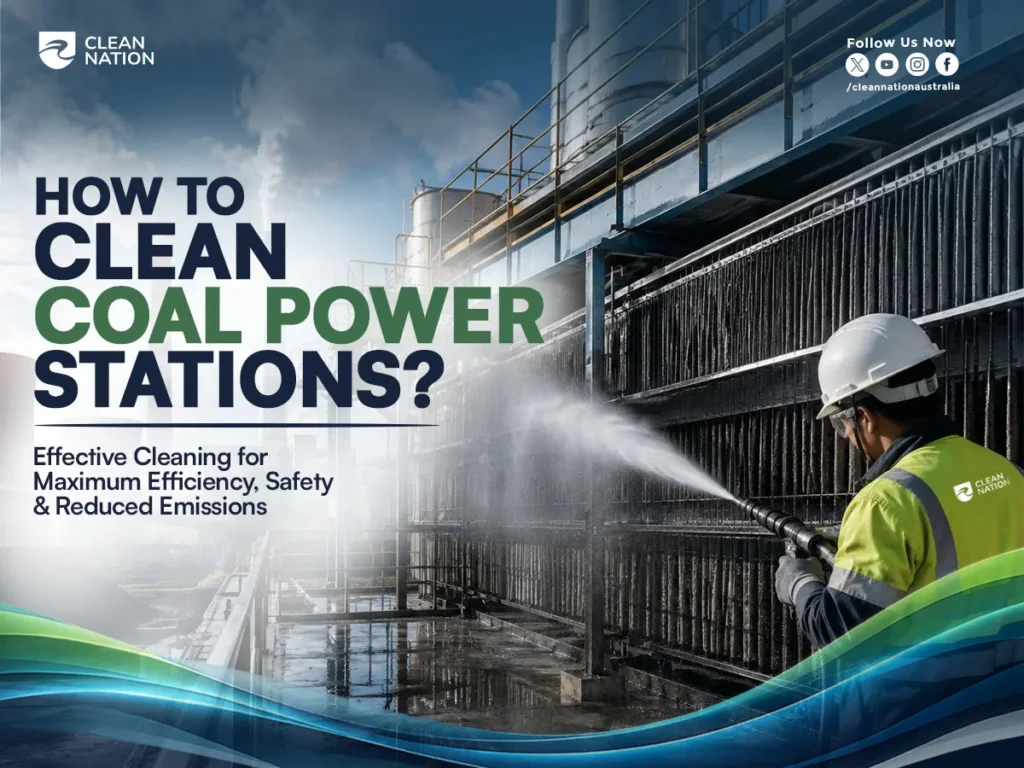
How to clean coal power stations: Start by inspecting the plant to identify contaminants and buildup, then remove coal dust and ash deposits using industrial vacuums and dust collection systems. Next, clean the boilers and combustion equipment to restore heat transfer, service flue gas systems like scrubbers, precipitators, and filters to control air pollution, treat waste and wastewater properly, and finish by monitoring emissions to confirm the plant is back in compliance. This is exactly how to clean coal power stations the right way, and when handled by an experienced team like Clean Nation, it cuts fuel waste, lowers emissions, reduces fire risk, and keeps the plant running safely and efficiently.
Why Coal Power Stations Need Cleaning?
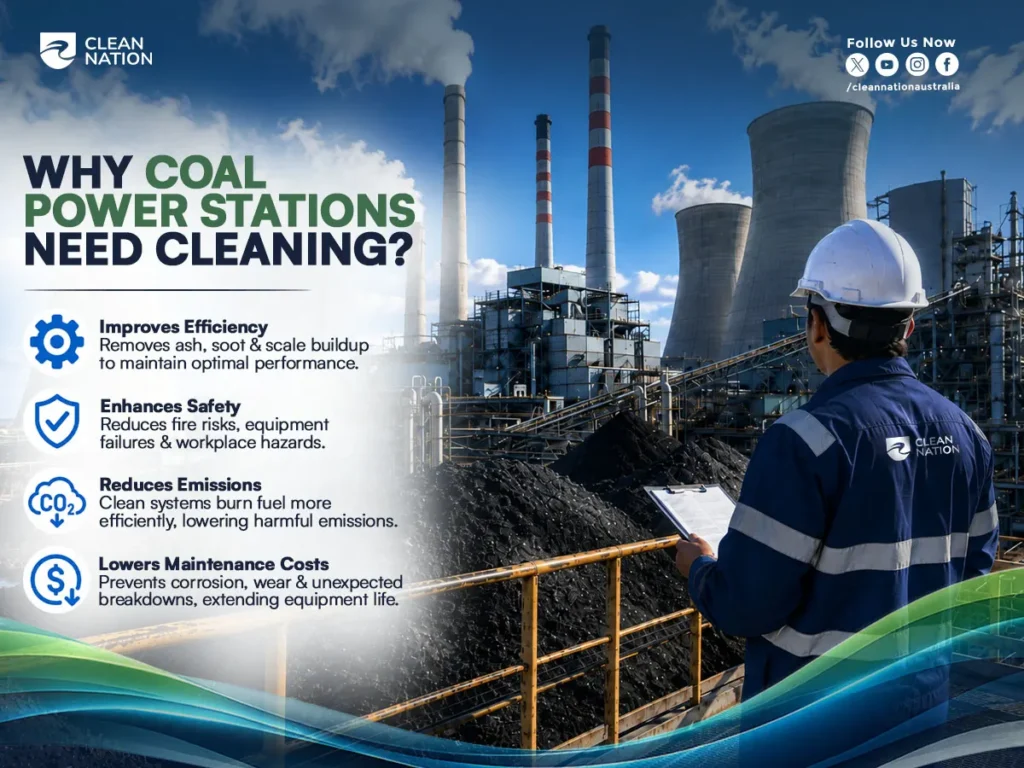
Burning coal doesn’t stop at electricity. The coal combustion process also creates fly ash, bottom ash, and a mix of toxic emissions that stick around long after the fire goes out.
Fly ash is the light, powdery waste that rises with the flue gas. If it isn’t captured properly, it escapes into the air. Bottom ash is heavier and settles at the base of the furnace. Both need careful ash management, since neither breaks down on its own.
When ash and soot pile up, coal plant efficiency drops. The plant has to burn more coal to make the same amount of power, which only adds to coal pollution. This is why plants across the country rely on a trusted cleaning service in Australia to keep operations running the way they should.
There’s a health side too. Toxic emissions from a dirty plant don’t stay put. They spread into nearby air and water, adding to environmental degradation and raising public health impacts for people living close by.
At Clean Nation, we treat cleaning as basic plant care, not an extra step. A clean coal station burns less fuel, releases fewer emissions, and puts less strain on the environment around it.
How to Clean a Coal Power Station: Step-by-Step Process
Cleaning a coal power station isn’t a single task. It’s a process with clear steps, each one protecting plant efficiency and cutting pollution. Here’s how Clean Nation approaches coal cleaning from start to finish, drawing on our broader industrial cleaning services in Australia to handle every stage of the job.
1. Inspect the Coal Power Station and Identify Contaminants
Every cleaning job starts with an inspection. Crews check equipment for toxic substances, buildup, and wear across the plant’s industrial infrastructure.
This step matters more for an ageing coal fleet. Older, inefficient coal plants tend to hide problems in places routine checks miss. Inspectors review emission data and compare it against expected plant efficiency to spot where contaminant removal is needed most.
The findings from this stage often guide coal power station upgrades. Some issues call for simple cleaning. Others point to bigger power plant modernization work down the line.
2. Remove Coal Dust and Ash Deposits
Next comes ash removal. Coal dust, fly ash, and bottom ash build up fast, and each one needs proper ash handling to avoid spreading further.
Crews use industrial vacuums and dust removal systems to pull loose material without kicking it back into the air. Bag filters help catch fine particulate matter during this process, keeping it out of the plant’s breathing zones.
This step alone can noticeably improve airflow and reduce strain on downstream equipment.
3. Clean Boilers and Combustion Equipment
The coal boiler is the heart of the plant, so it gets close attention. Crews clean the boiler drum and superheater tubes, where ash and scale interfere with steam generation.
For plants using supercritical boilers or pulverized coal combustion (PCC), cleaning also supports combustion optimisation. Clearing buildup helps advanced combustion technology run the way it was designed to, which keeps boiler technology performing at full capacity.
4. Clean Flue Gas and Control Air Pollution
Flue gas carries sulfur dioxide (SO₂), nitrogen oxides (NOx), and other pollutants out of the combustion process. Cleaning and maintaining the equipment that treats this gas is a major part of air pollution control.
This includes servicing electrostatic precipitators and fabric filters, which trap particulates before they exit the stack. Flue gas desulfurization (FGD) systems, low-NOx burners, and selective
catalytic reduction (SCR) units also need regular upkeep to keep pollution control equipment working as intended.
5. Treat Coal Plant Waste and Wastewater
Cleaning generates coal waste that has to go somewhere. Proper waste management keeps ash and runoff from turning into a bigger problem.
Wastewater treatment removes contaminants before water leaves the site, protecting against water pollution and water contamination. Ash itself doesn’t have to go to waste. Fly ash recycling and other by-product recycling programs turn it into material for concrete and construction, cutting down on soil contamination and reducing pressure on the disposal system.
6. Monitor Emissions After Cleaning
The last step confirms the cleaning worked. Emission monitoring systems and continuous monitoring systems (CMS) track output using gas sensors and flue gas sensors, giving real-time measurements right after service.
This data gets checked against emission standards and EPA guidelines to confirm the plant is back in compliance. Tracking CO2-e emissions and updated emission data also helps plan the next cleaning cycle before efficiency starts slipping again.
Equipment Used for Cleaning Coal Power Stations
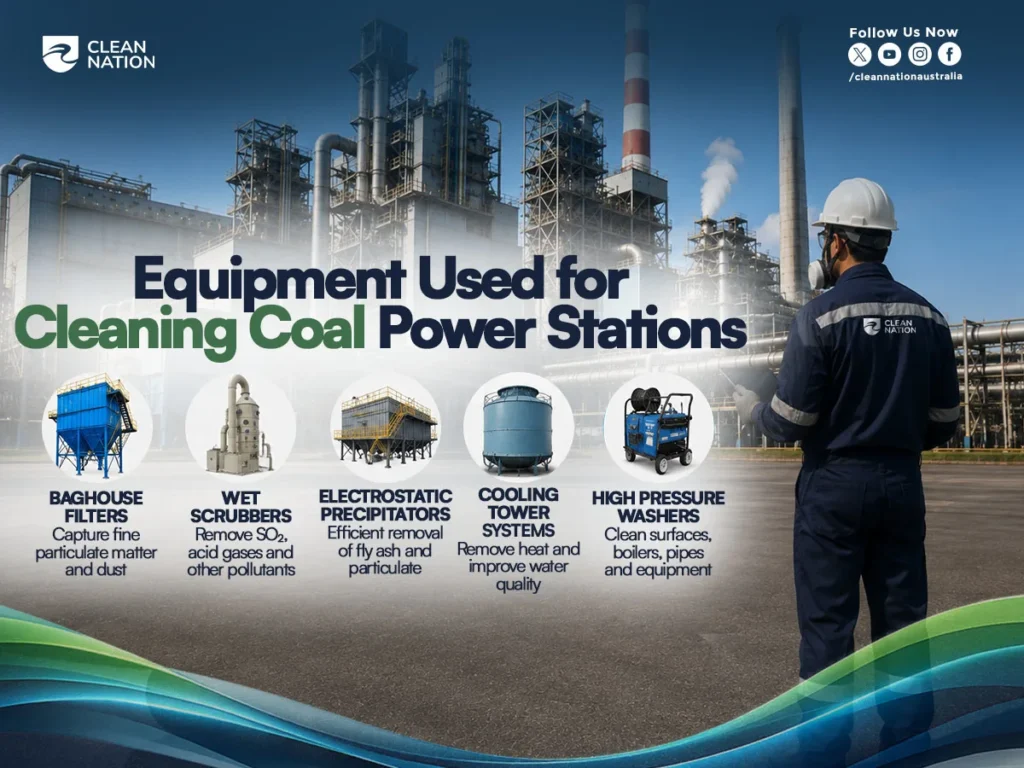
Cleaning a coal plant takes more than a crew and some tools. It takes the right pollution control equipment matched to the job. Our team, drawing on years running an industrial cleaning service in Sydney, has built out the equipment lineup below for exactly this kind of work.
Coal Scrubbers and Flue Gas Cleaning Systems
A coal scrubber removes sulfur dioxide and other pollutants from flue gas before it leaves the stack. Wet scrubbers use a liquid spray to capture contaminants, while dry systems handle the same job without added moisture.
Different designs suit different plants. A venturi scrubber forces gas through a narrow throat for fast contact with the scrubbing liquid. A spray tower scrubber uses a wide chamber with fine mist for broader coverage. Fluidized bed scrubbers and tray scrubbers offer other layouts, each built around the same goal: effective SO₂ absorption.
These systems sit at the core of any flue gas desulfurization setup. A well-maintained FGD system keeps sulfur emissions in check long after the cleaning crew leaves.
Industrial Vacuum and Dust Removal Systems
Loose coal dust and soot particles need to come out without getting kicked back into the air. That’s where industrial vacuums and dust removal systems come in.
A bag filtration system pulls air through fabric bags that trap fine particles as small as a few microns. This keeps particulate matter contained instead of spreading through the plant. Paired with a proper bag filter, these systems handle the bulk of loose dust cleanup during routine maintenance.
Air purification systems work alongside vacuuming to keep ambient dust levels down in work areas, which matters for both equipment protection and worker safety.
Ash Handling and Waste Treatment Equipment
Once ash is removed, it needs somewhere to go. Ash handling equipment moves fly ash and bottom ash from collection points to storage or processing, keeping ash management organized instead of chaotic.
Waste treatment equipment prepares this material for its next step. A lot of it doesn’t end up in a landfill at all. Coal fly ash recycling turns ash into usable material for concrete and other construction products, which is a growing part of industrial waste recycling.
This kind of waste utilization cuts disposal costs and reduces pressure on the plant’s disposal system.
Filtration and Emission Monitoring Systems
The final layer of equipment confirms the air leaving the plant meets standards. Electrostatic precipitators and fabric filters trap particulates before exhaust exits the stack, forming the backbone of most filtration systems on site.
Emission monitoring systems track what’s actually getting through. Continuous monitoring systems (CMS) paired with gas sensors give plants a live read on output, feeding directly into the plant’s emission control system.
Together, this equipment forms a full air quality control setup. It’s not one machine doing the work. It’s an industrial filtration system built from several parts, each one covering a different stage of the cleanup.
Challenges of Cleaning Coal Power Stations
Cleaning a coal plant isn’t always simple. Here are the main challenges that come up, ones we see regularly across our industrial cleaning services in New South Wales:
- Ageing infrastructure limits access. Older coal power stations weren’t designed for modern equipment. Tight layouts and outdated ageing energy infrastructure make maintenance access harder than it should be.
- Retrofits add cost. Bringing an old plant up to modern standards often means retrofit costs on top of routine cleaning. New filtration or monitoring equipment adds to capital costs fast.
- Corrosion never stops. Coal ash and flue gas eat away at equipment over time. Corrosion prevention has to be built into every cleaning plan, or freshly serviced parts fail again within months.
- New tech doesn’t always fit old systems. Adding modern monitoring or filtration to older plants creates technology challenges. Getting new equipment to work with existing infrastructure takes extra engineering.
- Costs keep climbing. Regular cleaning, waste handling, and upkeep all add to operating costs, putting pressure on plants that are already running lean.
- Investment decisions are risky. Choosing between routine cleaning and larger upgrades isn’t easy. Every dollar spent on an ageing plant carries some investment risk, especially with coal’s future still uncertain.
These challenges don’t make cleaning optional. They just mean it needs a clear plan, built around cost, safety, and what the plant actually needs.
Cleaning and Maintenance Requirements for Coal Power Stations
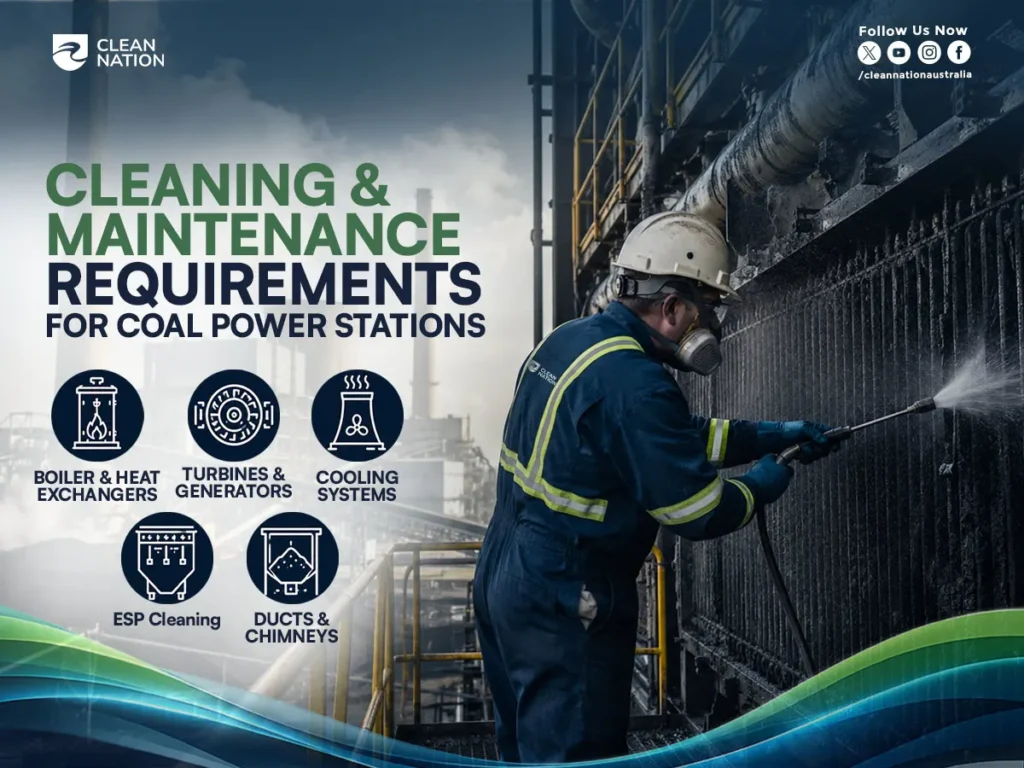
Keeping a coal plant clean isn’t a one-time job. It takes an ongoing power plant maintenance plan built around a few key requirements.
- Set a maintenance schedule. Regular checkups catch buildup and wear before they turn into bigger problems. Skipping this step is how small issues become expensive ones.
- Keep maintenance access clear. Crews need a clear path to boilers, scrubbers, and filtration units. Poor access slows down every job and drives up labor time.
- Service scrubbers on a set cycle. Scrubber maintenance keeps SO₂ removal working at full strength. This includes checking nozzle configuration, since clogged or misaligned nozzles cut scrubbing efficiency fast.
- Maintain the regeneration system. Systems that recycle scrubbing material need regular checks too. A regeneration system that isn’t working right forces the plant to use more raw material than it should.
- Plan for equipment upgrades. Parts wear out, and equipment upgrades keep cleaning systems running at the level they were designed for. Waiting too long usually costs more in repairs later.
- Budget for retrofit technology. Adding retrofit technology to older systems supports power station modernization without a full rebuild. It’s often the more practical path for plants not ready for a complete overhaul.
- Track coal plant upgrade costs. Knowing what upgrades cost ahead of time makes budgeting easier and avoids surprise expenses mid-project.
A solid maintenance plan doesn’t just keep the plant clean. It stretches equipment life and keeps costs predictable year over year.
Advanced Technologies for Cleaner Coal Power Generation
Cleaning keeps existing equipment running well, but the industry is also shifting toward clean coal technologies that reduce pollution at the source. Here’s where that technology stands today.
The goal across the board is the same: get coal power closer to near-zero emissions. Advanced coal technologies aim to make low-emission coal a real option instead of a talking point, with some research even pointing toward zero-emission coal down the line. This work fits into a bigger decarbonization push, where low-carbon technology plays a growing role in how plants operate.
Carbon Capture and Storage (CCS)
Carbon capture and storage (CCS) pulls CO₂ out of plant emissions before it reaches the atmosphere. Once captured, that carbon either goes into carbon sequestration, typically through geological CO₂ storage deep underground, or gets reused through carbon capture and utilization (CCU) for other industrial purposes.
There are a few ways to capture that carbon. Post-combustion capture removes CO₂ after coal is burned, which works well for retrofitting existing plants. Pre-combustion capture removes carbon before combustion happens, changing the fuel earlier in the process. Oxyfuel combustion burns coal in pure oxygen instead of air, producing a purer CO₂ stream that’s easier to capture.
Amine scrubbing is one of the most common capture methods, using a chemical solution that binds to CO₂ and separates it from the rest of the exhaust gas.
HELE Technology: Supercritical and Ultra-Supercritical Boilers
HELE (High Efficiency Low Emissions) technology focuses on getting more power out of the same amount of coal, which naturally cuts emissions per unit of electricity produced.
A standard subcritical boiler runs at lower steam pressure and steam temperature, capping how efficient it can be. Supercritical boilers push both higher, improving thermal efficiency. Ultra-supercritical coal technology takes this further, and advanced ultra-supercritical technology pushes conditions even higher still.
The result is a new generation of high-efficiency coal plants that burn less fuel for the same output. Less fuel burned means fewer emissions overall, which makes HELE technology one of the more practical near-term paths toward cleaner coal power without waiting on carbon capture to scale up.
Why Choose Clean Nation for Coal Power Station Cleaning?
Coal plant cleaning isn’t a job for generalists. It takes specific knowledge, the right equipment, and a team that understands what’s actually on the line. Here’s what Clean Nation brings to the table. You can also see our approach to industrial cleaning in action.
- Real industrial cleaning expertise. Our crews know coal plants inside and out, from boiler tubes to precipitators. We’re not learning on your equipment. Curious what that expertise pays? Check out What is the Average Salary for Industrial Cleaners in Australia?.
- Compliant cleaning practices. Every job follows compliant cleaning practices built around current regulations. You won’t be left explaining a violation to a regulator after we leave.
- Advanced industrial cleaning equipment. We show up with advanced industrial cleaning equipment matched to the job, whether that’s dry ice blasting, industrial vacuums, or scrubber servicing.
- Environmentally responsible solutions. We handle ash, wastewater, and byproducts with environmentally responsible solutions, keeping waste out of places it shouldn’t end up.
- Reliable maintenance support. Cleaning isn’t a one-off for us. We offer reliable maintenance support that keeps your plant running clean between major service dates.
- Emission reduction strategies. We build emission reduction strategies into every job, not just cleaning for appearance but cleaning to actually cut what leaves the stack.
- Pollution control optimization. We fine-tune the equipment we service, so pollution control optimization isn’t an afterthought; it’s part of the standard process.
- Support for sustainable power generation. Our work helps plants move toward sustainable power generation, cutting waste and emissions without sacrificing output.
When you work with Clean Nation, you’re not just getting a cleaning crew. You’re getting a team that understands what’s at stake for your plant, your compliance record, and the people living near it.
Client experience with Clean Nation
Client: A 500 MW coal-fired power station in the Midwest (identity withheld per client agreement)
The plant had run for over 30 years without a full deep clean. Fuel costs were rising, output was dropping, and stack temperatures were higher than normal. That combination pointed to poor heat transfer.
An inspection found heavy ash on the boiler tubes and clogged filters in the dust collection system. Coal dust had built up along the conveyor lines, raising fire risk. Emissions were also creeping close to the permit limit.
Clean Nation started with a full inspection to map every problem area. Crews then used industrial vacuums to clear coal dust from handling areas, cutting the fire risk right away.
For the boiler, dry ice blasting removed slag from the tubes without a full shutdown, saving several days compared to chemical cleaning. The team also serviced the scrubber system and swapped out worn filters. Recovered ash was sent to a recycler instead of a landfill.
After the work, monitoring confirmed emissions had dropped well under the permit limit within a week.
Results:
- Better fuel efficiency for the same output
- Particulate emissions cut roughly in half
- Lower fire risk in the coal handling area
- Job finished in one scheduled outage, no extended downtime
The plant didn’t need a big capital upgrade. It needed a proper cleaning cycle from a team that knew the equipment and the risks. That’s the result Clean Nation works toward on every job.
FAQs
How much does cleaning a coal power station cost?
Cost varies by plant size and scope of work, but most facilities spend a few hundred thousand to over a million dollars on a full deep clean during a scheduled outage. Smaller routine services, like dust removal or filter checks, cost far less and help avoid pricier emergency repairs later.
Can a coal power station be cleaned while it’s still running?
Some tasks, like dust removal in handling areas, sootblowing, and basic housekeeping, can happen during normal operation. Deep cleaning of boilers, precipitators, and scrubbers usually requires a shutdown, since crews need safe access to equipment that’s normally hot or under pressure.
How long does a full coal plant cleaning take?
A full deep clean typically takes anywhere from a few days to two weeks, depending on plant size and how much buildup has accumulated. Most operators schedule this work during a planned outage to avoid extending downtime beyond what’s already budgeted.
What certifications should a coal plant cleaning contractor have?
Look for contractors with OSHA confined space training, hazardous waste handling certification, and experience with combustible dust protocols. They should also carry liability insurance that specifically covers industrial and power generation work.
Does weather affect coal power station cleaning schedules?
Yes, especially for outdoor equipment like cooling towers and coal handling areas. Wet or humid conditions can affect dust suppression methods and drying times, so many plants time outdoor cleaning work around drier seasons when possible.
Conclusion
Coal power stations don’t run clean on their own. Ash builds up, filters clog, and efficiency slips away quietly until it shows up in your fuel bill or your emissions report. Regular cleaning isn’t a cost to avoid. It’s what keeps your plant compliant, efficient, and safe to operate.
Clean Nation handles that work so you don’t have to guess at it. Our team brings the right equipment, the right safety protocols, and a clear plan for every job, from a single boiler service to a full-plant deep clean.
Ready to cut fuel waste, lower emissions, and get ahead of your next compliance check? Contact Clean Nation today for a free plant assessment.