

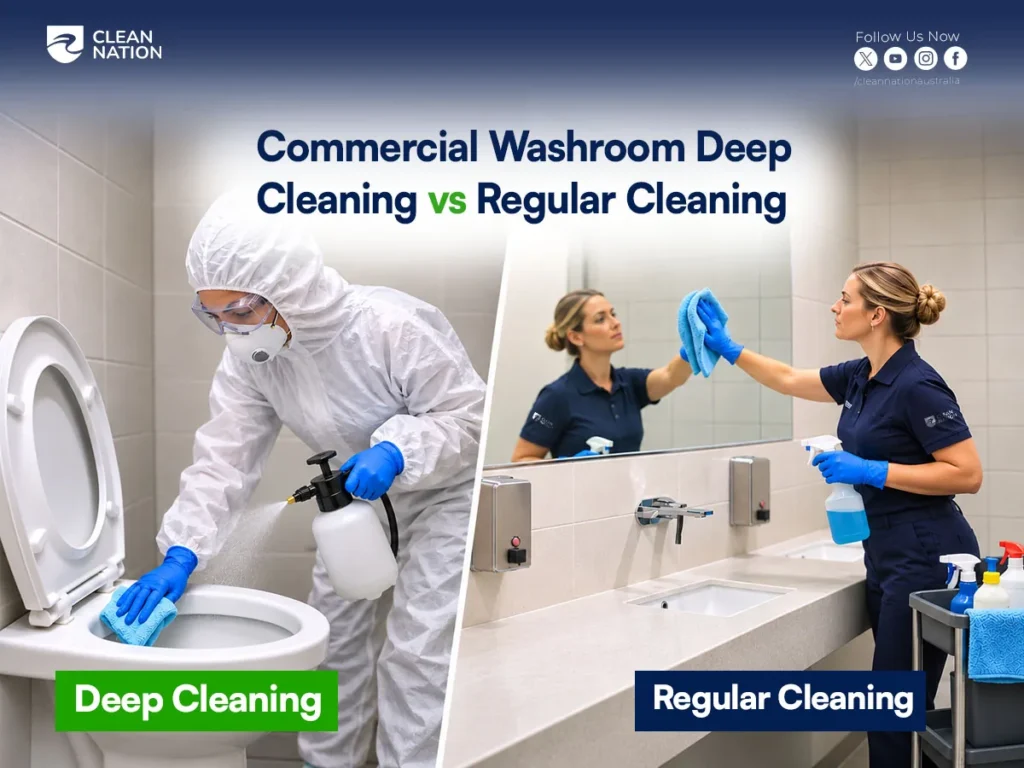
Commercial washroom deep cleaning removes stubborn dirt, limescale and grime that regular cleaning may leave behind. Regular cleaning focuses on everyday hygiene, including toilets, basins, floors and high-touch surfaces. Deep cleaning gives extra attention to grout, fixtures, floor edges and hard-to-reach areas. Most Australian businesses need both, but the right schedule depends on washroom use and condition.
This guide compares both services, explains what each includes and helps businesses decide when a commercial washroom needs more than routine cleaning.
Commercial Washroom Deep Cleaning vs Regular Cleaning – Key Differences
The main difference between regular washroom cleaning and deep cleaning is the amount of detail involved.
Regular cleaning maintains the washroom during normal business operations. It focuses on surfaces used throughout the day and helps prevent everyday dirt from building up.
Deep cleaning goes further. It targets stubborn deposits, neglected areas and surfaces that need more time or specialist attention.
| Feature | Regular Washroom Cleaning | Deep Washroom Cleaning |
| Main purpose | Maintain everyday cleanliness | Remove heavier build-up and detailed grime |
| Cleaning areas | Toilets, basins, mirrors, floors and touchpoints | Grout, tiles, fixture edges and difficult-to-reach areas |
| Cleaning depth | Routine surface cleaning | Detailed cleaning of agreed problem areas |
| Equipment | Standard commercial cleaning tools | May require specialist scrubbers or equipment |
| Frequency | Daily, weekly or as scheduled | Periodically or when needed |
| Cleaning time | Usually shorter | Often requires additional time |
| Best suited for | Ongoing washroom maintenance | Stubborn deposits, neglected areas and detailed cleaning needs |
For example, a small office bathroom may look clean after its regular service. However, mineral deposits around taps or dark grout between floor tiles may still need additional treatment.
A commercial washroom deep clean can address suitable build-up without replacing the regular cleaning schedule.
What Does Regular Commercial Washroom Cleaning Include?
Regular commercial washroom cleaning focuses on keeping facilities clean, usable and presentable during everyday operations.
The exact work depends on the cleaning contract, but routine services commonly include toilets, urinals, basins, mirrors, accessible floors and frequently touched surfaces.
Cleaners may also empty general waste bins and refill available washroom supplies where these tasks are included.
For example, a commercial office with four toilet cubicles might arrange cleaning at the end of each working day. The team completes the agreed routine tasks so the facilities are ready for staff the following morning.
Regular cleaning is important because it deals with dirt and waste before they become larger problems.
However, a normal cleaning visit may not allow enough time for detailed grout treatment, heavy limescale removal or cleaning less accessible areas.
Businesses can use Clean Nation’s Commercial Washroom Cleaning Checklist to understand the tasks usually covered during routine and periodic washroom maintenance.
What’s Included in Commercial Washroom Deep Cleaning?
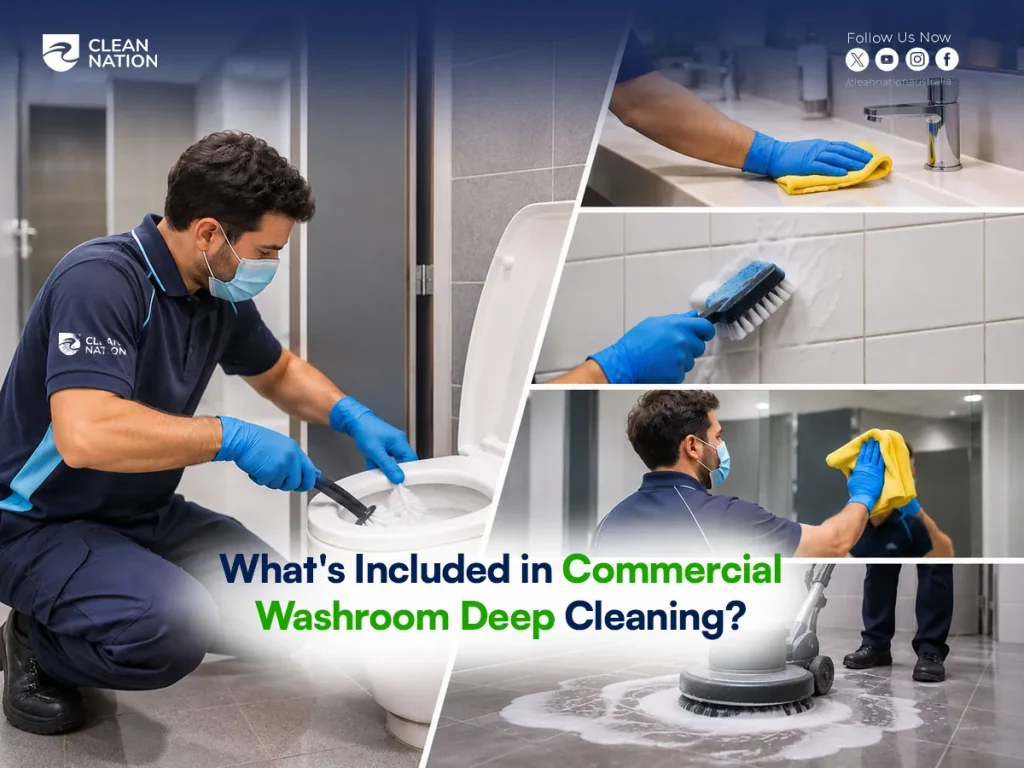
A commercial washroom deep cleaning service targets areas that need more attention than normal cleaning can provide.
The work depends on the condition of the washroom, its surfaces and the agreed cleaning scope.
Detailed Toilet and Urinal Cleaning
Toilets and urinals can develop mineral deposits, water marks and stubborn residue around their fixtures.
Regular cleaning removes everyday dirt, but older deposits may need a more detailed treatment.
Deep cleaning may involve extra attention to toilet rims, accessible hinge areas, urinal surrounds and suitable fixture surfaces.
For example, a frequently used urinal may develop visible deposits around its outlet. A detailed clean can target removable build-up using appropriate products and methods.
However, internal plumbing work, damaged seals and specialist urinal servicing are separate tasks unless included in the agreement.
Tile and Grout Deep Cleaning
Grout lines can hold dirt that ordinary mopping does not fully remove.
Over time, this may leave floor tiles looking dull or grout lines darker than the surrounding surface.
Professional tile and grout cleaning can target removable dirt using suitable cleaning products and equipment.
Depending on the surface, the work may include detailed scrubbing or machine cleaning.
Not every material should receive the same treatment. Natural stone, damaged grout and sensitive finishes may need special care.
Deep cleaning can improve the appearance of suitable surfaces, but it cannot replace missing grout or repair cracked tiles.
Limescale and Soap Residue Removal
Commercial washrooms can develop white mineral deposits around taps, basins and other water-exposed fixtures.
Soap residue may also collect around sink edges, splashbacks and shower areas.
These deposits can remain visible even after a normal surface clean.
A deep cleaning service may use suitable products to loosen and remove the build-up.
For example, a gym changing room with showers may need additional cleaning around shower screens, tap fittings and tiled walls.
The cleaner should assess the surface before selecting a treatment. Strong chemicals can damage some finishes, seals and grout.
Detailed Floor and Hard-to-Reach Area Cleaning
Washroom floors can collect dirt in corners, along wall edges and around toilet bases.
These areas may be difficult to reach during a short routine cleaning visit.
Deep cleaning may include detailed work around floor edges, cubicle partition supports, accessible fixture bases and suitable floor joints.
Some commercial floors may also benefit from machine scrubbing.
However, the equipment must suit the floor material and condition.
Accessible ventilation grilles and other high fittings may be included where safe access and suitable methods are available.
Electrical work, internal ventilation maintenance and inaccessible high-level cleaning should not be assumed to be part of a standard washroom deep clean.
When Does a Commercial Washroom Need Deep Cleaning?
A commercial washroom does not always need a full deep clean simply because it looks dirty.
Sometimes the problem can be solved by improving routine cleaning or treating one affected area.
The following signs may indicate a need for detailed cleaning.
Stains Remain After Regular Cleaning
If suitable tiles, grout or fixtures still show removable dirt after routine cleaning, a more detailed service may help.
For example, floor grout may remain dark even after several normal mopping visits.
The cleaning provider should inspect the area to determine whether the problem is accumulated dirt or permanent damage.
Limescale and Grime Have Built Up
Hard water deposits, soap residue and grime can become harder to remove when left untreated.
This is particularly common around taps, basins, shower areas and other water-exposed fixtures.
A targeted deep clean may be useful when normal cleaning products no longer remove the deposits.
Some Areas Have Been Missed for a Long Time
Commercial washrooms sometimes have fixtures or corners that are difficult to access.
If these areas have not received detailed cleaning for an extended period, grime may build up.
For example, an older toilet block might have accumulated dirt around cubicle supports and floor edges.
A detailed clean can address suitable areas that fall outside the normal cleaning visit.
The Washroom Needs Attention Before Reopening
Deep cleaning may also be useful before a commercial facility reopens after a long closure or renovation.
A recently renovated washroom may have construction dust, adhesive residue or other material that needs suitable cleaning.
However, builders’ cleaning and the removal of specialist construction materials should be clearly identified in the service scope.
The cleaning method should match the condition of the newly installed surfaces.
How Often Should Commercial Washrooms Be Deep Cleaned?
There is no single deep cleaning frequency that suits every commercial washroom in Australia.
The right interval depends on visitor numbers, the condition of the surfaces, the quality of routine cleaning and the facility’s hygiene requirements.
A quiet workplace bathroom may only need occasional detailed cleaning.
A busy gym, shopping centre or public facility may require more frequent attention to grout, fixtures and heavily used areas.
For example:
Small office washroom: Routine cleaning may keep the main surfaces in good condition. Detailed cleaning can be arranged when mineral deposits or other build-up start to appear.
Busy gym washroom: Showers, floor joints and changing areas may need more frequent detailed attention because of regular water exposure and heavy use.
Some businesses arrange periodic deep cleaning several times a year, while others include selected detailed tasks in their weekly or monthly contracts.
These are planning approaches, not mandatory nationwide frequencies.
A facility manager should review the washroom’s condition and cleaning records before deciding when additional work is needed.
Deep Cleaning, Disinfection and Maintenance: Are They the Same?
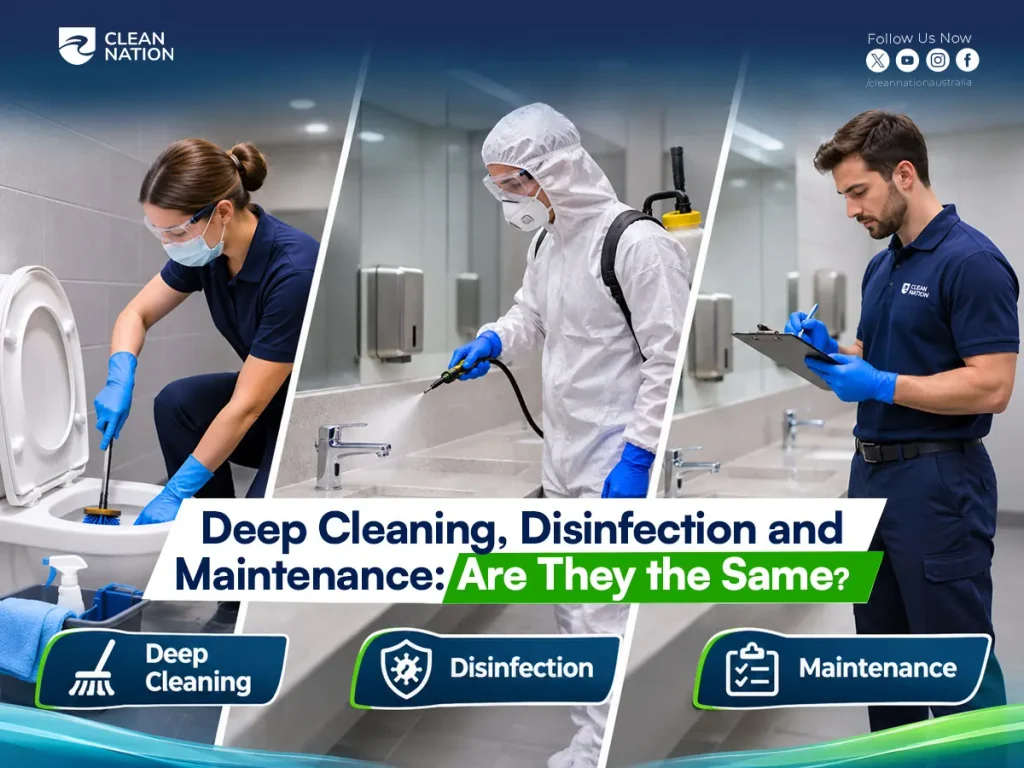
No. These services can overlap, but they do not all solve the same problem.
Deep cleaning focuses on removing accumulated dirt and grime through more detailed cleaning.
Disinfection uses suitable products and methods to reduce or inactivate specified microorganisms on surfaces. The correct procedure depends on the product, surface and risks involved.
Maintenance addresses physical faults such as damaged seals, blocked drains and broken fixtures.
For example, a washroom may have clean floors but still develop an unpleasant smell because of a faulty drain.
Another round of deep cleaning will not repair the plumbing.
Likewise, a detailed surface clean should not automatically be described as specialist infection-control cleaning.
Healthcare facilities and other higher-risk environments may require separate procedures, trained staff and specific cleaning products.
The cleaning provider should explain what its service includes and when another specialist is needed.
Regular Cleaning, Targeted Cleaning or Full Deep Cleaning
Not every washroom problem requires the same service.
The most practical approach is to identify the problem before booking extra cleaning.
| Washroom Condition | Recommended Approach | Reason |
| Everyday dirt on toilets and basins | Regular cleaning | Routine work can manage normal daily use |
| Small area of stubborn grout dirt | Targeted detailed cleaning | Only the affected section may need extra attention |
| Heavy build-up across several fixtures | Commercial washroom deep cleaning | Multiple areas require more detailed work |
| Washroom becomes dirty soon after cleaning | Review routine cleaning frequency | The existing schedule may not match visitor demand |
| Damaged grout or cracked tiles | Maintenance or repair | Cleaning cannot restore damaged materials |
| Persistent sewage smell | Plumbing investigation | A drainage fault may be responsible |
| Heavy contamination or hazardous waste | Specialist assessment | Ordinary cleaning may not be suitable |
For example, if only one basin has heavy limescale, a business may not need to book a full deep clean for every toilet cubicle.
A targeted treatment could be more suitable.
However, if the entire washroom has widespread floor grime, stained grout and heavy fixture deposits, a broader deep cleaning service may be worthwhile.
The best service is the one that addresses the actual problem without adding unnecessary work.
What Happens During a Professional Commercial Washroom Deep Clean
A detailed cleaning job should begin with an assessment rather than immediately applying stronger cleaning products.
A practical process normally includes the following stages.
Step 1: Inspect the Washroom Condition
The cleaning provider checks the affected surfaces, fixtures and level of build-up.
This helps identify what can be cleaned, which products may be suitable and whether specialist work is required.
Existing damage should be reported before cleaning begins.
Step 2: Confirm the Cleaning Scope
The provider agrees on the areas that need attention.
This may include selected toilets, urinals, grout lines, tiled surfaces and suitable floor areas.
The scope should also explain any exclusions, equipment requirements and access arrangements.
Step 3: Complete the Detailed Cleaning
Cleaners prepare the area and use appropriate equipment, protective gear and surface-safe products.
The work focuses on the agreed problem areas.
Products should be used according to their labels and Safety Data Sheets where applicable.
Bleach must never be mixed with acidic toilet cleaners or ammonia-based products.
Wet-floor hazards and restricted access should also be managed while work is taking place.
Step 4: Inspect the Results
Once the agreed cleaning work is complete, the provider should check the treated areas.
Any remaining stains, damaged surfaces or maintenance concerns should be explained.
The business can then decide whether routine cleaning arrangements need changing to help maintain the result.
Does Commercial Washroom Deep Cleaning Cost More Than Regular Cleaning?
Deep cleaning often costs more per visit than a routine washroom clean because it can require additional labour, equipment and detailed surface treatment.
However, the final price depends on the work required.
For example, cleaning one affected grout area may cost less overall than booking a full deep clean of a large amenities block.
The quote may be affected by:
- Number of toilets, urinals and basins.
- Size and condition of the washroom.
- Amount of limescale, soap residue and grime.
- Type of tiles, grout and flooring.
- Specialist equipment or products required.
- Cleaning hours and building access.
Clean Nation publishes general washroom cleaning prices on its website, but those rates should not be treated as a fixed commercial deep cleaning quote.
A commercial facility with multiple cubicles needs an assessment based on its actual cleaning scope.
When comparing quotes, ask whether the price covers a full washroom deep clean or only selected treatments.
Can Regular Cleaning Reduce the Need for Deep Cleaning?
Regular cleaning can help slow down the build-up of dirt and grime.
However, it cannot prevent every mineral deposit, stain or maintenance issue.
A suitable cleaning arrangement should give regular attention to frequently used surfaces while allowing more detailed work when needed.
For example, removing fresh soap residue from basins can help prevent heavier deposits from forming.
Similarly, dealing with visible floor dirt before it settles into grout lines may reduce the amount of detailed cleaning required later.
Businesses should also report leaking taps and damaged surfaces promptly.
A cleaning plan works best when routine cleaning, periodic detailed work and necessary maintenance support each other.
Commercial Washroom Deep Cleaning With Clean Nation
Clean Nation provides washroom cleaning services in Australia for offices, commercial buildings, public facilities and shared amenities.
Our published services include routine washroom cleaning and periodic detailed cleaning for suitable fixtures, tiles, grout and floors.
For businesses with heavier build-up, Clean Nation can discuss the condition of the washroom and the cleaning work required.
The service scope may include detailed attention to toilet and urinal surfaces, removable grout dirt, limescale and other suitable areas.
Cleaning methods and expected results depend on the surface condition and agreed work.

Request a Commercial Washroom Deep Cleaning Quote
If your washroom still has stubborn dirt or mineral deposits after regular cleaning, contact Clean Nation to discuss a suitable service.
Tell our team how many washrooms you have, which areas need attention and whether you require a one-off or ongoing cleaning arrangement.
Call +61480810142 or complete our online enquiry form to request a tailored quote.
Frequently Asked Questions
1. Can a commercial washroom remain open during deep cleaning?
It depends on the work involved. Some areas may need temporary closure because of wet floors, cleaning products or equipment. Businesses should agree on access arrangements and reopening conditions before the service begins.
2. Does a newly built commercial washroom need deep cleaning before opening?
It may need a detailed builder’s clean to remove construction dust, adhesive marks and installation residue. The required service depends on the finishing materials and condition of the new washroom.
3. Can cleaners deep-clean automatic taps and hand dryers?
Yes, suitable accessible surfaces can be cleaned carefully. However, electronic fixtures need methods approved by their manufacturers. Cleaners should avoid allowing water or chemicals into electrical components and should not dismantle equipment without authorisation.
4. Is deep cleaning suitable for commercial washrooms with natural stone tiles?
It can be, but natural stone needs careful product selection. Some acidic cleaners can damage marble, limestone and other sensitive materials. The cleaning provider should identify the surface and use an appropriate method.
5. Do businesses need to move washroom supplies before a deep clean?
Removing loose items can help cleaners access surfaces safely. Fixed dispensers and other fittings should normally remain in place unless their removal is necessary, safe and included in the agreed cleaning arrangements.