

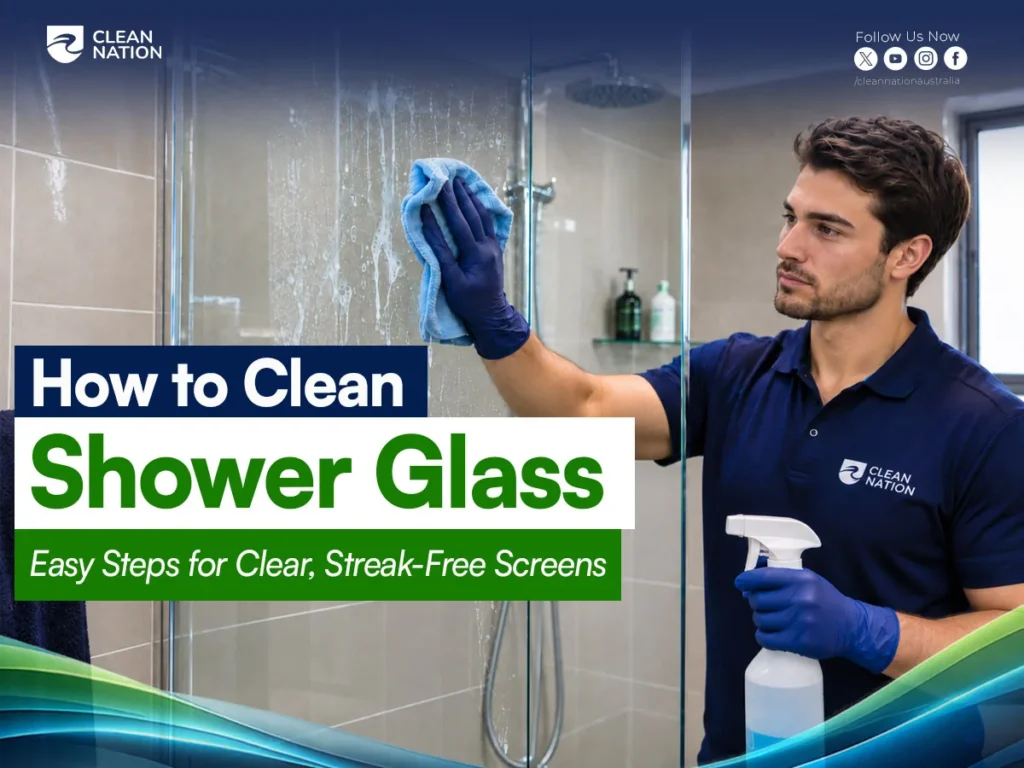
The best way to clean shower glass is to use warm water, mild dishwashing liquid and a soft microfibre cloth. Gently wipe away soap scum, rinse the glass and dry it with a rubber squeegee. For hard water stains, diluted white vinegar may help if the glass manufacturer allows it. Avoid abrasive scrubbers, harsh chemicals and products that could damage protective coatings.
This guide explains how to clean shower glass, remove stubborn water marks and keep shower screens clear without damaging the surface.
What Is the Best Way to Clean Shower Glass?
The best way to clean shower glass depends on the type of marks and whether the glass has a protective coating.
Most everyday dirt and soap residue can be removed with mild detergent and warm water. Hard water deposits may need a different treatment.
Before choosing a cleaner, check what is making the glass cloudy.
| Shower Glass Problem | Possible Cause | Suitable Cleaning Approach |
| Greasy or cloudy film | Soap scum and body oils | Mild dishwashing liquid and a soft cloth |
| White spots or chalky marks | Hard water mineral deposits | Manufacturer-approved mineral stain treatment |
| Light water streaks | Water drying on glass | Rinse, squeegee and dry |
| Dirt around glass edges | Soap residue and trapped grime | Gentle cleaning with a soft cloth |
| Cloudiness that remains after cleaning | Possible glass etching or surface damage | Ask a glass specialist to assess it |
Start with the gentlest suitable cleaning method. Stronger products are not always more effective and can damage certain shower screen surfaces.
Check Your Shower Glass Before Cleaning
Not all shower screens need the same care.
Australian homes commonly have framed, semi-frameless and frameless shower screens. Some also have protective coatings that help water run off the glass.
The frame design affects where dirt collects, while the glass coating determines which cleaning products are suitable.
Framed and Frameless Shower Screens
Framed shower screens have metal edges and tracks where soap residue and water can collect.
Frameless shower screens have less framing, but their hinges, clamps and seals still need suitable care.
For both types, avoid applying strong chemicals to fittings without checking the manufacturer’s instructions.
A product suitable for plain glass may damage aluminium frames, painted finishes or nearby materials.
Shower Glass With Protective Coatings
Some shower screens have water-repellent or easy-clean coatings.
These coatings can make routine cleaning easier, but they may also require special care.
For example, some manufacturers recommend mild detergent and soft cloths while warning against abrasive products.
Before cleaning coated glass:
- Check the manufacturer’s care instructions.
- Avoid abrasive powders and rough scrubbers.
- Do not use vinegar unless the coating instructions allow it.
- Test any approved product on a small, less visible area.
- Rinse and dry the glass as directed.
If you do not know whether your glass is coated, start with a gentle clean using mild detergent and water. Contact the supplier before attempting stronger treatments.
What Do You Need to Clean Shower Glass?
You do not need a large collection of cleaning products to remove ordinary dirt from shower glass.
Start with a few basic tools.
| Cleaning Item | Purpose |
| Soft microfibre cloth | Lifts dirt and wipes the glass without rough scrubbing |
| Rubber squeegee | Removes water and helps prevent streaks |
| Mild dishwashing liquid | Loosens soap residue and body oils |
| Warm water | Helps soften and rinse away everyday dirt |
| Soft, non-abrasive sponge | Gently removes suitable surface residue |
| Clean, dry microfibre cloth | Dries the glass and removes remaining water marks |
| Rubber gloves | Protects hands when using cleaning products |
White vinegar may also be useful for compatible, uncoated shower glass affected by mineral stains.
However, it should not be treated as a universal shower glass cleaner.
Avoid using any cleaning product that conflicts with the shower screen manufacturer’s instructions.
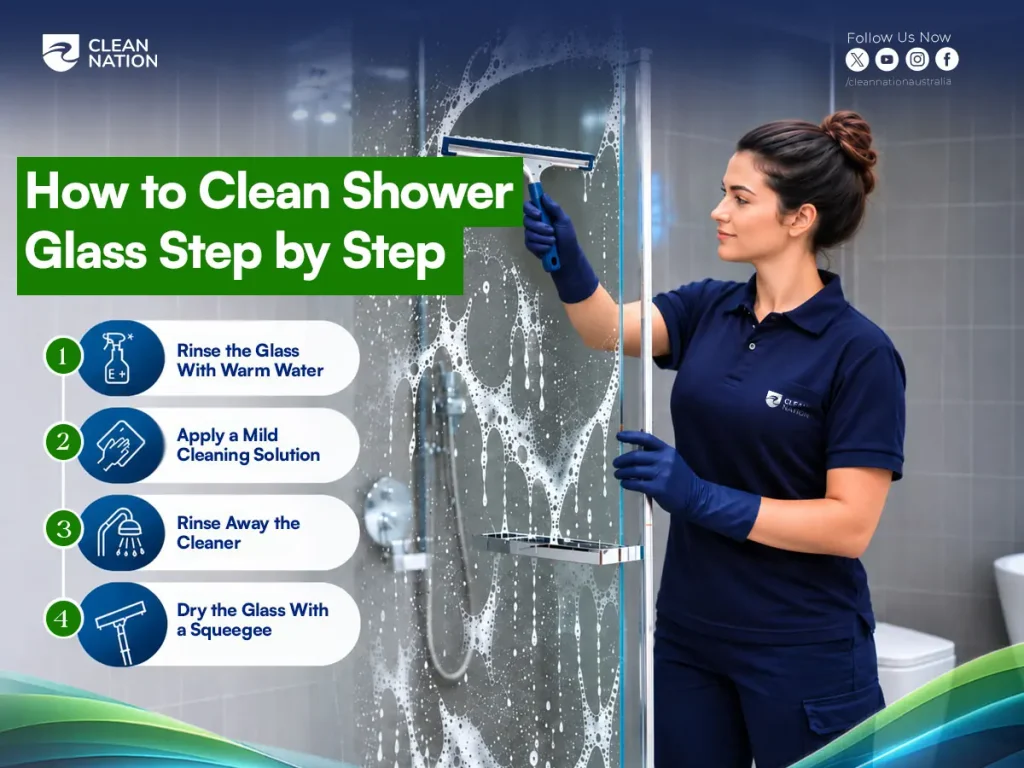
How to Clean Shower Glass Step by Step
For regular cleaning, a mild detergent solution is a practical starting point.
Follow these steps to remove everyday dirt, soap residue and light water marks.
Step 1: Prepare the Shower Glass
Remove shampoo bottles and other loose items that could get in the way.
Check the glass for visible damage, loose fittings or chipped edges.
Open a window or use the bathroom exhaust fan to improve ventilation.
If the screen is damaged or unstable, avoid placing pressure on it and arrange an appropriate inspection.
Step 2: Rinse the Glass With Warm Water
Use warm water to wet the shower glass.
This helps loosen light soap residue and remove loose particles before wiping.
Avoid very hot water or sudden temperature changes, particularly if the glass is already damaged.
Work from the top of the screen towards the bottom.
Step 3: Apply a Mild Cleaning Solution
Add a small amount of mild dishwashing liquid to warm water.
Dip a clean microfibre cloth or soft sponge into the solution.
Gently wipe the shower glass, paying extra attention to visible soap marks and greasy areas.
Avoid scrubbing hard.
If residue remains, apply the approved cleaner again rather than using a rough scouring pad.
Step 4: Rinse Away the Cleaner
Rinse the glass thoroughly with clean water.
Make sure no detergent remains along the bottom edge or around accessible fittings.
Leftover cleaning solution can dry on the glass and leave visible streaks.
Take care to keep water and cleaning products away from fittings or nearby materials that should not be soaked.
Step 5: Dry the Glass With a Squeegee
Place a clean rubber squeegee near the top of the wet glass.
Pull it down in smooth strokes, slightly overlapping each pass.
Wipe the rubber blade between strokes to avoid spreading water back across the surface.
Finish by drying the edges and corners with a clean microfibre cloth.
Drying is one of the most useful steps when cleaning shower glass. It removes water before mineral deposits can dry onto the surface.
How to Remove Soap Scum From Shower Glass
Soap scum is a common reason shower screens look cloudy.
It forms when soap residue, body oils and minerals build up on bathroom surfaces.
Unlike ordinary water spots, soap scum can feel slightly greasy or leave a dull film across the glass.
Best Method for Removing Soap Scum
For shower screens that allow mild detergent cleaning:
- Wet the glass with warm water.
- Apply a mild dishwashing liquid solution using a soft cloth.
- Gently wipe the affected areas to loosen the residue.
- Repeat if needed without abrasive scrubbing.
- Rinse thoroughly and dry with a squeegee.
Pay attention to the lower part of the shower screen, where soap residue may collect.
If the glass still looks cloudy, check whether mineral deposits are also present.
A greasy soap film and a hard water stain are different problems and may need different cleaning methods.
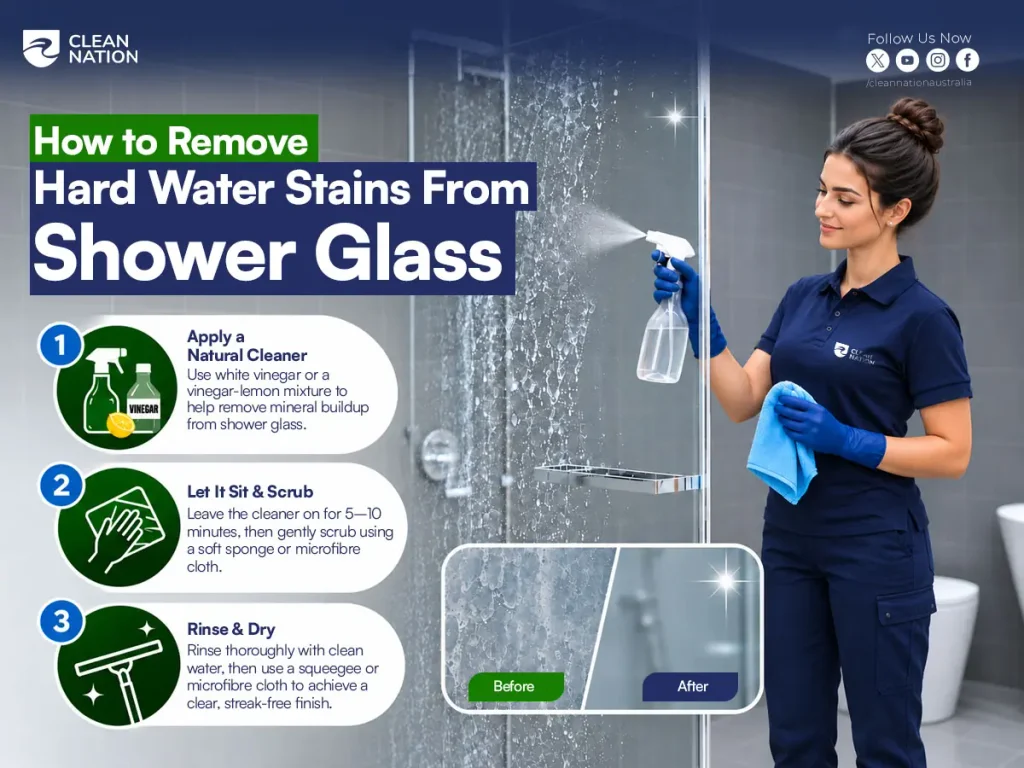
How to Remove Hard Water Stains From Shower Glass
Hard water stains form when water containing dissolved minerals dries on glass.
Calcium and magnesium deposits can leave white spots, cloudy patches or a chalky layer.
Over time, these marks may become harder to remove.
Can You Use Vinegar to Clean Shower Glass?
White vinegar can help loosen mineral deposits on compatible glass.
However, some shower screens and protective coatings should not be cleaned with acidic products.
Only use vinegar when the glass manufacturer’s care instructions allow it.
For compatible glass, follow the manufacturer’s recommended dilution and contact time. Some Australian glass suppliers recommend diluted vinegar, but the correct strength varies between products.
A suitable process is to:
- Confirm that vinegar is permitted for the glass.
- Prepare the dilution recommended by the manufacturer.
- Apply it carefully to the affected glass area.
- Leave it only for the recommended contact time.
- Wipe gently with a clean, soft cloth.
- Rinse thoroughly and dry immediately.
Keep vinegar away from marble, limestone, natural stone and finishes that may react to acids.
Do not allow the solution to run onto incompatible frames, seals or surrounding surfaces.
Never mix vinegar with bleach or bleach-based bathroom cleaners. Dangerous fumes can result.
What If Vinegar Does Not Remove the Stains?
If suitable cleaning does not remove the marks, do not keep increasing the strength of the solution or scrubbing harder.
The glass may have heavy mineral deposits or surface damage.
A manufacturer-approved descaling treatment may help with removable deposits. However, some cloudy marks are caused by glass etching or corrosion.
Cleaning cannot always reverse damage to the glass itself.
In these cases, ask the shower screen supplier or a suitable glass specialist to assess the surface.
Can You Clean Shower Glass With Baking Soda?
Baking soda, also called bicarbonate of soda, is often recommended for bathroom cleaning.
However, it is mildly abrasive.
While some household guides suggest baking soda paste for tough stains, it may not be suitable for coated shower screens or glass with sensitive finishes.
For this reason, baking soda is not the first cleaning method we recommend for shower glass.
Start with mild detergent and a soft cloth instead.
Only consider a baking soda treatment if the glass manufacturer specifically permits it.
Do not use baking soda with rough scourers, steel wool or other abrasive tools.
Mixing baking soda with vinegar is also not necessary for a routine shower glass clean. Combining the two reduces the acidity that helps vinegar dissolve mineral deposits.
For most households, a suitable liquid cleaner, gentle wiping and proper drying are simpler options.

What Should You Avoid When Cleaning Shower Glass?
Using the wrong cleaning product can leave permanent scratches or damage protective coatings.
Avoid these common mistakes.
Using Rough Scouring Pads
Steel wool, abrasive scourers and razor blades can scratch shower glass.
Even toughened safety glass can be damaged by abrasive materials.
Use clean microfibre cloths and suitable soft sponges instead.
Applying Strong Chemicals Without Checking the Surface
Some acidic, alkaline or solvent-based cleaners can damage protective coatings, frames and surrounding materials.
A cleaning product labelled for bathrooms is not automatically suitable for every shower screen.
Always check the product label and manufacturer’s care instructions.
Leaving Cleaning Products to Dry on the Glass
Some cleaners can leave marks when they dry on the surface.
Apply products for the recommended time, then rinse and dry them as directed.
Avoid using cleaning solutions on very hot glass if they may dry before you can remove them.
Mixing Bathroom Cleaning Products
Do not mix bleach with vinegar, ammonia or other cleaning products.
Some combinations produce dangerous gases.
Use one suitable product at a time and follow its instructions.
If bleach or another strong bathroom cleaner has already been used, do not apply vinegar over the residue.
Scrubbing Hard-to-Remove Permanent Cloudiness
A cloudy shower screen does not always mean dirt is still present.
Repeated hard scrubbing can cause additional damage.
If the glass remains cloudy after suitable cleaning and drying, ask a professional to assess whether the surface has been etched.
How Often Should You Clean Shower Glass?
Regular care is usually easier than removing months of soap scum and mineral deposits.
Australian shower screen manufacturers commonly recommend removing water after use and cleaning the glass at least weekly, although the correct routine depends on the product.
A simple routine can help.
| Cleaning Frequency | Recommended Action |
| After each shower | Use a rubber squeegee to remove water |
| Weekly | Clean suitable glass with mild detergent and rinse |
| When water spots appear | Check whether an approved mineral treatment is needed |
| As required | Arrange detailed cleaning for stubborn removable build-up |
These are general maintenance suggestions. Follow the screen manufacturer’s instructions if they differ.
Make Daily Cleaning Easier
Keep a clean squeegee in the shower and use it after each shower.
Dry the lower glass edges where water tends to remain.
Good bathroom ventilation can also help surfaces dry between uses.
For apartments with several bathrooms or shared facilities, regular cleaning arrangements may help keep shower screens in better condition.
Clean Nation provides apartment cleaning services in Australia for suitable regular and one-off cleaning needs.
When Should You Hire a Professional Shower Glass Cleaner?
Many light water marks and soap stains can be removed with regular home cleaning.
However, professional help may be useful when the glass has heavy build-up, the surface needs careful treatment or you are preparing a property for inspection.
Heavy Soap Scum and Mineral Build-Up
When shower glass has not been cleaned regularly, residue can become difficult to remove.
A professional cleaner can assess suitable surfaces and discuss the cleaning methods available.
However, permanent etching and damage may require advice from a glass specialist rather than further cleaning.
Moving Out of a Rental Property
Shower screens are often checked during end-of-lease inspections.
Soap residue, removable water marks and dirt around accessible glass edges may need attention before the property is handed back.
For renters preparing to move, Clean Nation offers end-of-lease cleaning services in Sydney as part of its wider residential cleaning services.
The agreed service scope should be checked before booking, particularly if the screen has heavy deposits or existing damage.
Cleaning Several Bathrooms
Large homes and properties with several bathrooms may take more time to maintain.
Professional house cleaning services in Australia can help with routine bathroom care and agreed shower screen cleaning.
If stubborn deposits also affect nearby tiled surfaces, separate tile and grout cleaning services may be suitable.
The correct service depends on which surfaces need attention.
How Can Clean Nation Help With Shower Glass Cleaning?
Clean Nation provides residential cleaning services across Australia, including suitable bathroom and shower screen cleaning.
Our published cleaning services include removing soap residue, water marks and suitable surface build-up as part of agreed cleaning tasks.
For properties with heavier deposits, the cleaning approach depends on the glass type, condition and manufacturer instructions.
Clean Nation can help with removable dirt and residue, but cannot guarantee restoration of permanently etched or damaged glass.
Request a Cleaning Quote From Clean Nation
If your shower glass has stubborn soap scum or water marks, contact Clean Nation to discuss your cleaning needs.
Let our team know whether the shower screen is coated, which areas need attention and whether you require regular cleaning or a one-off service.
Call Clean Nation on +61480810142 or contact our team online for a tailored cleaning quote.
Frequently Asked Questions
1. Can I Use Ordinary Window Cleaner on Shower Glass?
Some window cleaners work on shower glass, but not all are safe for protective coatings. Check the screen manufacturer’s instructions and the cleaner’s label before use. Ordinary glass cleaners may also be ineffective against heavy soap scum.
2. Is Steam Cleaning Safe for Glass Shower Doors?
Steam cleaning may not suit every shower screen. Heat, damaged glass, seals and protective coatings can affect safety. Check the manufacturer’s guidance before using steam equipment, especially on older or damaged glass.
3. Can I Apply a Water-Repellent Coating After Cleaning Shower Glass?
Some shower screens can receive approved water-repellent treatments. However, the product must suit the glass and any existing coating. Follow the manufacturer’s preparation and application instructions, or ask the supplier before applying a new treatment.
4. How Should I Clean Frosted or Patterned Shower Glass?
Use a gentle cleaner approved for the glass finish, together with a soft cloth. Textured surfaces may need careful attention to their grooves. Avoid abrasive tools or stronger chemicals unless the manufacturer confirms they are suitable.
5. What Should I Do If My Shower Glass Has a Scratch or Chip?
Stop using abrasive cleaning methods and avoid pressing on the damaged area. A chip or crack may affect the safety of the screen. Ask a qualified glazier or the screen supplier to inspect it before attempting further cleaning.