


A warehouse does not have to stop operating just because it needs cleaning. The real challenge is choosing a cleaning window that keeps floors, loading areas, racking and shared spaces clean without putting cleaning crews in the path of forklifts, interrupting picking and packing, or slowing deliveries.
The best time to schedule warehouse cleaning is generally during your lowest-activity periods, such as before or after a shift, during shift changeovers, overnight, on weekends, or during planned operational downtime. However, there is no single cleaning time that works for every warehouse. Facilities operating 24/7 often need a zone-based schedule that allows one section to be cleaned while work continues elsewhere.
The right approach is therefore not simply to ask, “When should we clean?” It is to identify when each part of the warehouse can be cleaned with the least interference to normal operations.
This guide explains how to build a warehouse cleaning schedule around your shifts, traffic patterns, cleaning requirements and operational priorities.
Why Warehouse Cleaning Timing Matters
Cleaning a warehouse at the wrong time can create almost as many operational problems as an inadequate cleaning program.
Imagine running an industrial floor scrubber through a main aisle while forklifts are transporting pallets. Or wet-cleaning a loading area just before several trucks arrive. Even when the cleaning itself is necessary, poor timing can interfere with movement and create avoidable conflicts between cleaners and warehouse staff.
A well-planned warehouse cleaning schedule helps separate cleaning activities from the periods when particular areas are busiest.
That can make it easier to:
- keep forklift and pedestrian routes accessible;
- prevent cleaners from interfering with picking and packing;
- give cleaned floors sufficient time to dry;
- access areas underneath or around equipment;
- complete high-level and specialist cleaning safely;
- coordinate cleaning with warehouse maintenance; and
- maintain routine cleaning without shutting down the entire facility.
Timing is particularly important from a safety perspective. Warehouse cleaning involves more than presentation: floors, forklifts, racking, equipment, chemicals and pedestrian traffic can all interact with cleaning activities.
For a detailed explanation of those responsibilities, see our warehouse cleaning and WHS compliance guide.
So, What Is the Best Time to Schedule Warehouse Cleaning?
For most warehouses, the best cleaning window is the period with the lowest combination of vehicle traffic, employee movement, picking activity and loading or dispatch work.
Depending on how your facility operates, that may be:
| Cleaning Window | Best Suited For | Main Advantage |
| Before the first shift | Floors, walkways and common areas | Clean starting environment |
| Shift changeovers | Routine zone cleaning and waste removal | Temporary reduction in activity |
| Overnight | Floor scrubbing and broader cleaning | Lower operational traffic |
| Weekends | Deep and specialist cleaning | Longer access windows |
| Planned downtime | Machinery, floors and difficult areas | Less conflict with operations |
| Low-volume periods | Loading docks and active zones | Reduced traffic |
| Zone-by-zone during operations | 24/7 warehouses | Cleaning without full shutdown |
The important point is that the warehouse’s operational schedule should determine the cleaning schedule, rather than forcing operations to work around cleaning.
Before or After a Shift
The period immediately before the first shift or after the final shift is often one of the most practical times for routine warehouse cleaning.
Forklift traffic is usually lower, fewer employees are moving through aisles, and cleaners have better access to floors and shared spaces.
Tasks may include:
- sweeping or machine-cleaning main aisles;
- removing packaging debris;
- emptying bins;
- cleaning pedestrian walkways;
- servicing staff amenities; and
- spot-cleaning frequently used areas.
For warehouses with predictable working hours, this arrangement can provide consistent cleaning without interrupting core operations.
During Shift Changeovers
Shift changes can create useful short cleaning windows.
Not every cleaning task requires several hours. A coordinated cleaning crew can use quieter transition periods to tackle specific high-priority zones before the next team becomes fully operational.
For example, one team may clean a designated picking aisle while another handles staff areas or a temporarily inactive section.
The key is coordination. Cleaning should be scheduled around the actual shift handover rather than assuming the entire warehouse becomes empty.
Overnight Cleaning
For warehouses that close or significantly reduce operations at night, overnight cleaning can provide one of the least disruptive options.
Cleaners may have better access to:
- warehouse floors;
- loading and receiving zones;
- pedestrian routes;
- waste collection points;
- storage aisles; and
- common areas.
It also provides additional time for wet-cleaned surfaces to dry before normal traffic resumes.
However, overnight cleaning is not automatically the right solution for a warehouse operating around the clock. In a 24/7 facility, “night” may simply be another busy shift.
Weekend Cleaning
Weekends can be particularly useful for warehouse deep cleaning when normal operations slow down.
Longer access windows make weekends suitable for work that is difficult to perform between normal shifts, such as:
- intensive floor scrubbing;
- high-level dust removal;
- cleaning difficult-to-access areas;
- detailed loading dock cleaning;
- racking-area cleaning; and
- selected specialist industrial cleaning tasks.
Rather than placing every task into the daily cleaning routine, warehouses can reserve more disruptive work for these longer low-activity periods.
Planned Operational or Maintenance Downtime
If your warehouse already has planned maintenance periods, they can provide an ideal opportunity to coordinate more intensive cleaning.
Cleaning and maintenance teams can plan access to areas that are normally occupied by equipment, pallets or moving vehicles.
This approach is especially useful when cleaning involves machinery or industrial equipment.
Where equipment itself requires specialist attention, our machinery cleaning services can be incorporated into planned maintenance periods rather than introducing another separate disruption to operations.
How to Schedule Cleaning in a 24/7 Warehouse
A warehouse that never closes needs a different strategy.
Waiting for the building to become empty may simply be unrealistic. Instead, divide the facility into cleaning zones and service each zone when activity there is lowest.
For example:
- Zone A — receiving and loading docks;
- Zone B — primary storage aisles;
- Zone C — picking and packing;
- Zone D — dispatch;
- Zone E — machinery or equipment areas;
- Zone F — offices, amenities and break rooms.
Cleaning can move through these areas according to operational activity rather than trying to service the whole facility simultaneously.
If receiving is busiest in the morning, clean it later. If dispatch peaks in the afternoon, schedule that zone outside the dispatch rush. If one storage aisle can temporarily be taken out of circulation, clean that section while neighbouring aisles remain operational.
This zone-based warehouse cleaning approach allows routine operations to continue while the cleaning crew works through controlled areas.
It is particularly valuable in distribution centres, where goods may be moving through the facility almost continuously.
Match the Cleaning Time to the Task
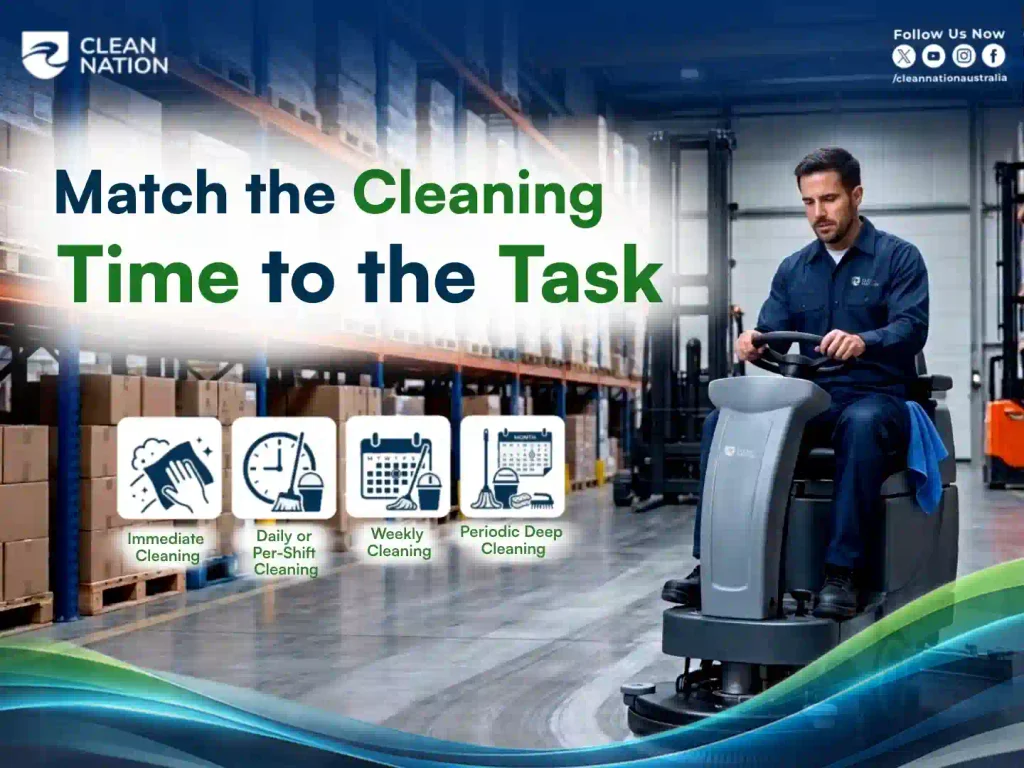
Not every warehouse cleaning task needs the same scheduling window.
Trying to perform everything at once can create unnecessary disruption. A better approach is to match the cleaning frequency and timing to the type of work involved.
Immediate Cleaning
Some tasks should never wait for the scheduled cleaning crew.
These include:
- spills affecting walkways or vehicle routes;
- broken packaging creating trip hazards;
- unexpected leaks;
- loose debris in forklift routes; and
- contamination requiring immediate control.
A cleaning schedule should support rapid response rather than replace it.
Daily or Per-Shift Cleaning
High-traffic and frequently used areas generally need the most regular attention.
Depending on the facility, these can include:
- main warehouse aisles;
- pedestrian walkways;
- picking and packing areas;
- loading zones;
- entrances;
- bins and waste points;
- staff kitchens;
- washrooms; and
- other shared areas.
Schedule these tasks around natural pauses in warehouse activity wherever possible.
Weekly Cleaning
Weekly work can address buildup that routine spot cleaning does not fully remove.
Potential tasks include:
- machine scrubbing selected floors;
- cleaning underneath accessible racking;
- detailed dock cleaning;
- removing accumulated dust;
- cleaning lower-use storage zones; and
- checking corners and edges missed during daily cleaning.
These jobs are often better suited to low-traffic periods, shift changes or quieter days.
Monthly or Periodic Deep Cleaning
Some areas require less frequent but more intensive attention.
Periodic warehouse deep cleaning may cover:
- high-level surfaces;
- difficult-to-access racking areas;
- structural surfaces;
- intensive floor cleaning;
- selected machinery areas; and
- accumulated dust and grime outside normal reach.
Schedule these tasks during planned downtime, quieter weekends or other extended access windows whenever practical.
Build Your Warehouse Cleaning Schedule Around Traffic Patterns
A calendar alone does not tell you when a warehouse is actually quiet.
Look at how people, products and vehicles move through the facility.
Start by identifying:
Peak receiving times: When are delivery vehicles most likely to arrive?
Peak dispatch periods: When is outbound activity highest?
Forklift traffic: Which aisles and intersections stay active throughout each shift?
Picking cycles: When are storage and picking areas busiest?
Shift patterns: Where are the natural breaks and handover periods?
Maintenance windows: When is equipment already unavailable for operational reasons?
Once those patterns are mapped, the cleaning contractor can work around them.
For example, there is little benefit in cleaning a loading dock at 7:00 am if the site receives most inbound deliveries between 6:30 and 9:00 am. The same dock may be far easier to clean later in the day.
A customised schedule should reflect how your warehouse actually works, not simply when a cleaning crew happens to be available.
Use Zone-Based Cleaning to Reduce Operational Disruption
Large warehouses rarely need every section cleaned simultaneously.
Dividing the facility into zones makes it possible to isolate cleaning work.
A practical sequence may look like this:
- Operations clear the nominated cleaning zone.
- The cleaning team establishes the work area and required safety controls.
- Cleaners complete the scheduled tasks.
- Floors and surfaces are brought back to a safe condition.
- The area is checked before normal traffic resumes.
- The cleaning crew moves to the next available zone.
This is more practical than attempting to restrict access across an entire warehouse.
It also makes scheduling easier because the cleaning plan can adapt when one part of the warehouse unexpectedly becomes busy.
Coordinate Cleaning With Warehouse Operations
The cleaning contractor and warehouse operations team should not work from completely separate schedules.
Before cleaning begins, both sides should understand:
- which zones are available;
- forklift and pedestrian traffic routes;
- loading and dispatch times;
- restricted areas;
- hazardous or sensitive materials;
- equipment shutdown requirements;
- cleaning methods being used;
- drying or re-entry requirements; and
- who can confirm that an area is ready to return to normal use.
This becomes even more important when an external cleaning contractor works onsite.
Our guide to warehouse cleaning and WHS compliance explains why coordination between the warehouse and cleaning contractor matters from a workplace safety perspective.
Don’t Schedule Every Warehouse Area at the Same Frequency
One of the biggest mistakes in a warehouse cleaning schedule is treating every square metre equally.
A loading dock that handles constant vehicle and pallet traffic does not accumulate dirt at the same rate as a low-use storage corner.
Likewise, a busy picking aisle may need attention far more frequently than an upper racking surface.
Cleaning frequency should therefore reflect factors such as:
- traffic volume;
- type of work performed;
- dust and debris generation;
- spills or contamination;
- products being stored;
- weather and material tracked inside;
- seasonal activity;
- equipment movement; and
- workplace-specific safety requirements.
This prevents both under-cleaning busy areas and unnecessarily disrupting operations to clean low-risk areas too frequently.
Adjust Cleaning During Peak Warehouse Periods
A cleaning schedule should not remain static all year if warehouse activity changes significantly.
Peak seasons may mean:
- more employees;
- additional shifts;
- increased forklift movement;
- higher picking volumes;
- more deliveries;
- additional packaging waste; and
- heavier loading dock traffic.
The cleaning plan should scale accordingly.
You may need more frequent spot cleaning and waste removal during busy periods while moving disruptive deep-cleaning work to quieter days.
After peak periods, a more comprehensive clean may also be appropriate to deal with accumulated dust, packaging debris and high-traffic floor areas.
Common Warehouse Cleaning Scheduling Mistakes
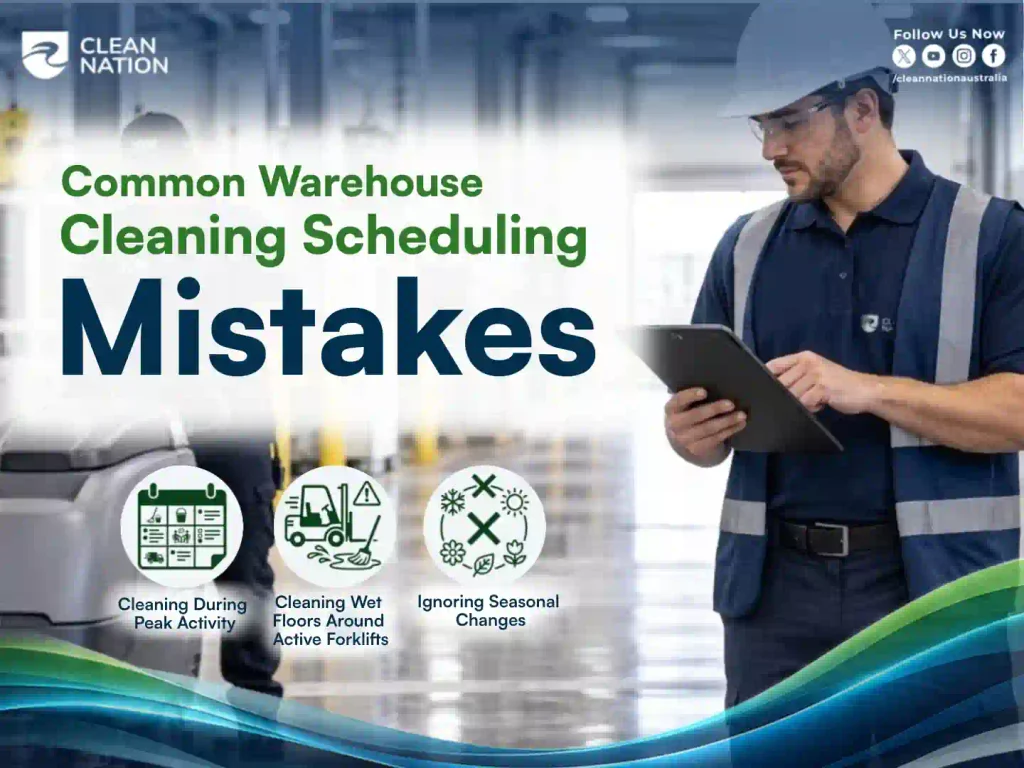
Even a detailed cleaning checklist can underperform if the timing is wrong.
Cleaning During Peak Activity
Cleaning busy picking aisles or loading docks at their busiest time creates unnecessary conflict between operations and the cleaning crew.
Use traffic data and shift information to find quieter windows.
Cleaning Wet Floors Around Active Forklifts
Wet cleaning and moving warehouse vehicles require careful separation.
Schedule floor washing or scrubbing so the area can be controlled and safely returned to use before normal traffic resumes.
Scheduling Everything for One Day
Trying to complete every cleaning task during one large session can create unnecessary disruption.
Spread routine work across shifts and zones while reserving longer shutdown periods for deep cleaning.
Ignoring Seasonal Changes
A schedule that works during a quiet month may not work during peak distribution periods.
Review the plan when warehouse activity changes.
Failing to Coordinate With Operations
Cleaners need to know when a loading bay suddenly becomes active or when an aisle cannot be taken out of service.
Warehouse staff also need to know where cleaning will take place.
Clear communication prevents the two teams from competing for the same space.
Treating Cleaning as an Afterthought
Waiting until floors or racking visibly look dirty makes cleaning reactive.
A structured plan is easier to manage because tasks, frequencies, zones and responsibilities are determined before conditions deteriorate.
A Practical Warehouse Cleaning Schedule Example
The right plan will vary by facility, but the following framework can help warehouse managers start planning:
| Frequency | Example Tasks | Suggested Timing |
| Immediate | Spills, hazardous debris, blocked paths | As soon as identified |
| Per shift | Waste, high-traffic areas, amenities | Shift change or quiet period |
| Daily | Main aisles, entrances, walkways | Before/after shifts |
| Weekly | Floor scrubbing, docks, selected racking areas | Low-volume window |
| Monthly | Detailed and difficult-to-access areas | Weekend/planned downtime |
| Periodic | Intensive deep or specialist cleaning | Planned shutdown/quiet season |
This should be treated as a planning framework rather than a universal frequency rule. The actual schedule should reflect the warehouse’s size, layout, operating hours, traffic and risk profile.
How to Create a Warehouse Cleaning Plan Without Unnecessary Downtime
A practical process is:
- Map your operating hours: Identify shifts, receiving times, dispatch peaks and planned maintenance.
- Divide the warehouse into zones: Separate docks, storage, picking, dispatch, machinery and staff areas.
- Identify high-traffic periods: Record when each zone is busiest.
- Identify cleaning requirements: Determine what needs immediate, daily, weekly and periodic attention.
- Match tasks to quiet windows: Put disruptive tasks into the lowest-activity periods.
- Coordinate access: Confirm how cleaners and warehouse staff will communicate when zones are released or reopened.
- Review the schedule: Adjust frequency and timing when workload, shifts or seasonal demand changes.
The goal is not to find one perfect hour when the entire warehouse can be cleaned.
The goal is to create a flexible cleaning schedule that follows warehouse operations.
Professional Warehouse Cleaning That Works Around Your Operations
Warehouse cleaning should support productivity rather than compete with it.
At Clean Nation, we provide commercial cleaning services for workplaces including warehouses and industrial environments, with cleaning arrangements that can be tailored around business requirements, frequency and preferred timing.
For industrial facilities, cleaning requirements can vary significantly depending on warehouse size, operating hours, equipment, traffic levels and the type of materials handled. A site-specific approach allows cleaning tasks and service windows to be planned around those conditions.
If you need a cleaning plan built around your shifts and operational requirements, contact Clean Nation for a tailored cleaning quote and schedule.
Frequently Asked Questions
What is the best time to clean a warehouse?
The best time is usually the warehouse’s lowest-activity period. Depending on the operation, this could be before or after shifts, during shift changes, overnight, on weekends or during planned downtime. Warehouses operating 24/7 can use zone-based cleaning instead of waiting for a complete shutdown.
Can warehouse cleaning be done while operations continue?
Yes, in many facilities, cleaning can continue while operations run if work is carefully separated and coordinated. Zone-based cleaning lets you service one section while other sections remain operational.
Is overnight warehouse cleaning always better?
No. Overnight cleaning works well when warehouse activity falls significantly at night. For a 24/7 distribution centre, overnight hours may still be busy, so shift patterns and traffic levels are more useful than the clock alone.
How often should warehouse floors be cleaned?
There is no universal frequency. High-traffic aisles, loading areas and spill-prone locations may need daily or per-shift attention, while some lower-traffic or high-level areas can be handled less frequently. Frequency should reflect traffic, contamination, facility use and site-specific risks.
When should warehouse deep cleaning be scheduled?
Deep cleaning is generally easiest during longer low-activity windows such as weekends, planned maintenance periods, seasonal slowdowns or other scheduled downtime. Large 24/7 facilities can also deep-clean individual zones sequentially.
How can a warehouse reduce downtime during cleaning?
Divide the facility into cleaning zones, schedule each zone around its lowest traffic period, coordinate with operations staff, separate cleaning from forklift and pedestrian movement, and reserve disruptive tasks for planned low-volume or maintenance windows.
Keep the Warehouse Moving While the Cleaning Gets Done
The best time to schedule warehouse cleaning is not determined by a universal day or hour. It is determined by how your warehouse operates.
Start with your shifts, forklift traffic, receiving and dispatch schedules, high-traffic zones and planned downtime. Use short quiet periods for routine cleaning, longer low-volume windows for deep cleaning, and zone-based scheduling when operations run continuously.
With the right plan, professional warehouse cleaning can become part of the operational rhythm rather than an interruption to it.
Need a warehouse cleaning schedule designed around your operating hours? Contact Clean Nation to discuss a tailored cleaning plan for your facility.