

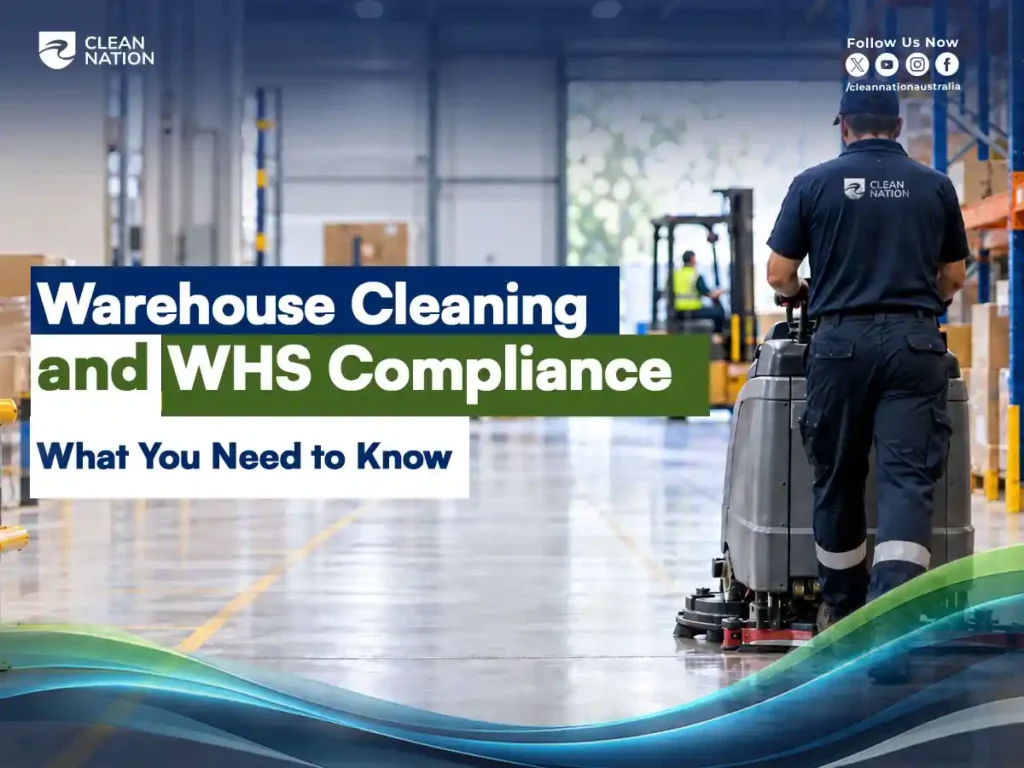
A warehouse floor that “looks clean” and a warehouse floor that’s actually safe are not always the same thing. A film of cleaning product residue can make concrete more slippery than the grime it replaced. A cleaner working a scissor lift near racking without the right training is a fall risk your site didn’t have an hour earlier. Cleaning is supposed to reduce risk in a warehouse and when it’s done without WHS in mind, it can just as easily create it.
Most warehouse operators know they need a cleaning schedule. Fewer stop to ask who actually carries the WHS responsibility when an outside contractor is the one holding the mop, the scrubber or the elevated work platform. That question matters more in a warehouse than almost anywhere else, because forklifts, racking, dangerous goods and constant vehicle movement turn an ordinary cleaning job into one with real safety stakes.
This guide covers what WHS compliance actually means for warehouse cleaning: who’s responsible, what makes warehouse cleaning riskier than an office clean, what belongs in your contract or documentation, and the questions worth asking before you sign a cleaning contractor on. For the day-to-day task checklist, see our industrial workspace cleaning safety checklist; for what a cleaning checklist document itself should contain, see what’s included in a warehouse cleaning checklist.
Why Warehouse Cleaning Is a WHS Matter, Not Just a Presentation One
WorkSafe Queensland’s guidance on cleaning and slip risk makes a point worth sitting with: good cleaning reduces contamination, but bad cleaning increases it. A floor that’s left wet and unmarked, cleaning cords run across a walkway, or the wrong product used on the wrong surface can all make a floor less safe than it was before anyone touched it.
The same guidance points to four things an effective cleaning system needs: the right methods for the surface, a proper schedule rather than ad hoc cleaning, suitable equipment, and cleaners who are trained and supervised. Miss any one of the four and cleaning stops being a safety control and starts being a hazard of its own. That’s true in any workplace, but it matters more in a warehouse, where the floor isn’t just somewhere people walk, it’s where forklifts operate, pallets get staged, and a patch of residue or an unmarked wet section sits in the path of a moving plant.
Whose Responsibility Is It – Yours or Your Cleaning Contractor’s?
Under WHS laws, both sides carry a duty. Your warehouse is a “person conducting a business or undertaking” (a PCBU) with obligations for the health and safety of everyone at the site, including contractors. Your cleaning company is a PCBU too, with its own duties to its own workers. Bringing in a contractor doesn’t hand your WHS obligations over to them; it adds a second duty holder alongside yours.
Where more than one business shares responsibility for the same work, WHS laws in most states and territories require them to consult, cooperate and coordinate with each other. In practice, that means your site and your cleaning contractor need to actually talk before work starts: what hazards exist on your site, what the contractor’s own safe work procedures are, and how the two sets of procedures fit together, not two separate safety plans that never reference each other.
One nuance worth knowing if you operate across state lines: Victoria is the only state that hasn’t adopted the harmonised WHS laws used elsewhere in Australia. It runs its own Occupational Health and Safety Act 2004, which imposes broadly similar duties but isn’t the same legislation. If your warehouse cleaning contract covers sites in Victoria and elsewhere, don’t assume one compliance document reads the same way in both places, check it against the right Act for each state.
What Makes Warehouse Cleaning Riskier Than an Office Clean
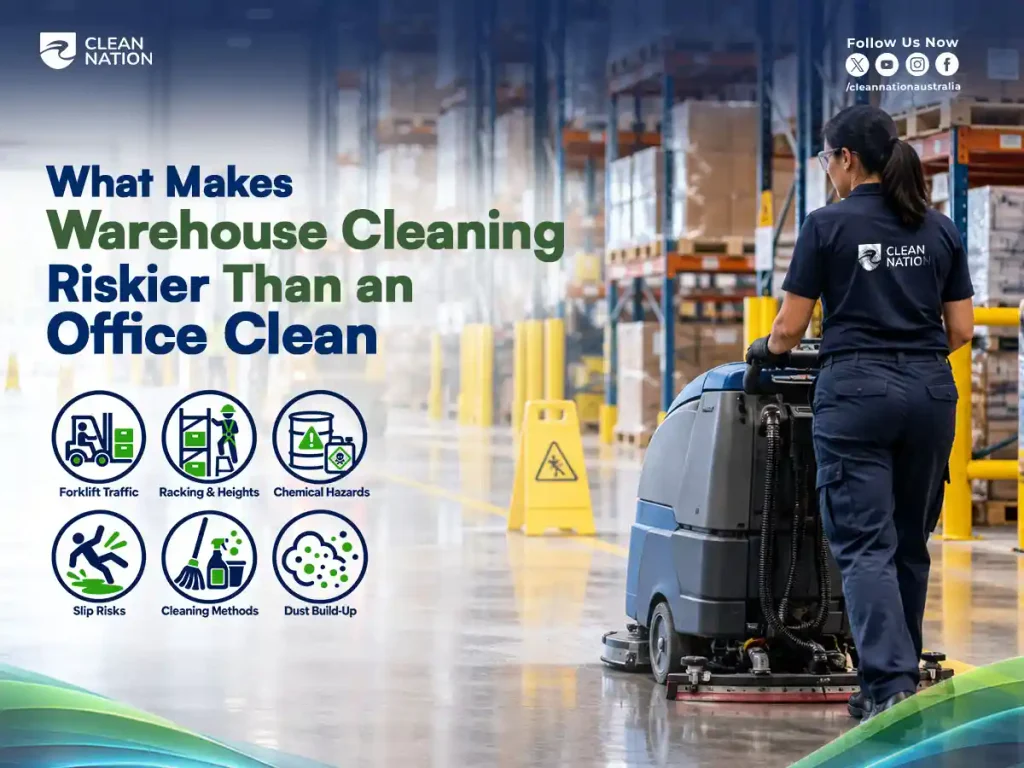
A cleaner mopping an office kitchen and a cleaner working a warehouse floor face genuinely different hazards. A cleaning plan that doesn’t account for the difference is where most of the risk sits.
Forklift and vehicle traffic. A warehouse floor is rarely empty. Cleaning has to work around forklifts, pallet jacks and delivery vehicles rather than assuming the space is clear, which means timing, wet floor signage and a clear traffic route matter far more than in a standard commercial space.
Racking, height and falling-object risk. High-level cleaning near pallet racking means working at height, often with an elevated work platform, and doing it close to stored stock that could be dislodged. Steel storage racking itself is covered by AS 4084:2023, which calls for a formal inspection by a competent person at least every 12 months. Cleaners aren’t that inspector but they’re often the ones closest to the racking day to day, so a simple “report visible damage” step in the cleaning process is worth more than it costs.
Chemical storage and cross-contamination. If your warehouse stores dangerous goods or hazardous chemicals, your cleaning contractor’s own products need to be stored, labelled and used in a way that fits your site’s chemical storage and segregation rules, not just general good practice.
Dust, including combustible dust in the right warehouses. Most warehouse dust is a housekeeping issue. In facilities that store or handle fine combustible materials, it can be a genuine hazard in its own right. If that applies to your site, it’s worth a conversation with your WHS advisor about what dust control your cleaning program needs to support, rather than assuming every warehouse’s dust risk is the same.
Wet floors around constant traffic. The WorkSafe Queensland “clean-to-dry” principle leaving a surface dry and free of moisture or dry waste rather than just clean matters more where forklifts and foot traffic never really stop. A wet patch that’s a minor annoyance in an office can sit directly in a forklift’s path in a warehouse.
What a WHS-Compliant Cleaning System Actually Looks Like
Taking WorkSafe Queensland’s four elements and applying them to a warehouse specifically:
- Methods that match the surface and the contaminant the right product, the right dilution, and a “clean-to-dry” finish rather than a wet floor left for traffic to find.
- Schedules that are planned, not reactive, and that account for shift patterns and quiet periods rather than assuming any time is a good time to clean.
- Equipment suited to the task and the environment ride-on scrubbers and industrial sweepers for large floor areas, elevated work platforms with trained, certified operators for anything at height.
- Personnel who are trained, equipped and supervised, with a clear line of accountability if something’s missed.
A cleaning contractor who can speak to all four, specifically for your warehouse rather than in general terms, is a genuinely different proposition from one who can only tell you what day they’ll show up.
What Should Be in Your Cleaning Contract or Documentation
You don’t need to write your contractor’s safety procedures for them, but your contract or site agreement should confirm a few things are in place before work starts:
- A documented scope that names your site’s specific hazards forklift zones, racking areas, chemical storage not a generic cleaning scope copied from another client.
- Confirmation of the contractor’s own safety data sheets and chemical register for anything they bring on site.
- Evidence that cleaning staff working at height or around your racking are trained and, where required, certified for the equipment they’re using.
- A site induction before anyone starts, covering your traffic flow, emergency procedures and no-go areas.
- A clear process for reporting hazards, incidents and near misses back to you, not just to the contractor’s own office.
- Insurance that actually covers work on your site, not just a general commercial cleaning policy.
For the detailed, line-by-line version of what cleaning staff should be checking on the day PPE, SDS, spill response, working at heights procedure that’s covered fully in our industrial workspace cleaning safety checklist, so we haven’t repeated it here.
Questions to Ask a Warehouse Cleaning Contractor Before You Sign
Have your cleaners worked in a warehouse with active forklift traffic before, or mainly in offices?
The hazards genuinely aren’t the same, and experience shows in how the answer is framed.
Who’s trained and certified to operate an elevated work platform, and can you show that certification?
Not “we can organise it” an actual, current certification.
What’s your process when a cleaner notices damaged racking or a chemical spill that isn’t theirs?
A contractor without a clear answer here doesn’t have a real reporting process.
How do you schedule cleaning around our forklift and vehicle movement?
Vague answers like “we work around it” aren’t a plan.
Can you provide your safety data sheets and chemical register before you start on site? If they can’t produce this before day one, they won’t produce it when you need it.
What does your site induction cover, and how long does it take?
A five-minute induction for a warehouse with real hazards is a red flag in itself.
What insurance do you hold, and does it cover work at height and around mobile plants specifically?
Ask for the certificate of currency, not just a verbal yes.
Red Flags That Signal a Contractor Isn’t WHS-Ready
- They describe their approach as “standard commercial cleaning” without adjusting anything for a warehouse environment.
- Nobody can name who’s trained and certified to work at height, or how that’s verified.
- There’s no mention of coordinating with your site’s own safety procedures, just their own, in isolation.
- Chemical products arrive on site with no SDS offered and no questions asked about what your warehouse already stores.
- Cleaning is scheduled without any reference to your forklift traffic or shift patterns.
- “We’re fully compliant” is the whole answer, with nothing specific behind it.
How This Fits With Your Other Warehouse Cleaning Documentation
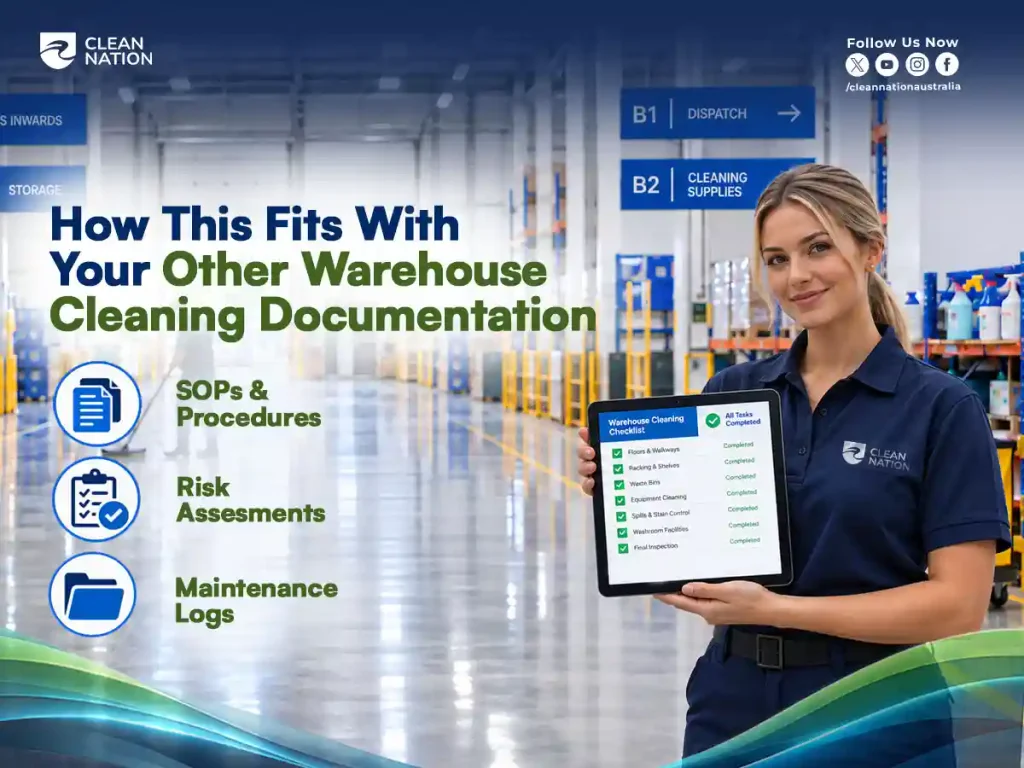
WHS compliance, a cleaning checklist and a cleaning schedule are three different documents doing three different jobs, and it’s worth knowing which one answers which question:
- This guide answers who’s responsible and what a compliant cleaning arrangement looks like.
- What’s included in a warehouse cleaning checklist answers what the checklist document itself should contain the zones, tasks and sign-off fields.
- How often should warehouses be professionally cleaned answers how frequently each area needs attention.
- Industrial workspace cleaning safety checklist answers the line-by-line safety steps cleaning staff follow on the day.
Together they cover the full picture. On their own, none of them tells you everything you need.
Cleaning That’s Actually Built for a Warehouse Site
At Clean Nation, our warehouse cleaning is carried out under WHS-compliant cleaning practices, with a risk assessment and safety plan for the site and proper PPE for the job, not a commercial office routine dropped into an industrial space. Our teams are police-checked and fully insured, and we work with ride-on scrubbers, industrial sweepers and elevated work platforms suited to warehouse-scale floors and high-level areas.
If you’re not confident your current cleaning arrangement would hold up to the questions in this guide, that’s worth a conversation before it becomes an incident report.
Frequently Asked Questions
Does our cleaning contractor need their own WHS policy, or can they just follow ours?
They need their own as a separate PCBU, your contractor carries its own WHS duties to its own workers regardless of your site’s policies. What should happen is coordination between the two, not one replacing the other.
Is a Safe Work Method Statement legally required for every warehouse clean?
No, not for every clean. A SWMS is a specific requirement for high-risk construction work under WHS regulations, which certain cleaning tasks work at height above a threshold, for example can fall under depending on how the job is done. Routine floor cleaning generally isn’t high-risk construction work in itself. Ask your contractor which of their tasks on your site actually meet that definition, rather than assuming either that none do or that all do.
Does Victoria follow the same WHS Act as the rest of Australia?
No. Victoria is the only state that hasn’t adopted the harmonised WHS laws used elsewhere in Australia and instead operates under its own Occupational Health and Safety Act 2004. The duties are broadly similar in principle, but it’s a different Act, so don’t assume documentation written for NSW or Queensland reads the same way in Victoria.
Who’s liable if a cleaner is injured on our warehouse site?
It depends on the circumstances and can involve both parties. Your site and your cleaning contractor each carry WHS duties, and liability generally follows who controlled the relevant hazard or process at the time. This is exactly why consultation and a clear division of responsibilities before work starts matters it’s not something to work out after an incident.
Can our cleaning contractor refuse to work in an area they consider unsafe?
Yes, and a contractor that won’t is arguably a bigger problem. Workers have a right to stop work they reasonably believe is unsafe. A contractor should flag a hazard, not clean around it and say nothing.
Does a cleaner reporting damaged racking count as a formal racking inspection?
No. Formal racking inspection under AS 4084:2023 needs a competent person on a set schedule. A cleaner flagging visible damage they notice while working nearby is a useful extra check, not a substitute for that formal inspection.
Conclusion
WHS compliance in warehouse cleaning isn’t a box to tick once and forget. It’s an ongoing arrangement between your site and your cleaning contractor, built around the hazards a warehouse actually has forklifts, racking, chemicals, dust, and floors that are never really empty. Know who’s responsible for what, put it in writing, ask the right questions before you sign, and keep talking to your contractor once the contract’s running, not just before it starts.
If your current cleaning arrangement couldn’t answer the questions in this guide with confidence, get a free quote from Clean Nation’s warehouse cleaning team and see what a properly documented, WHS-aware cleaning program looks like for your site.