

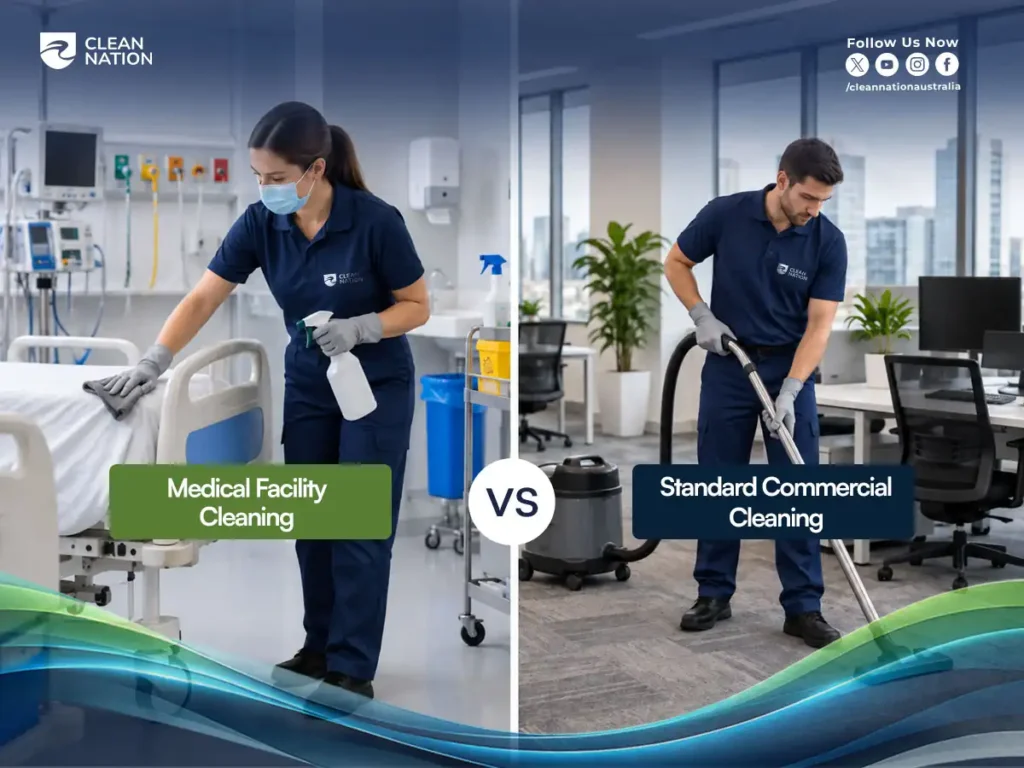
A clean office and a clean medical centre can look similar at first. Both may have spotless floors, empty bins, clean bathrooms and wiped surfaces. But the risks behind the cleaning are very different.
Medical Facility Cleaning vs Standard Commercial Cleaning comes down to more than how often a cleaner visits. Medical environments need greater attention to infection control, high-touch surfaces, disinfection, cross-contamination, PPE, clinical areas and clear cleaning procedures.
For clinics, medical centres, allied health practices and other healthcare facilities, using an ordinary office-cleaning approach may leave important risks unmanaged. That is why choosing the right cleaning service matters.
What Is the Main Difference?
Standard commercial cleaning is mainly designed to keep normal workplaces clean, organised, hygienic and presentable.
It works well for offices, reception areas, meeting rooms, kitchens, ordinary staff bathrooms and many other business spaces.
Medical facility cleaning has a different purpose.
It must consider how patients, staff, visitors, surfaces and treatment areas interact throughout the day. Cleaning needs to support infection prevention while still keeping the facility comfortable and professional.
Australian infection-control guidance treats environmental cleaning as part of infection prevention within healthcare environments rather than simply a housekeeping job.
If you want a deeper explanation of the rules behind healthcare cleaning, Clean Nation’s guide to medical facility cleaning standards in Australia explains how requirements can differ between GP clinics, hospitals, day procedures and other healthcare settings.
Medical Facility Cleaning vs Standard Commercial Cleaning at a Glance
| Area | Standard Commercial Cleaning | Medical Facility Cleaning |
| Main purpose | Workplace cleanliness and presentation | Hygiene plus infection-risk control |
| Cleaning plan | General workplace routine | Risk-based healthcare cleaning plan |
| High-touch areas | Usually part of routine cleaning | Given greater attention based on use and risk |
| Disinfection | Used when needed | Important in suitable clinical and high-risk areas |
| Cross-contamination | General control measures | Stronger area and equipment separation |
| Staff knowledge | General commercial cleaning | Healthcare-specific procedures may be required |
| PPE | Based on normal cleaning tasks | Based on task and exposure risk |
| Waste | Mainly ordinary workplace waste | Can involve defined healthcare waste procedures |
| Frequency | Based on traffic and presentation | Based on risk, use and contamination |
| Documentation | Basic checklists may be suitable | More detailed schedules and records may be needed |
| Quality checks | Appearance and task completion | Process, hygiene and task completion matter |
The biggest mistake is thinking medical cleaning is simply normal commercial cleaning with stronger chemicals.
It isn’t. The entire cleaning approach changes.
Medical Cleaning Is Built Around Infection Prevention
An office cleaner normally focuses on dust, rubbish, floors, desks, kitchens, bathrooms and general presentation.
Those jobs still matter inside a medical facility, but they are only part of the picture.
Healthcare spaces can include waiting rooms, consultation rooms, treatment rooms, shared bathrooms, reception counters and other areas where many people move through the building.
That means cleaners need to think about how contamination may move between surfaces and areas.
Door handles, chair arms, taps, light switches, reception counters, shared screens and similar touchpoints may require more attention because they are handled repeatedly.
This is where dedicated medical facilities cleaning services become more appropriate than treating the property like an ordinary office.
A healthcare site needs a cleaning plan that matches how the facility is actually used.
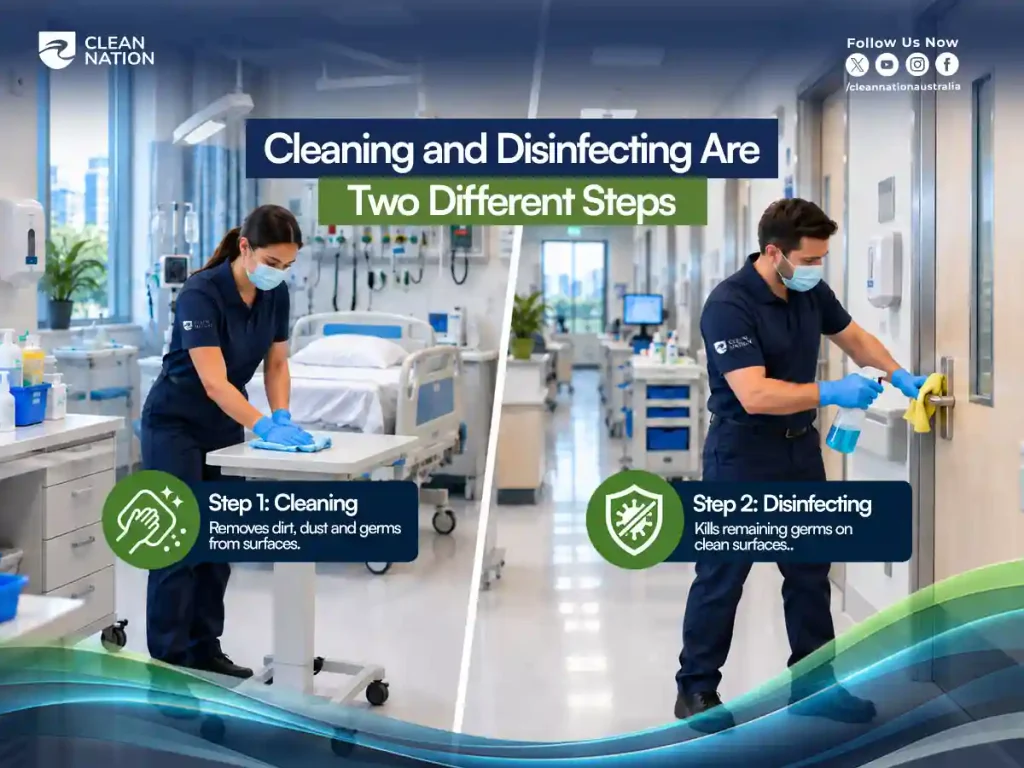
Cleaning and Disinfecting Are Two Different Steps
This difference is important.
Cleaning removes dirt, dust, organic material and other unwanted matter from a surface.
Disinfection targets microorganisms that remain on a surface after cleaning.
Putting disinfectant onto a visibly dirty surface is not the same as carrying out a proper cleaning and disinfection process.
Australian healthcare guidance separates cleaning from disinfection because each step serves a different purpose.
The product must also suit the job.
The Therapeutic Goods Administration regulates disinfectants supplied in Australia under different requirements depending on the claims being made. In healthcare settings, product directions, contact time and surface compatibility matter.
That means “hospital-grade” should never be treated as a magic marketing phrase.
A professional cleaning plan should consider what product is being used, where it is being used and how it should be applied.
Cross-Contamination Needs Tighter Control
Imagine a cleaner using the same cloth in a toilet area and then on a treatment-room surface.
Even if both surfaces look clean afterwards, the cleaning method itself has created a problem.
Cross-contamination control is therefore a major difference between medical and ordinary commercial cleaning.
Healthcare cleaning systems may separate cloths, mops, buckets and other tools according to the areas where they are used.
Colour coding is commonly used to make that separation easier, although there is not one universal national colour scheme that every facility must follow. The important point is consistency.
Cleaning equipment used in higher-risk or bathroom areas should not simply move through the rest of the facility without an appropriate process.
Not Every Room Should Be Cleaned the Same Way
A staff office, waiting room and treatment room are not the same environment.
So why would they all receive the same cleaning routine?
Medical cleaning should consider the purpose and risk of each area.
A staff administration room may mainly need standard workplace cleaning.
A busy waiting room may need more frequent attention to chairs, counters and shared touchpoints.
A treatment or procedure area may have completely different cleaning requirements because patient care takes place there.
This risk-based approach is one reason healthcare cleaning cannot be reduced to a simple “one clean per night” checklist.
Clean Nation’s article on medical facility cleaning standards in Australia goes deeper into higher-risk, medium-risk and lower-risk areas if you want to understand how these decisions are made.
High-Touch Surfaces Need More Attention
Some surfaces can be touched dozens or even hundreds of times during a busy day.
Think about a clinic entrance.
One patient touches the door handle. Another signs in. Someone uses an EFTPOS terminal. Another person sits in a waiting chair. Staff move between rooms throughout the day.
That is very different from a quiet storage room.
For this reason, high-touch areas need to be identified rather than left to chance.
These can include door hardware, reception counters, chair arms, switches, taps, handrails, shared screens and frequently handled bathroom surfaces.
This does not mean every surface needs constant disinfection.
It means the cleaning frequency should make sense for how the area is used.
Standard Commercial Cleaning Still Matters
Standard commercial cleaning is not an inferior service.
It simply solves a different problem.
Offices and normal workplaces need regular removal of dust, rubbish, spills, fingerprints, food residue and everyday dirt.
They also need clean bathrooms, kitchens, workstations, floors and shared spaces.
If you want to see exactly what a normal workplace service may include, Clean Nation’s guide on what to expect from commercial office cleaning breaks down daily, weekly and deeper cleaning tasks.
For workplaces that do not operate as healthcare environments, professional office cleaning services can provide the structured cleaning needed to keep staff areas, desks, meeting spaces, kitchens and common areas maintained.
Medical facilities can also contain office-style areas, but their clinical spaces require a different level of planning. That distinction is important.
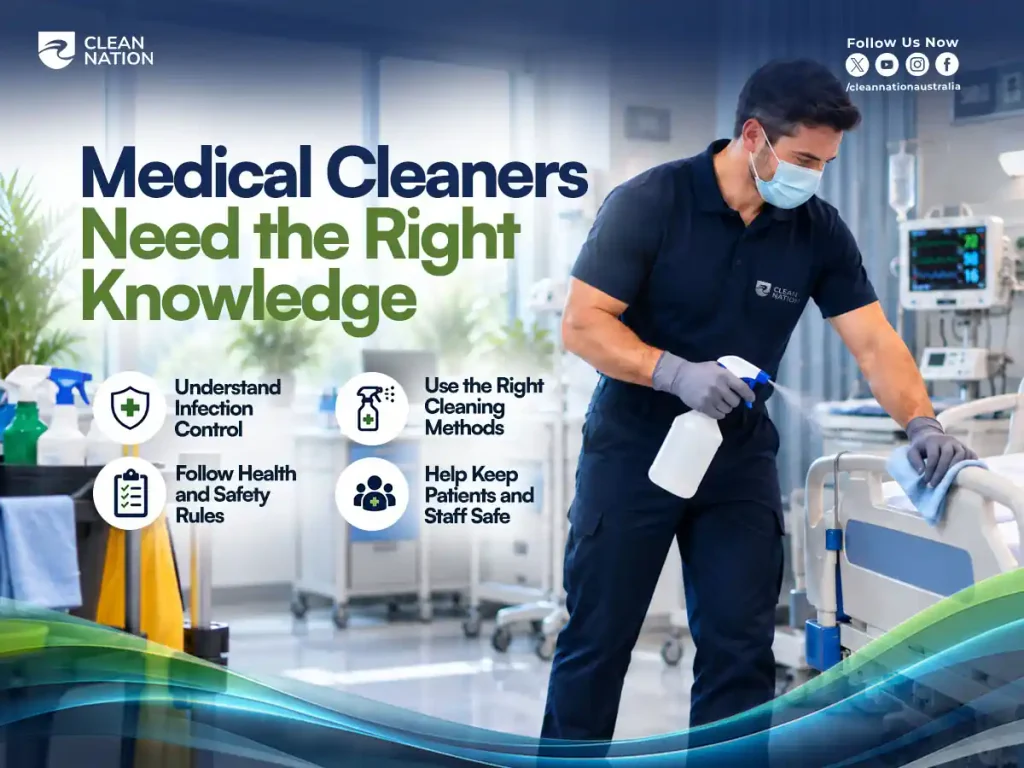
Medical Cleaners Need the Right Knowledge
A cleaner can be excellent at general office cleaning and still need additional instruction before working inside a healthcare environment.
Medical cleaning may require knowledge of infection-control procedures, correct PPE use, high-touch cleaning, cross-contamination prevention, cleaning chemicals, spill procedures, sharps awareness and facility-specific requirements.
The cleaner also needs to understand what they should not touch.
That is important around clinical equipment, instruments, medication areas and other items that may remain under the control of healthcare staff.
Clear responsibilities protect both the facility and the cleaning team.
Before hiring a provider, ask what training applies specifically to healthcare sites rather than accepting a vague statement that cleaners are “professionally trained”.
PPE Should Match the Cleaning Task
Gloves are common in many cleaning jobs, but healthcare environments can require more careful PPE decisions.
The correct protection depends on the task and the expected exposure.
Depending on the situation, this may involve gloves, protective clothing, masks or eye protection.
More PPE does not automatically equal better cleaning.
The important part is using suitable PPE correctly and following the facility’s established procedure.
A cleaner who wears gloves all day while touching multiple areas without changing them correctly can still create cross-contamination.
Procedure matters just as much as equipment.
Waste Responsibilities Must Be Clear
An ordinary office mostly produces general rubbish such as paper, packaging and food waste.
Healthcare facilities can have more complex waste streams.
Clinical waste, sharps containers and contaminated materials may be controlled differently from ordinary rubbish.
Cleaning staff should know exactly which waste they are responsible for handling and what must remain with clinical staff or an authorised waste provider.
There should also be a clear procedure for unexpected situations.
If a cleaner finds an unsecured sharp or unknown contaminated material, guessing should never be the plan.
The cleaning agreement should already explain what happens next.
Medical Washrooms Need More Than a Quick Wipe
Bathrooms are important in every workplace, but healthcare washrooms can carry additional hygiene concerns because patients, visitors and staff may use them throughout the day.
Toilets, taps, basins, door handles, grab rails, floors and other frequently handled surfaces need an organised cleaning routine.
For facilities that need these areas managed separately or alongside a wider healthcare-cleaning plan, professional washroom cleaning services can support regular cleaning of suitable amenities and shared bathroom areas.
A bathroom should not only look fresh.
The cleaning method needs to make sense for the level of traffic and the environment.
Cleaning Frequency Should Follow Risk and Use
There is no single cleaning timetable that works for every medical facility.
A small allied health practice with limited daily appointments is different from a busy GP clinic.
A staff office is different from a procedure room.
A waiting room used by many patients is different from a locked storage area.
Cleaning frequency may therefore depend on patient numbers, operating hours, room use, high-touch activity, visible contamination and the site’s own infection-control requirements.
Some tasks may happen once each day.
Others may need attention more frequently.
Some cleaning may also be required after a spill, procedure or unusual contamination event.
The right question is not:
“How many times does every clinic need cleaning?”
The better question is:
“What needs cleaning in this facility, and how often does each area need it?”
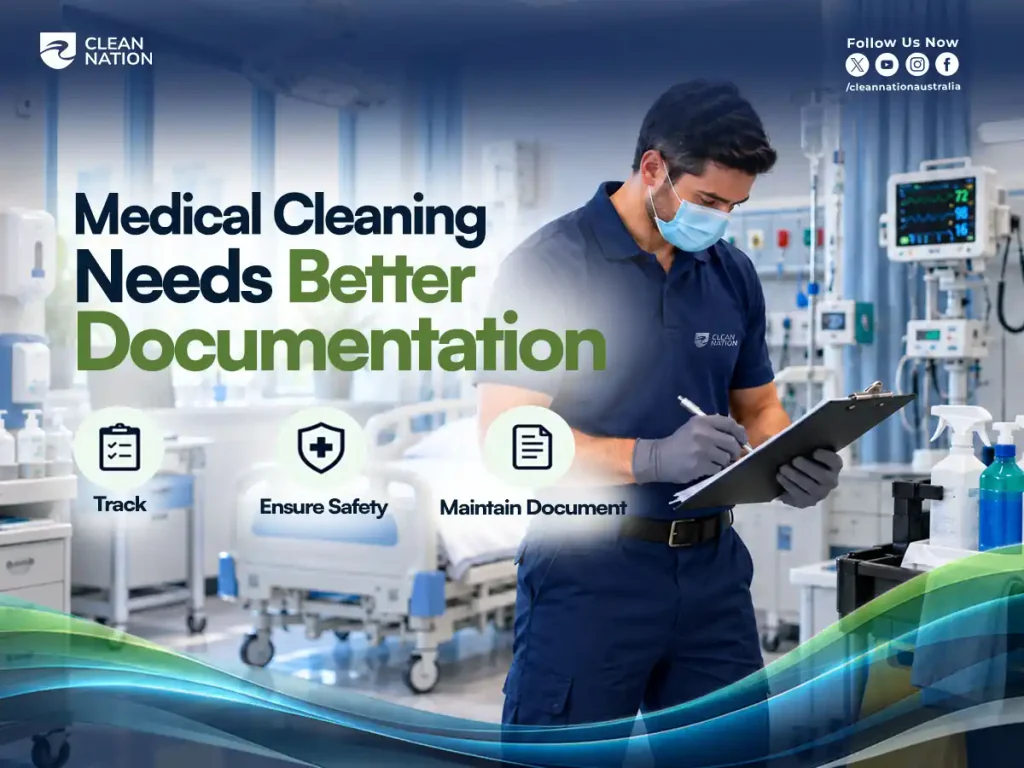
Medical Cleaning Needs Better Documentation
In a normal office, a simple checklist may be enough.
Healthcare facilities often need clearer records.
A structured plan can show which rooms are included, what tasks are required, how often they happen and who is responsible.
This is especially useful where facility managers need to review cleaning performance or demonstrate that an agreed process exists.
Australian healthcare standards and guidance place importance on documented cleaning schedules, training and monitoring in applicable healthcare settings.
Documentation also makes cleaning easier to manage.
Instead of asking whether someone “probably cleaned” an area, the facility has a defined process that can be checked.
Looking Clean Is Not the Same as Being Properly Cleaned
A shiny floor is easy to notice.
A missed door handle is not.
This is one reason visual appearance cannot be the only measure of healthcare cleaning quality.
A facility can look excellent while important cleaning steps are being missed.
Healthcare cleaning should consider whether the correct task was completed, whether the correct method was followed and whether problems were corrected when found.
For normal workplaces, appearance still matters strongly. If you manage offices or administration areas, Clean Nation’s article on why workplace hygiene matters explains how regular cleaning supports a more comfortable and well-maintained working environment.
Medical sites need both sides.
They should look professional and follow the right cleaning process.
Medical Equipment Requires Clear Boundaries
Cleaning a reception desk and cleaning medical equipment are not the same job.
Certain external surfaces may be included where the facility permits it.
Other equipment, instruments or reusable medical devices may require specialist reprocessing procedures and must remain under the responsibility of appropriately trained healthcare staff.
The contract should therefore explain exactly what the cleaning company will clean.
Never assume that “full medical cleaning” means a cleaner should handle every piece of equipment inside the building. Clear boundaries prevent mistakes.
Different Healthcare Facilities Can Have Different Requirements
A GP clinic, dental practice, allied health centre, day procedure service and hospital do not necessarily operate under the same accreditation and regulatory framework.
Clean Nation’s published guide explains that Australian healthcare cleaning requirements are layered across organisations and guidance including NHMRC, ACSQHC, RACGP, the TGA and relevant state or territory requirements.
This is important when comparing cleaning providers.
Be careful when a company tells you that one universal checklist makes every medical property “compliant”.
The smarter approach is to understand the facility first and then build the cleaning plan around its actual needs.
When Is Standard Commercial Cleaning the Better Fit?
Standard commercial cleaning remains the right choice for many normal business environments.
Think of corporate offices, administration buildings, professional suites, ordinary staff areas and other workplaces without clinical treatment activities.
These properties still need strong workplace hygiene.
They just do not carry exactly the same cleaning risks as medical environments.
For businesses comparing routine cleaning arrangements, the commercial office cleaning service guide from Clean Nation gives a useful picture of the tasks normally expected in office environments.
The important thing is matching the cleaning service to the building.
Do not pay for a healthcare cleaning system where you do not need one.
More importantly, do not use a basic office-cleaning plan where healthcare risks demand more.
What Should a Medical Facility Ask Before Hiring a Cleaner?
Price matters, but it should not be the first and only question.
Ask the cleaning provider how it separates clinical and non-clinical areas. Ask how cross-contamination is controlled. Ask what products will be used. Ask how cleaners are instructed for the site. Ask what waste they will handle. Ask what is excluded. Ask how completed work is recorded.
Those answers tell you much more than a low hourly rate.
A professional provider should be able to discuss the actual property rather than immediately selling the same package used everywhere else.
At Clean Nation, the aim is to match cleaning requirements to the type of space being serviced, whether that involves healthcare environments, offices, washrooms or other commercial areas.
That gives facility managers one clear place to start instead of trying to fit a specialist healthcare environment into a generic cleaning package.
Why Medical Facilities Should Not Settle for Basic Office Cleaning
The cheapest cleaning quote can become expensive if the service does not suit the property.
Missed high-touch points, unclear waste responsibilities, cross-contamination, unsuitable products and poorly defined cleaning duties can all create avoidable problems.
Medical facilities need clarity.
Who cleans each area?
Which products are used?
Which surfaces are included?
Which equipment is excluded?
How often is each task completed?
What happens if there is a spill or unusual contamination event?
Those questions should be answered before the cleaning begins.
If your existing cleaner is using almost exactly the same checklist for your treatment rooms as they use for an ordinary office, it may be time to review the arrangement.
Choose Cleaning That Matches Your Facility
Medical Facility Cleaning vs Standard Commercial Cleaning is ultimately about matching the cleaning process to the risk.
Ordinary workplaces need reliable cleaning.
Healthcare environments need reliable cleaning plus a stronger understanding of infection-control risks, clinical areas, cross-contamination, disinfection, PPE, waste boundaries and site-specific procedures.
Clean Nation provides medical facilities cleaning services for healthcare properties and office cleaning services for standard workplace environments, allowing the cleaning arrangement to reflect what the site actually needs.
Do not choose a cleaning service simply because the building looks similar to another workplace.
Choose one that understands what happens inside it.
Call Clean Nation on +61 480 810 142 or send an online enquiry to discuss the cleaning requirements for your facility.
Frequently Asked Questions
Can one cleaning company handle both the office and clinical parts of a medical centre?
Yes, where the provider is suitable for the work. The important part is separating the cleaning approach. Administration areas may need normal workplace cleaning, while clinical spaces can require different products, procedures, frequencies and site instructions.
What information should I provide when requesting a medical cleaning quote?
Explain the facility type, operating hours, rooms to be cleaned, patient-facing areas, bathrooms, treatment spaces, access arrangements and any site-specific cleaning procedures. This helps the provider understand the work before preparing the cleaning arrangement.
Can medical facility cleaning be completed after closing hours?
It may be possible where site access, security and facility procedures allow it. After-hours cleaning can reduce disruption, but the cleaning company still needs clear instructions about restricted rooms, alarms, access and areas requiring special handling.
Should a medical cleaning agreement list tasks the cleaner will not perform?
Yes. Clear exclusions can be just as important as included tasks. The agreement should identify responsibilities around medical devices, instruments, sharps, clinical waste, medication areas and any specialist work controlled by healthcare staff.
How do I move from a normal commercial cleaner to a medical cleaning service?
Start by reviewing your current checklist against the actual rooms and risks in the facility. Identify clinical areas, high-touch surfaces, waste responsibilities and special procedures, then discuss these requirements with a provider experienced in healthcare cleaning.