

Australia’s cleaning industry is worth billions of dollars a year, driven by tens of thousands of registered businesses and a large, growing workforce across commercial, healthcare, education, and hospitality sectors.
Commercial cleaning makes up the largest share of this revenue, while residential cleaning adds a smaller but growing slice. When people ask How Much Is the Cleaning Industry Worth in Australia?, the answer really comes down to this split between commercial and residential demand, along w ith strong regional activity. New South Wales and Victoria lead the market thanks to Sydney and Melbourne’s commercial density, with Queensland and Western Australia following close behind. Despite challenges like labour shortages and rising costs, the industry’s steady growth, backed by increasing hygiene expectations and demand for sustainable cleaning solutions, shows it’s one of Australia’s most stable and consistently expanding service sectors.
Key Cleaning Industry Statistics in Australia
Australia’s cleaning industry includes tens of thousands of registered businesses and employs a workforce that spans full-time, part-time, and casual workers across the country. The industry is fragmented, meaning it’s made up mostly of small operators rather than a handful of giants controlling everything.
That fragmentation matters. It means there’s room for new businesses to enter, but it also means competition is real, especially at the local level where small cleaning businesses fight for the same residential and commercial clients.
Number of Cleaning Businesses in Australia
There are 10,000 registered cleaning businesses operating in Australia today, according to ASIC business registers and ABS Business Counts by Industry data under ANZSIC code 7321 (Building and Other Industrial Cleaning Services).
Most of these are small operations. Think sole traders, family-owned cleaning businesses, and local operators servicing a handful of regular clients. A smaller slice of the market is made up of larger commercial cleaning companies that hold institutional and government contracts. This mix is part of why the industry is described as fragmented rather than dominated by a few big players.
Number of People Employed in the Industry
The cleaning industry employs a large and diverse workforce across Australia, made up of full-time cleaners, part-time workers, and casual staff who often move between residential and commercial jobs.
Employment in this sector tends to be geographically concentrated around major cities like Sydney, Melbourne, Brisbane, and Perth, simply because that’s where the bulk of commercial and residential demand sits. Labour flexibility is common too. A lot of cleaners work casual or part-time hours, which gives businesses room to scale their workforce up or down depending on contract volume.
Commercial vs Residential Cleaning Market Split
Commercial cleaning makes up the larger share of the industry’s total revenue, while residential cleaning represents a smaller but steadily growing segment driven by busy, dual-income households.
Commercial cleaning includes offices, retail spaces, healthcare facilities, and educational institutions, and these contracts tend to be longer-term and higher value. Residential cleaning, on the other hand, is built around smaller, recurring jobs like weekly or fortnightly house cleaning. Both segments are growing, but commercial cleaning continues to carry more weight in overall industry revenue because of the scale and consistency of its contracts.
What Is Driving Growth in Australia’s Cleaning Industry?
Growth in Australia’s cleaning industry is being pushed by rising demand for commercial cleaning, greater focus on workplace hygiene, and expansion across healthcare, education, and hospitality. These four forces are working together to push the industry’s Compound Annual Growth Rate (CAGR) higher year after year.
None of these drivers work in isolation either. A business that returns to full-time office work also wants better hygiene standards, and a growing healthcare sector needs both regular and specialised cleaning at the same time. As demand climbs, more businesses are turning to industry cleaning services in Australia to keep up with rising expectations around hygiene and presentation.
Rising Demand for Commercial Cleaning Services
Commercial cleaning demand is climbing as more businesses return to physical offices and expect higher cleaning standards than before. The return-to-office movement across corporate Australia has meant office buildings, shopping centres, and business premises need more frequent cleaning schedules than they did a few years ago.
This isn’t just about vacuuming carpets anymore. Office cleaning frequency has increased, and businesses are asking for more thorough, documented cleaning routines as part of their contracts, not just a quick tidy-up at the end of the day.
Greater Focus on Workplace Health and Hygiene
Workplace hygiene has become a bigger priority for Australian businesses, driving stronger demand for cleaning services that meet clear health and safety standards. This shift didn’t happen overnight, but it accelerated in recent years and hasn’t slowed down.
Businesses now think about hygiene compliance the way they think about workplace safety generally. Reducing sick leave, protecting employee wellbeing, and maintaining public health standards are now baked into how commercial cleaning contracts get written.
Expansion Across Healthcare, Education, and Hospitality Sectors
Healthcare, education, and hospitality are some of the fastest-growing sectors for cleaning demand, thanks to an ageing population, NDIS growth, and steady expansion in schools and aged care facilities. Hospitals, aged care homes, and educational institutions all require specialised, high-frequency cleaning that goes well beyond standard office cleaning.
Infection control cleaning is a big part of this. Healthcare cleaning and aged care cleaning both call for stricter protocols, trained staff, and consistent quality control, which is pushing up demand for specialised cleaning services in these sectors specifically.
Demand for Sustainable and Eco-Friendly Cleaning
More Australian businesses and households are asking for eco-friendly cleaning solutions, and that shift is reshaping how cleaning companies operate. Sustainable cleaning practices, biodegradable cleaning products, and chemical-free cleaning methods are becoming standard requests rather than a niche preference.
Environmental responsibility plays into this too. Businesses want to reduce their environmental footprint, cut down on microplastics and harsh detergents, and work with cleaning providers who can show they’re using low-toxicity, environmentally sustainable products.
Which Cleaning Services Are Most in Demand?
Office and commercial cleaning remains the most in-demand service across Australia, followed closely by industrial cleaning and retail or hospitality cleaning. Each of these segments has its own set of requirements, but they all share one thing in common: businesses want consistency and reliability from their cleaning provider.
Office and Commercial Cleaning
Office and commercial cleaning is the backbone of the industry, covering everything from daily desk and floor cleaning to full facility maintenance for office towers and business premises. This is where the bulk of commercial cleaning contracts sit, and it’s also where competition among cleaning companies is toughest.
Businesses expect scheduled cleaning, consistent service quality, and often want digital reporting so they can track what’s been done and when. Office cleaning services that can’t keep up with these expectations tend to lose contracts quickly. Many businesses now specifically look for professional industry cleaning providers who can offer that level of accountability.
Industrial and Warehouse Cleaning
Industrial cleaning covers warehouses, factories, and industrial facilities, and demand here tracks closely with construction and industrial approvals across the country. As warehouse building approvals and industrial construction activity pick up, so does the need for industrial cleaning services.
This type of cleaning often involves heavier equipment like industrial vacuums and floor scrubbers, and it usually comes with stricter safety and compliance requirements than standard office cleaning.
If your facility has concrete flooring, following the right maintenance process is essential. Read our guide on How to Clean Industrial Concrete Floors? to learn the best cleaning methods, equipment, and maintenance tips.
Retail and Hospitality Cleaning
Retail and hospitality cleaning demand is closely tied to Australia’s tourism recovery, with hotels, shopping centres, and visitor attractions all needing consistent, high-standard cleaning. This sector is sensitive to seasonal shifts too, with demand often rising during peak tourist periods.
Hotel cleaning in particular has specific standards around guest turnover and presentation, which means hospitality cleaning contracts tend to be more detailed than a standard retail cleaning agreement.
Which Australian States Have the Largest Cleaning Markets?
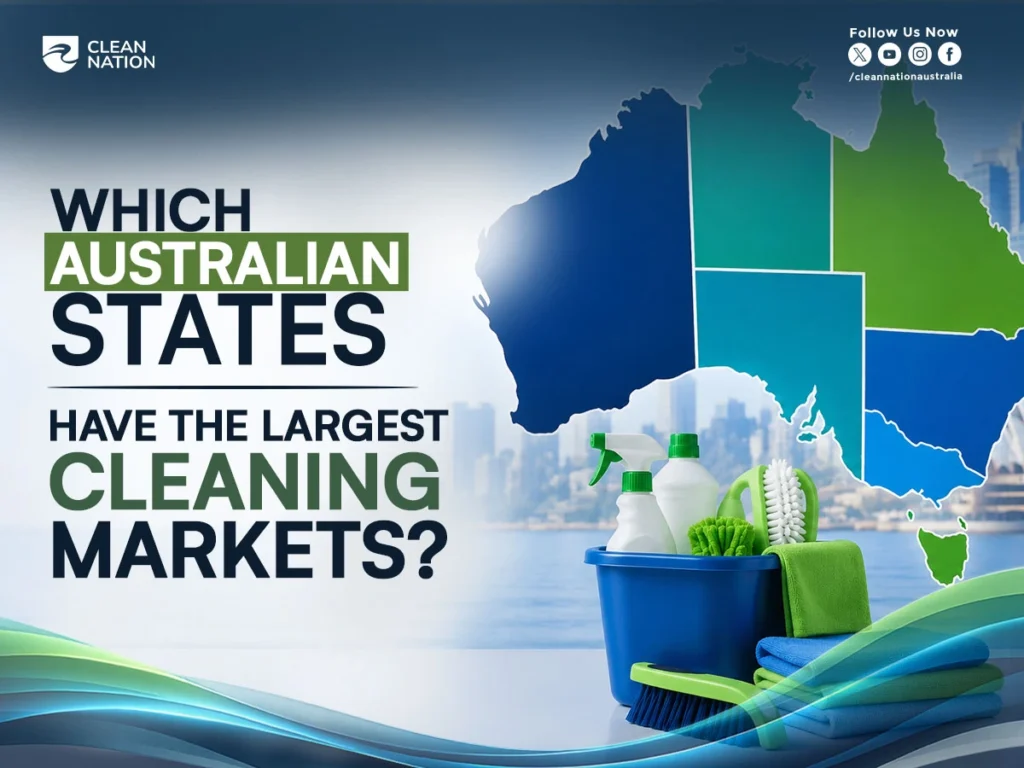
New South Wales and Victoria hold the largest cleaning markets in Australia, largely because Sydney and Melbourne are the country’s biggest commercial and population centres. Queensland and Western Australia follow, each with their own regional strengths tied to population growth and commercial activity.
New South Wales
New South Wales has the largest cleaning market in the country, driven mostly by Sydney’s dense concentration of office buildings, retail spaces, and commercial contracts. Businesses across the state looking for industrial cleaning services in New South Wales have access to the widest range of providers in the country, from small local operators to large commercial cleaning companies with government contracts.
Commercial cleaners in Sydney face high demand but also high competition, since so many cleaning companies operate in this state to serve the sheer volume of businesses based here. Anyone searching for industrial cleaning services in Sydney specifically will notice the market is more competitive and often more premium-priced than other states, simply because of how concentrated the commercial activity is in the city.
Victoria
Victoria’s cleaning market is anchored by Melbourne, which has a strong mix of commercial, healthcare, and education cleaning demand thanks to its large number of universities, hospitals, and corporate offices. Melbourne’s cleaning market has shown consistent growth in line with the city’s broader commercial expansion.
Queensland
Queensland’s cleaning market is growing steadily, supported by Brisbane’s commercial sector and the state’s strong tourism and hospitality industry. Hotel and hospitality cleaning demand tends to run higher here than in some other states, simply because of Queensland’s tourism draw.
Western Australia
Western Australia’s cleaning market is centred around Perth, with demand spread across Perth CBD, Fremantle, Joondalup, and other metropolitan suburbs. Perth’s cleaning industry benefits from a mix of commercial offices, industrial properties tied to the mining sector, and a growing residential cleaning market.
Because Perth’s cleaning businesses often operate across both commercial and residential jobs, this state shows a slightly different business mix compared to the east coast markets.
Challenges Facing the Australian Cleaning Industry
Labour shortages, rising costs, and growing competition are the biggest challenges facing cleaning businesses in Australia right now. These pressures affect everyone in the industry, from solo operators to large commercial cleaning companies.
Labour Shortages and Staff Retention
Finding and keeping reliable cleaning staff is one of the toughest ongoing challenges for Australian cleaning businesses. Cleaner recruitment has become harder in recent years, and workforce turnover remains high across the industry.
Staff retention strategies, like better pay, more consistent scheduling, and clearer career paths, are becoming more important as businesses compete for a limited pool of reliable workers.
Rising Labour and Operating Costs
Operating costs for cleaning businesses have climbed steadily, driven by wage inflation, rising insurance premiums, and higher equipment costs. Minimum award rates have gone up, and that flows directly into what cleaning businesses need to charge clients just to stay profitable.
This cost pressure is especially tough on small cleaning businesses, which don’t always have the same pricing power as larger commercial cleaning companies with long-term contracts already locked in.
Increasing Competition Among Providers
The cleaning industry is highly fragmented, which means competition is intense, especially in residential cleaning and smaller commercial contracts. Price competition is common, and it can squeeze margins for cleaning businesses that don’t differentiate themselves through service quality or specialisation.
Changing Safety and Environmental Requirements
Cleaning businesses now have to keep up with evolving health and safety regulations, environmental rules, and chemical safety requirements. Compliance costs have gone up as a result, and businesses need proper documentation, like MSDS records, to stay on the right side of regulators.
Award compliance is another layer here. Getting payroll and worker classifications wrong isn’t just a compliance risk; it can lead to real financial penalties for cleaning business owners.
The Future of Australia’s Cleaning Industry
The future of Australia’s cleaning industry points toward more automation, continued demand for green cleaning, and sustained growth in commercial cleaning contracts. Businesses that adapt to these shifts early are likely to be the ones that come out ahead.
Automation and Smart Cleaning Technology
Robotic cleaning and smart cleaning technology are starting to reshape how cleaning services get delivered in Australia. Tools like AI-powered navigation, digital quality-control systems, and app-based booking platforms are becoming more common, especially among larger commercial cleaning providers.
This shift toward automation doesn’t mean cleaners are being replaced entirely. It’s more about making operations more efficient, cutting down on manual scheduling, and giving businesses better visibility into what’s actually happening on site.
More Demand for Eco-Friendly Cleaning
Green cleaning practices are set to become even more standard as environmental awareness grows among both businesses and everyday consumers. Expect to see more cleaning companies shifting toward plant-based products, reduced chemical use, and cleaning methods that cut down on plastic waste and harmful runoff.
Continued Growth of Commercial Cleaning Services
Commercial cleaning is expected to keep growing steadily, supported by ongoing demand from offices, healthcare facilities, and educational institutions. As long as businesses keep prioritising hygiene and presentation standards, commercial cleaning contracts should remain one of the most stable parts of the industry.
What This Means for Australian Businesses?
For Australian businesses, this all points to one simple truth: professional cleaning isn’t a nice-to-have anymore; it’s part of running a functional, compliant, and reputable operation.
Clean, well-maintained workplaces directly affect employee wellbeing, client impressions, and even sick leave rates. As hygiene expectations rise across every sector, cutting corners on cleaning is no longer a low-risk decision for any business.
Look for a provider with clear service agreements, proven compliance with safety and hygiene standards, and a track record of reliability. Ask about their staff training, their quality control process, and whether they can scale their service as your business grows. Businesses that invest in professional industry cleaning upfront tend to avoid the higher costs that come with inconsistent or unreliable service down the line.
Regular professional cleaning isn’t just about appearances. It supports productivity, reduces health risks, and protects your business’s reputation with clients and staff alike. For most businesses, the cost of a good cleaning contract is small compared to the operational and reputational risk of not having one.
Why Choose Clean Nation for Industrial Cleaning?
Clean Nation stands out because it combines reliable, accountable service with the kind of consistency Australian businesses actually need from a cleaning partner. As a trusted provider of industrial cleaning services in Australia, Clean Nation focuses on building long-term relationships built on trust, transparency, and professional standards, rather than treating cleaning as a one-off task.
What sets a provider like Clean Nation apart in a crowded market isn’t just showing up on time. It’s having proper systems in place, trained staff who understand compliance and safety requirements, and the flexibility to handle everything from routine office cleaning to more specialised jobs like healthcare or industrial cleaning. For businesses trying to cut through the noise of a fragmented industry, working with a provider that takes accountability seriously makes a real difference to day-to-day operations.
FAQs
How is the value of Australia’s cleaning industry calculated?
The industry’s value is calculated by combining total revenue generated by registered cleaning businesses each year, sourced from data like IBISWorld industry reports, ABS business statistics, and ATO taxation records. This includes revenue from commercial contracts, residential jobs, and specialised services like industrial or healthcare cleaning.
How Much Does Commercial Cleaning Cost in Australia?
Commercial cleaning in Australia typically costs $35 to $65 per hour, with specialised services like medical or industrial cleaning sometimes pushing past $80 per hour. Standard office spaces generally sit at the lower end of that range, between $35 and $50 per hour, while medical, government, and industrial facilities attract higher rates due to stricter safety standards and specialised processes
Is the cleaning industry a good business to start in Australia?
Yes, the cleaning industry remains a strong option for new business owners because entry costs are relatively low and demand is steady across residential and commercial markets. Success usually depends on building reliable client relationships and staying compliant with award wages and safety regulations.
How much do cleaners earn in Australia?
Under the Cleaning Services Award 2020, commercial cleaners earn a base rate of around $28 to $30 per hour, though actual wages can be higher depending on experience, shift timing, and whether the role involves specialised work like healthcare or industrial cleaning. Evening, weekend, and public holiday shifts typically attract additional penalty rates on top of the base pay.
Do commercial cleaning businesses need insurance in Australia?
Yes, most commercial cleaning businesses need public liability insurance at minimum, and often workers’ compensation insurance if they employ staff. Insurance requirements can be higher for businesses working in healthcare, government, or industrial sites, since these contracts usually demand proof of coverage before work begins.
Conclusion
Australia’s cleaning industry is a significant part of the economy, worth billions of dollars and supported by tens of thousands of businesses across the country. Growth is being driven by rising commercial demand and stronger hygiene expectations, even as the industry deals with real challenges like labour shortages and rising costs.
The core need stays the same: businesses and households want reliable, professional cleaning, and that demand isn’t slowing down anytime soon.
If your business needs a cleaning partner you can actually rely on, get in touch with Clean Nation today and find out how we can help keep your workplace clean, compliant, and running smoothly.