

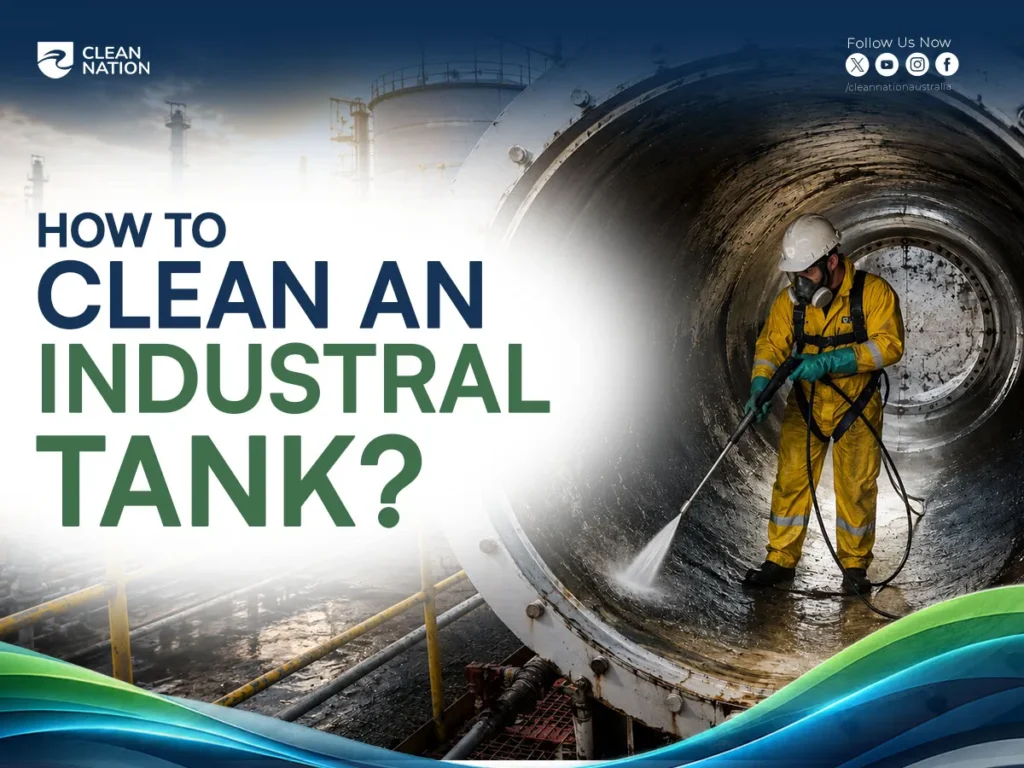
How To clean an industrial tank, start by draining and isolating it, then ventilate and test the atmosphere before any work begins. Choose the right cleaning method based on residue type: high-pressure jetting, chemical cleaning, steam, or robotic/CIP systems for no-entry jobs, then remove sludge and residue, rinse, and inspect for damage. Dispose of wastewater and sludge through licensed, EPA-compliant channels, then sign off and return the tank to service once it passes inspection. This is essentially how to clean an industrial tank safely: follow AS/NZS 2865 confined space rules, use trained technicians, and stick to a regular cleaning schedule to keep the process safe, compliant, and cost-effective long-term.
What Is Industrial Tank Cleaning and Why Does It Matter?
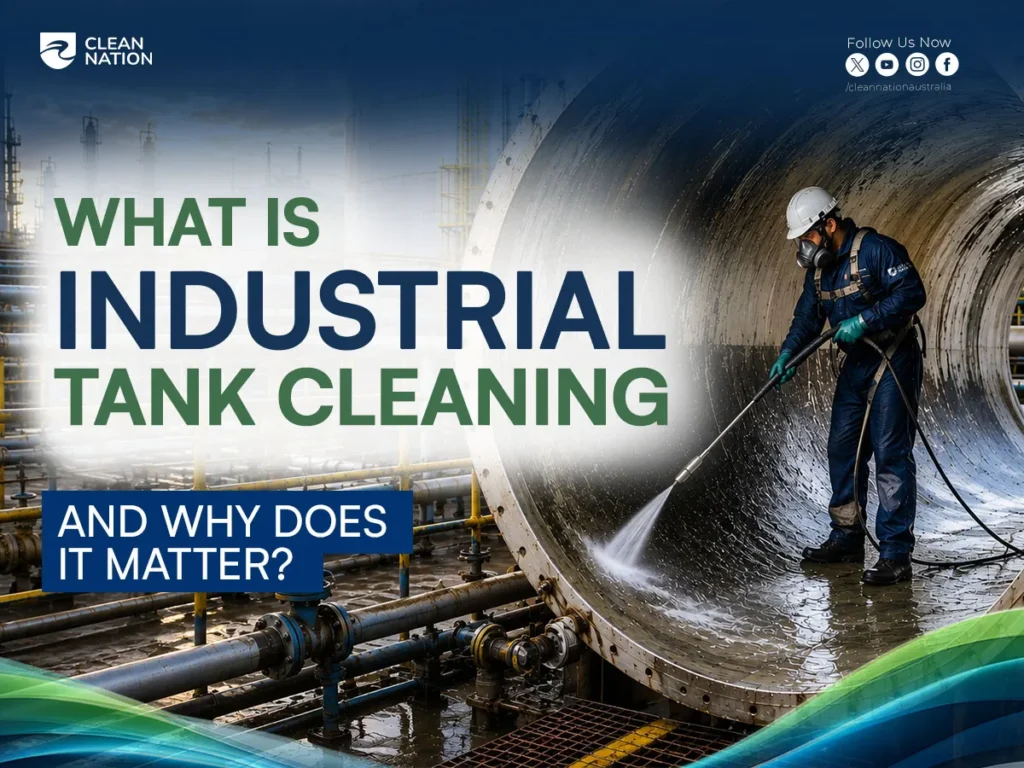
Industrial tank cleaning removes sludge, scale, rust, and chemical buildup from inside storage tanks and process vessels. It’s a regular part of tank maintenance, not a one-time job.
Industrial tank cleaning removes sludge, scale, rust, and chemical buildup from inside storage tanks and process vessels. It’s a regular part of tank maintenance, not a one-time job.
Buildup does more damage than it looks like. Over time, it wears down tank integrity from the inside, even when the tank looks fine on the outside. That’s why businesses across the country rely on a trusted cleaning service in Australia to keep their equipment compliant and running.
This is why industrial tank cleaning is important. It protects three things:
- Asset protection: clears corrosive residue before it damages tank walls and linings.
- Operational reliability: fewer unexpected failures, steadier performance.
- Equipment longevity: well-maintained tanks last much longer.
Skip cleaning, and you risk production continuity too. A tank that fails inspection or springs a leak can shut down a whole line without warning. That costs far more than a scheduled clean.
Extended equipment lifespan doesn’t happen on its own. It comes from staying ahead of buildup, not reacting after something breaks.
At Clean Nation, this is the goal behind every job: protect the asset, keep operations running, and get more years out of your equipment.
Before You Start: Pre-Cleaning Checklist
Every tank cleaning job starts with proper planning. Risk assessments, tank inspection, and hazard identification come first, before any equipment gets set up.
A few things need to happen before work begins:
- Tank inspection: check the tank’s condition and confirm access points.
- Residue assessment: work out what’s inside and how much buildup there is.
- Cleaning method selection: pick the right approach based on the tank and residue type.
- Tank accessibility: confirm how the crew and equipment will reach the tank.
- Trained personnel and qualified operators: only put people on the job who are certified for it.
- Safety procedures: have every step signed off before work starts.
Skipping this stage is where most problems start. A few extra minutes here prevent bigger issues once the job is underway.
Identifying Tank Contents and Residue Type
Know what’s inside the tank before anyone touches it. Every tank holds different risks, so residue type evaluation comes first.
- Check for sludge, scale deposits, and industrial deposits built up on the walls.
- Look for chemical residues or other harmful substances left behind by the last product stored.
- Note if the tank held heavy liquids; these often need extra time and a stronger cleaning method.
This step decides what tank contamination removal method makes sense. Guessing at this stage leads to the wrong equipment on site and wasted time.
Confined Space Entry Requirements
Most industrial tanks count as confined spaces. That means confined space entry rules apply under AS 2865 and AS/NZS 2865:2009, Australia’s confined space safety standards.
Before anyone goes near the access point:
- A permit-to-work system must be signed off first.
- A standby rescue person needs to be on site the whole time.
- Only trained staff should enter, and no-man entry systems should be used wherever possible to avoid entry altogether.
Following these steps isn’t just about WHS compliance; it’s what keeps the crew alive. Isolation protocols should be locked in before work starts, not adjusted on the fly.
Atmospheric Monitoring and Gas Testing
Toxic gas and low oxygen are the biggest risks in confined space work. Atmospheric monitoring isn’t optional; it has to happen before entry and continue throughout the job.
- Use multi-gas detectors or sniffer detectors to check oxygen levels.
- Test for Lower Explosive Limit (LEL) and Hydrogen Sulfide (H2S), two of the most dangerous readings to miss.
- Run oxygen deficiency monitoring continuously, not just once at the start.
- Use real-time gas detection so any change in conditions gets caught immediately.
Hazardous atmosphere control means ventilating the tank and retesting before anyone steps inside. If readings fall outside the safe range at any point, work stops until it’s fixed.
Step-by-Step: How to Clean an Industrial Tank
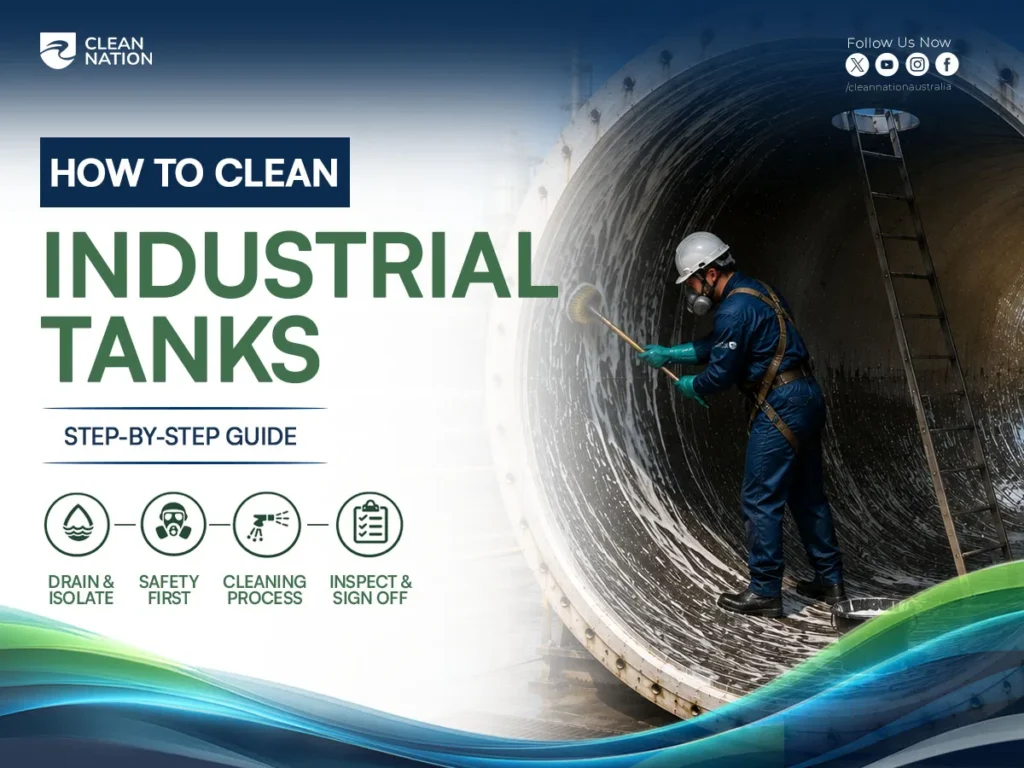
Once the pre-cleaning checklist is done, the actual work follows a clear sequence. Tank draining, system isolation, and the right combination of high-pressure cleaning, vacuum cleaning, and sludge removal services make up the core of the job.
Good industrial waste management and attention to cleaning efficiency run through every step below. The goal is a deep cleaning process that meets industrial hygiene standards without cutting corners.
Step 1 – Drain and Isolate the Tank
Start with tank draining. Empty the tank fully before any work begins.
Next comes system isolation. Lock out connected pipework so product can’t flow back in while the crew is working. This step follows strict isolation protocols and standard safe operating procedures.
- Open the tank access flange to prepare for entry or equipment setup.
- Confirm all connections to other tank vessels are shut off.
- This step supports risk reduction across the whole job, not just this stage.
Some jobs follow full decommissioning procedures if the tank is coming out of service for an extended period. Either way, this step protects the rest of the industrial operations on site while cleaning is underway.
Step 2 – Ventilate and Test the Atmosphere
Before anyone enters or equipment goes in, atmospheric testing confirms the air is safe.
- Run gas monitoring and oxygen monitoring together, not one or the other.
- Ventilate the tank to support vapor suppression if fumes are present.
- This step is central to hazardous environment cleaning; skipping it is the fastest way to create an incident.
Where possible, confined space entry prevention methods are used so no one has to step inside. If entry is unavoidable, atmospheric test results must confirm safe conditions first.
Emergency preparedness should be in place before this step, not arranged afterward. This is basic workplace safety; no shortcuts.
Step 3 – Choose Your Cleaning Method
Cleaning method selection depends on the residue type identified earlier. This is also where cleaning equipment selection happens.
- Match the method to the job: advanced cleaning techniques for heavy buildup, simpler tank cleaning solutions for lighter jobs.
- Bring in the right industrial cleaning equipment, jetting units, vacuum systems, or chemical tools.
- Specialist cleaning techniques may be needed for hard-to-reach areas or unusual tank shapes.
The right choice here drives precision cleaning and better cleaning efficiency through the rest of the job. Modern tank cleaning technology, including remote and automated systems, often reduces both time and risk.
Step 4 – Remove Sludge and Residue
This is the core of the clean. Sludge removal and sludge extraction clear out what’s built up inside the tank.
- Residue removal and sediment extraction target the layers stuck to tank walls and the base.
- Heavy residue removal may need repeat passes with high-pressure equipment.
- Tank descaling deals with mineral buildup that water alone won’t shift.
- Sludge buildup removal and hydrocarbon removal apply where fuel or oil residue is present.
Contamination removal at this stage should leave the internal surface ready for inspection, not just visibly cleaner.
Step 5 – Rinse and Inspect
After internal tank cleaning, the tank gets rinsed and checked before it’s cleared for use again.
The tank inspection process typically includes:
- Camera-assisted inspection or borescope inspection to check areas hard to see by eye.
- Structural inspection and tank lining inspection to catch cracks or wear.
- Corrosion inspection services where rust or pitting is a concern.
Visual monitoring throughout this step supports proper surface preparation, especially if repairs or recoating come next.
Step 6 – Dispose of Waste Water and Residue Compliantly
Sludge, chemical residue, and rinse water all need proper waste disposal management. This isn’t optional; it’s a legal requirement.
- Contaminated wastewater treatment happens before any water is released or transported.
- Liquid waste disposal and sludge disposal must go through licensed channels.
- Use licensed waste transport to move waste offsite, backed by waste classification certificates.
- Some waste types need trackable waste documentation, particularly in NSW.
EPA-compliant waste disposal protects the business from fines and keeps the job aligned with responsible waste handling standards.
Step 7 – Sign Off and Return to Service
The last step is return-to-service preparation. The tank isn’t done until it’s checked, signed off, and documented.
- Complete a final inspection to confirm the tank is ready.
- Confirm operational readiness before reconnecting or refilling.
- Quality assurance and performance verification checks close out the job properly.
- Complete a treated water refill if the tank needs to go straight back into use.
Keep documentation records and inspection records on file. This supports compliance certification and gives you proof of the work if an auditor or insurer ever asks for it.
Comparing Tank Cleaning Methods
| Method | Best For | Entry Required? | Key Notes |
| High-pressure water jetting | General sludge, scale, most tank types | Sometimes | Uses 3,000 bar water pressure up to 40,000 psi; 3D heads give 360° coverage |
| Chemical cleaning | Grease, oil films, mineral scale | Sometimes | Degreasers/neutralisers break down residue; needs strict handling |
| Steam cleaning | Biofilm, microbial buildup, food-grade tanks | Sometimes | Thermal process, supports sanitisation and hygiene standards |
| Manual entry cleaning | Small tanks, tight or hard-to-reach spots | Yes | Highest risk method, needs trained technicians and full confined space controls |
| Robotic/automated cleaning | Large tanks, hazardous contents | No | Removes human entry risk entirely; semi- to fully-automated options |
| Clean-in-Place (CIP) systems | Food, dairy, chemical process tanks | No | Built-in closed-loop system, cleans without opening the vessel |
Want me to keep this same table format consistent across the rest of the document, or add a “relative cost” or “cleaning time” column too?
Safety Precautions During Industrial Tank Cleaning
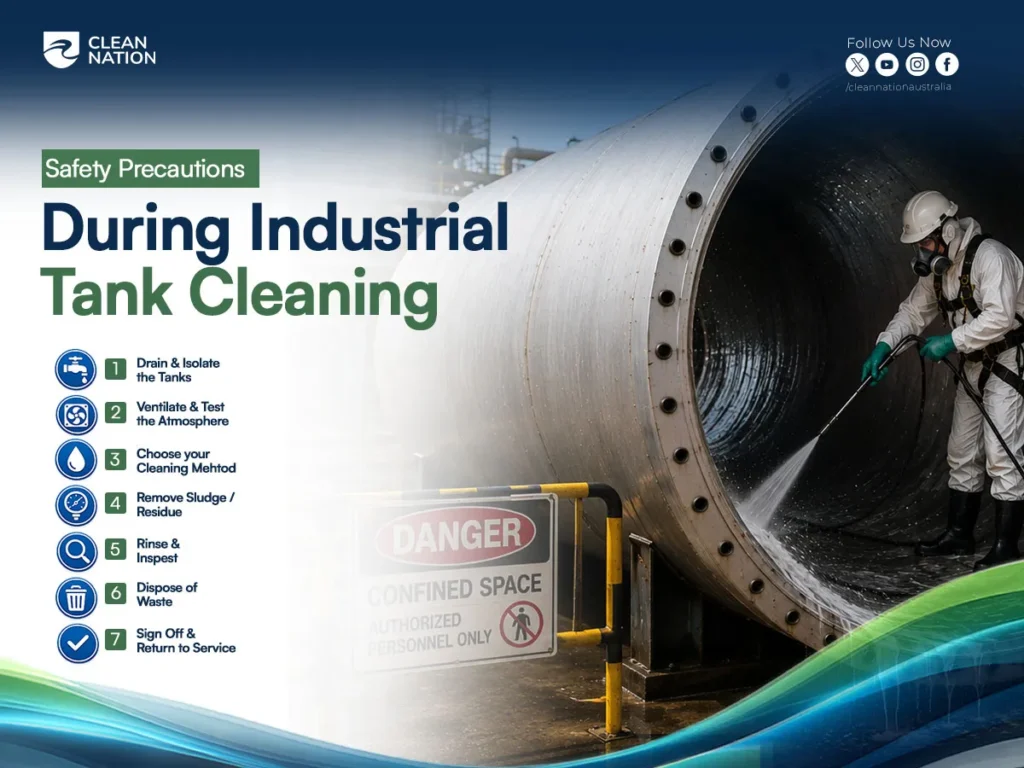
Tank cleaning is one of the highest-risk jobs on an industrial site. Strong safety compliance starts with WHS regulations and follows through every step of the job, not just the parts that feel dangerous.
Every job should run on risk management principles, starting with a proper hazard assessment before work begins. Sites that follow Australian WHS laws closely tend to have far fewer incidents than those treating safety as a checkbox exercise.
Good safety management systems tie all of this together. They cover planning, training, equipment checks, and sign-off, not just PPE on the day. The aim across the industry is a zero-incident safety approach: no near misses treated as acceptable, no shortcuts under time pressure.
None of this works without the right safety equipment on hand and technicians trained to industrial safety standards from day one.
PPE and Confined Space Protocols
Personal protective equipment (PPE) is the last line of defence, not the first. It still has to be right for the job.
- Waterjet PPE for high-pressure cleaning work, rated for the pressures being used.
- Breathing protection equipment for any job with fumes, dust, or low oxygen risk.
- Self-Contained Breathing Apparatus (SCBA) or supplied-air respirators for confined space entry.
- Protective safety gear covering hands, eyes, and body from chemical splash or debris.
Every confined space job runs through confined space safety systems before entry is approved. This includes operator protection measures like standby rescue and communication checks.
Technicians should hold current safety certification for the equipment and environment they’re working in. A certificate that’s expired is the same as no certificate at all.
Common Hazards: Toxic Fumes, Oxygen Deficiency, Flammability
Three hazards cause most tank cleaning incidents. All three can be prevented with proper monitoring.
Toxic fumes
- Toxic gas monitoring should run continuously, not just at the start of the job.
- Hazardous vapor management matters most with chemical residue or fuel tanks.
- Watch for oxidized hydrocarbons and other hazardous materials that release vapour as they’re disturbed.
Oxygen deficiency
- Confined spaces can lose breathable oxygen fast, often without any warning sign.
- This is why hazardous environment management includes constant air testing, not a single check before entry.
Flammability
- Explosive atmosphere prevention and flammable vapour control are critical in fuel and chemical tanks.
- Hydrocarbons and diesel particulates can reach dangerous concentrations quickly in an enclosed space.
- Any spark risk, tools, static, or equipment needs to be ruled out before work starts.
Equipment Checklist: DIY vs Professional Cleaning
The right tank cleaning equipment depends on the job size and risk level. Some tasks can be handled with basic industrial cleaning equipment. Others need specialised gear only a professional crew will have on hand.
Core equipment across most jobs includes:
- High-pressure cleaning equipment and pressure washers
- Vacuum systems for sludge and liquid extraction
- Hose reels and cleaning lances for reach and control
- Diesel-powered pumps or electric pumps, depending on site power and location
What You Need for Manual/DIY Methods
Smaller, low-risk jobs can sometimes be handled without bringing in a full contractor team. Even then, the basics matter.
- Pressure washing tanks with the right lance setup for the residue type
- Cleaning lances and waterjet lances sized for the tank
- Remote control units where available, to limit manual handling
- Safety equipment appropriate for the tank’s contents
- Industrial vacuum services for removing loosened sludge
Before starting any manual cleaning, complete proper hazard identification and follow documented risk assessment procedures. Skipping this step is the most common mistake on DIY jobs.
When to Call a Professional Service
Some jobs are too risky, too large, or too regulated to handle without expert help. Call professional tank cleaners if:
- The tank held hazardous chemicals, fuel, or unknown contents.
- Confined space entry is required.
- You need compliance documentation signed off by qualified personnel.
- The job involves large tanks, difficult access, or heavy sludge buildup.
An established industrial cleaning company brings expert tank cleaning technicians, proper equipment, and the training needed to do the job safely the first time.
Working with industrial cleaning services in Australia that know the relevant standards saves time and reduces risk. A reliable industrial cleaning partner offers complete solutions from cleaning through to waste disposal, not just the clean itself.
Choosing between industrial cleaning contractors comes down to track record, safety certification, and whether they handle the full job, not just part of it.
Environmental Compliance and Waste Disposal
Tank cleaning waste isn’t ordinary rubbish, and treating it that way is one of the fastest ways to run into trouble. Strong environmental compliance protects the business from fines and keeps operations running without interruption.
In New South Wales, the NSW EPA (Environmental Protection Authority) sets the rules for how tank cleaning waste gets classified, transported, and disposed of. Businesses across the state rely on experienced industrial cleaning services in New South Wales to stay compliant from collection through to final disposal.
Good waste management solutions start with correct EPA waste classification from the first day of the job, not worked out after the fact. Sites working toward the ISO 14001 Environmental Management Standard build this into their processes from the start, rather than treating it as an afterthought.
Keep waste disposal records for every job. Auditors and insurers will ask for them, and having clean documentation on hand makes that process painless. Meeting compliance standards consistently is what separates a reliable operation from one constantly playing catch-up.
EPA/State Waste Disposal Requirements
Getting rid of tank cleaning waste properly involves more steps than most people expect.
- Waste must be handled through EPA-compliant waste disposal channels from collection to final treatment.
- Discharge into sewer or stormwater systems usually requires trade waste agreements with the local water authority.
- Only licensed waste transport operators can legally move hazardous or classified waste offsite.
- Waste needs to reach approved waste treatment facilities, not just any disposal site.
- Waste classification services determine whether material falls under Category A waste or Category B waste; this affects how it’s handled and where it can go.
- In NSW, disposal activity is governed by the Protection of the Environment Operations Act 1997, and sites can face regulatory audits to confirm compliance.
Getting classification wrong at the start can mean waste ends up at the wrong facility, which creates compliance problems that are far harder to fix after the fact.
What Happens to Contaminated Water After Cleaning
Rinse water and wastewater from tank cleaning almost always need treatment before they can go anywhere.
- Contaminated water disposal starts with proper wastewater treatment tank cleaning procedures on site.
- Dewatering units separate solids from liquid, reducing the volume that needs further treatment.
- Onsite filtration systems handle a portion of the treatment before water leaves the site.
- Remaining contaminated water is transported to offsite waste disposal facilities for full treatment.
- Hazardous liquid removal is treated as a separate process from general wastewater, given the higher risk involved.
Good operators build in waste minimisation wherever they can, reducing the total volume of contaminated water rather than just treating whatever comes out. This lines up with broader sustainable waste practices and supports water conservation across the site, cutting disposal costs and environmental impact at the same time.
How Often Should Industrial Tanks Be Cleaned?
There’s no single answer here. Tank cleaning frequency depends on what’s stored, how the tank is used, and what standards apply to your industry.
As a general guide:
- General storage tanks, cleaning every 2–3 years, adjusted based on inspection results.
- Fire suppression tanks, cleaning every 5 years, in line with fire tank cleaning every 5 years requirements under AS 1851.
- Food and dairy tanks often follow batch-based cleaning schedules, cleaned after every production run or on a strict rotation.
Frequency should sit inside a proper maintenance schedule, not get decided ad hoc when a tank starts causing problems. Sites with scheduled tank maintenance programs catch buildup early, before it turns into a bigger job.
Preventive maintenance works better than reactive cleaning every time. Waiting until a tank fails inspection or starts leaking almost always costs more than staying ahead of it.
Between full cleans, annual tank inspections and routine checks help track how fast buildup is forming. If sludge or scale is building up faster than expected, it’s a sign the cleaning interval needs to shorten, not a reason to push the next clean back further.
How to Keep Your Tank Clean for Longer?
A good clean only lasts if you look after the tank between services. A few habits make a real difference to how fast buildup returns.
- Filter incoming product. Stopping debris and contaminants at the inlet means less sediment settles inside the tank.
- Control temperature where possible. Heat speeds up microbial growth and chemical breakdown, especially in fuel and oil tanks.
- Check for water contamination regularly. Water sitting at the base of fuel tanks is what causes “diesel bug” and microbial buildup.
- Inspect more often than you clean. A quick visual or camera check between full cleans catches problems early, before they turn into heavy sludge.
- Fix leaks and corrosion fast. A small crack or rust spot gets worse fast and gives contaminants somewhere to collect.
- Keep vents and seals in good condition. Poor sealing lets in dust, moisture, and outside contaminants that speed up buildup.
- Match your cleaning method to the tank’s use. A tank that’s cleaned the first time properly, using the right method, tends to stay cleaner longer than one rushed through with the wrong approach.
None of this replaces scheduled cleaning. It just stretches the time between full cleans and keeps the tank in better shape when the next one is due.
Cost of Industrial Tank Cleaning
Cost varies a lot by tank type, size, and condition. Here’s a general guide:
- Standard water tanks: $400–$9,000+. A 5,000L tank runs $400–$900; a 50,000L tank can reach $1,800–$3,500.
- Fuel and fire protection tanks: $2,000–$8,000+, mostly driven by hazardous waste removal and access difficulty.
- Food-grade silos (CIP systems): $3,000–$9,000, based on sanitation requirements.
- Large industrial reservoirs: can run $5,000 for small units up to $35,000+ for large-scale tanks. A 50,000L diesel tank often costs $8,500–$12,000.
What drives the price:
- Tank size: bigger tanks take more time and equipment.
- Access difficulty: manual entry or divers cost more than remote jetting.
- Residue type: hardened or hazardous sludge takes longer and adds to disposal costs.
- Waste disposal, licensed transport, and treatment add to the total.
- Downtime and lost production time often cost more than the clean itself.
Get a proper site assessment before locking in a quote. Skipping this step usually means the price changes once the job starts.
Cheapest isn’t always best. Choosing the right method the first time cuts downtime and saves money over the tank’s lifespan, not just on this one clean.
Why Choose Clean Nation for Industrial Tank Cleaning?
What sets Clean Nation apart: Expert tank cleaning technicians trained, certified, and experienced with confined space work. Curious what that kind of specialised expertise is worth in the industry? See our breakdown on What is the Average Salary for Industrial Cleaners in Australia?
What sets Clean Nation apart:
- Expert tank cleaning technicians trained, certified, and experienced with confined space work.
- Complete cleaning and disposal solutions, including cleaning, inspection, and compliant waste removal in one job.
- End-to-end industrial services: no need to juggle multiple contractors for one project.
- Australia-wide industrial services support across states, not just one region.
- Compliant industrial cleaning solutions: every job follows current WHS and EPA requirements.
For businesses looking for reliable industrial tank cleaners in Australia, Clean Nation offers a single point of contact from first assessment through to final sign-off. See our industrial cleaning work in action.
Client experience with Clean Nation
A manufacturing facility brought in Clean Nation, a trusted industrial cleaning service in Sydney, to clean several process tanks during a scheduled shutdown. The window was tight, and any delay would push the whole plant restart back.
Clean Nation’s industrial services team combined high-pressure jetting with manual cleaning for one hard-to-access tank. Waste was classified, transported, and disposed of through licensed channels, with full documentation supplied for the client’s compliance file.
Clean Nation applies the same approach across food processing plants and chemical processing sites, where turnaround cleaning has to happen fast and without cutting corners on safety.
The result: all tanks passed inspection and returned to service on schedule. No extension to the shutdown, no lost production time beyond what was planned. Read more client reviews to see how Clean Nation delivers on real industrial sites across Australia.
This is the standard Clean Nation works to on every job: production reliability, operational efficiency, and minimal disruption to the client’s operations, whatever the site or industry.
FAQs
What signs indicate a tank needs cleaning?
Watch for reduced storage capacity, slower flow rates, unusual odours, discoloured product, or visible sediment when the tank is inspected. A failed atmospheric or lining inspection is also a clear signal it’s overdue.
Does tank cleaning require shutting down the entire plant?
Not always. Many jobs are scheduled around a planned shutdown or turnaround window, but robotic and remote cleaning methods can sometimes clean a tank while the rest of the site stays operational.
What happens if a tank fails a compliance inspection?
The tank gets flagged for immediate cleaning or repair before it can return to service. Operating a non-compliant tank risks fines, insurance issues, and in some cases forced shutdown until it’s fixed.
Can one contractor clean different tank types, like fuel, chemical, and food-grade tanks?
Yes, but the contractor needs experience across all three. Each tank type has different residue, safety, and hygiene requirements, so check a provider’s track record before assuming they can handle every type.
What’s usually included in a tank cleaning quote?
A proper quote covers labour, equipment, waste classification, and disposal. It should also include the site risk assessment. If disposal or documentation isn’t listed, ask before signing; leaving it out often means extra costs later.
Conclusion
Cleaning an industrial tank properly takes planning, the right method, and strict safety and compliance checks at every step. Get it right, and you protect your equipment, avoid costly downtime, and stay on the right side of Australian regulations.
If your tank is overdue for a clean or you’re not sure which method fits your site, Clean Nation can help. Contact Clean Nation today for a free site assessment and a straight answer on cost, timing, and the right approach for your tank.