

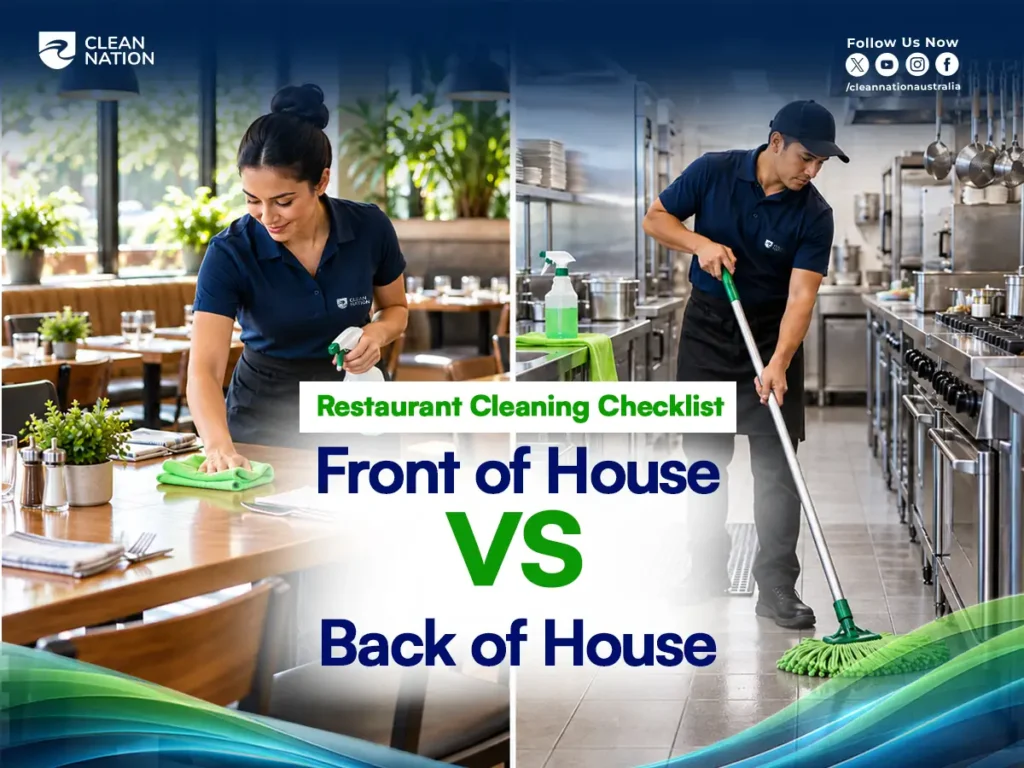
A restaurant can have spotless dining tables while grease, food scraps and spills are building up behind the kitchen doors. Both areas matter, but they need different cleaning routines.
A restaurant cleaning checklist helps staff know what to clean, when to clean it and who is responsible. Front of house cleaning focuses on areas customers use, while back of house cleaning covers food preparation spaces, cooking equipment and kitchen storage.
This guide breaks down both areas, with practical checklists, cleaning schedules and food safety tips for restaurants across Australia.
What Is the Difference Between Front of House and Back of House Cleaning?
Front of house (FOH) covers the spaces customers see and use. These usually include the entrance, dining area, service counters, bar and customer toilets. Cleaning these areas helps create a comfortable dining experience and keeps frequently touched surfaces hygienic.
Back of house (BOH) includes the kitchen, food preparation benches, storage rooms, wash-up stations and waste areas. Cleaning here focuses more on food safety, grease removal and preventing cross-contamination.
The key difference is the type of risk. A sticky dining table can affect a customer’s experience, while an unclean food preparation bench may contaminate food.
| Cleaning task | Front of house | Back of house |
| Main areas | Dining tables, entrance, bar, toilets | Kitchen, preparation areas, storage |
| Main focus | Customer hygiene and presentation | Food safety and kitchen hygiene |
| Common cleaning | Wiping tables, vacuuming, mopping | Cleaning equipment, sanitising benches, grease removal |
| Cleaning frequency | Before, during and after service | Throughout food preparation and after service |
| Main staff | Waitstaff and cleaning staff | Kitchen staff and cleaning staff |
Both areas need regular cleaning, but they should not rely on the same checklist.
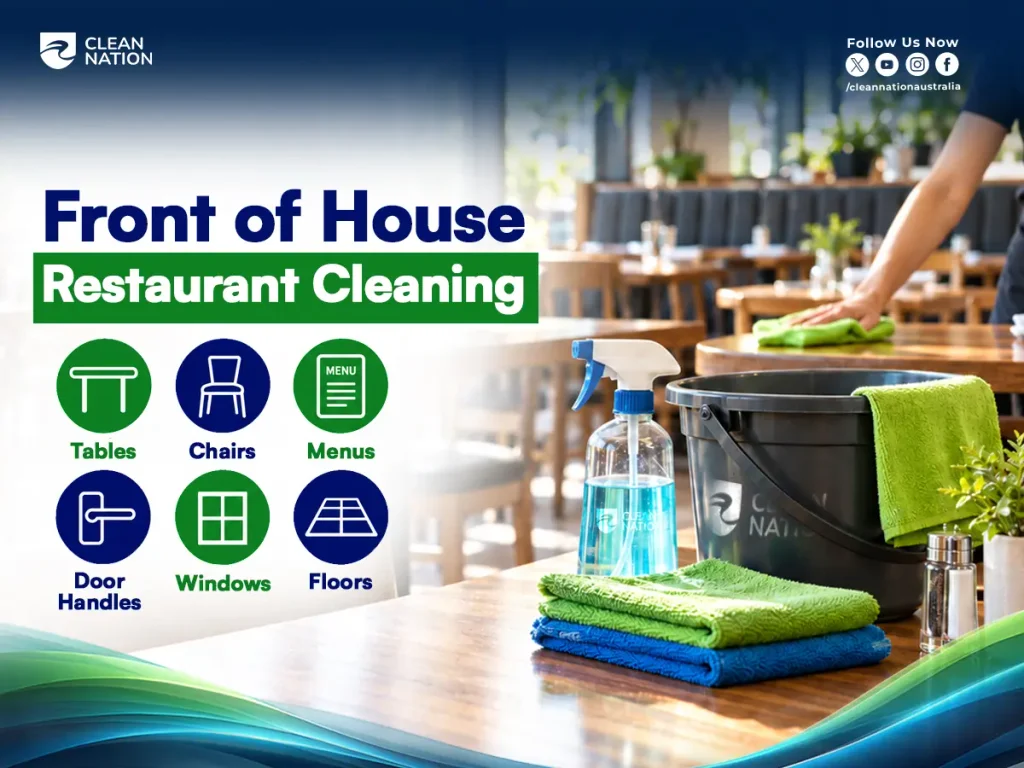
Front of House Restaurant Cleaning Checklist
The dining area is often the first thing customers notice. Dirty tables, overflowing bins or poorly maintained bathrooms can leave a bad impression before food even arrives.
Front of house cleaning should follow three stages: before opening, during service and after closing.
Before Opening: Prepare the Dining Area
Staff should inspect customer areas before the restaurant opens. This allows time to address anything missed during the previous shift.
Before-opening checklist:
- Sweep or vacuum entrance and dining floors.
- Wipe dining tables, chairs and service counters.
- Remove marks from glass doors and windows.
- Clean menus, payment terminals and shared touchpoints.
- Inspect customer toilets and clean where needed.
- Refill soap, toilet paper and hand-drying supplies.
- Check for spills, loose rubbish and floor hazards.
Pay extra attention to entrances and waiting areas. These spaces collect dirt quickly, especially in restaurants with frequent foot traffic.
During Service: Keep Customer Areas Clean
Cleaning does not stop once customers arrive. Staff need to deal with spills, used dishes and frequently touched surfaces without interrupting the dining experience.
During-service checklist:
- Clear used plates, glasses and food scraps promptly.
- Clean and sanitise tables between customers as appropriate.
- Wipe shared menus and condiment containers when needed.
- Respond to drink spills immediately.
- Check bathrooms regularly and restock supplies.
- Empty customer-facing bins before they overflow.
- Keep walkways free from rubbish and obstacles.
For example, a busy restaurant in Sydney CBD may serve hundreds of customers across lunch and dinner. During peak periods, staff may need to clean tables and inspect bathrooms more often than during quieter hours.
After Closing: Complete the Final Clean
Closing time gives staff access to areas that are difficult to clean while customers are present.
After-closing checklist:
- Clean beneath dining tables and chairs.
- Wipe bar counters and customer service stations.
- Spot-clean upholstery and booth seating.
- Sweep and mop hard floors.
- Clean toilets, sinks, mirrors and bathroom fixtures.
- Empty bins and replace liners.
- Check doors, handles and other frequently touched surfaces.
- Inspect the dining area for anything needing further attention.
A final walk-through helps identify missed tasks before the next opening.
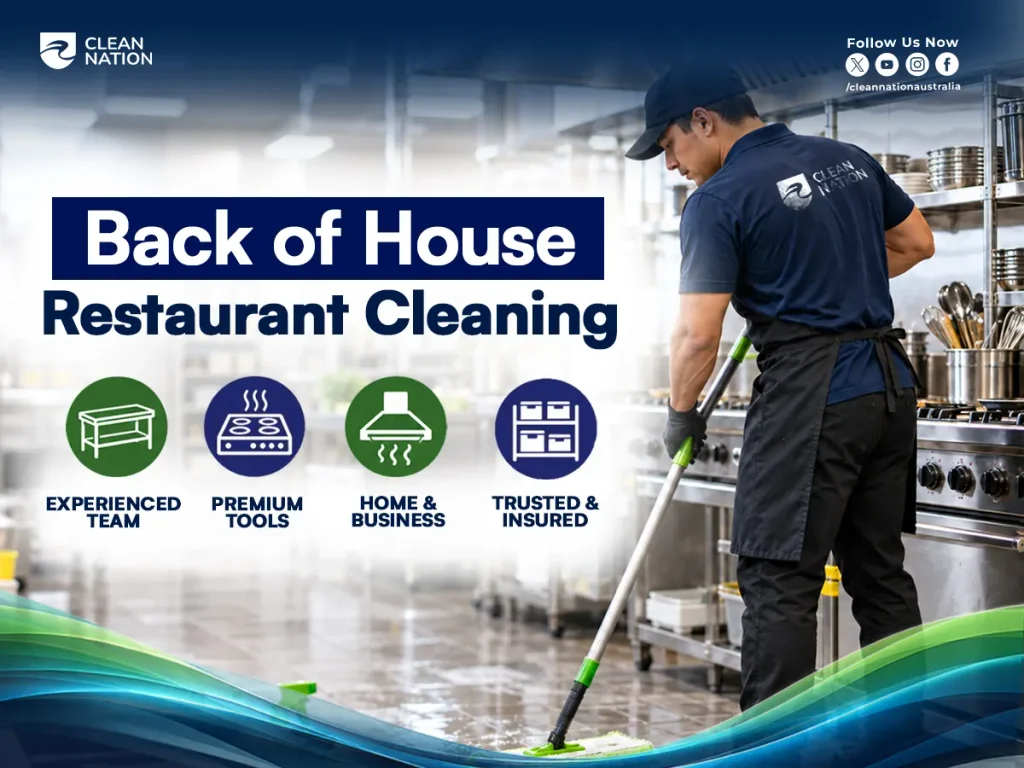
Back of House Restaurant Cleaning Checklist
The kitchen needs a different cleaning approach because food is prepared, cooked and stored there.
Grease, raw ingredients, moisture and food waste create risks that cannot always wait until the end of a shift. Some surfaces must be cleaned and sanitised between food preparation tasks.
Food Preparation Benches and Workstations
Food preparation surfaces come into contact with raw ingredients, utensils and ready-to-eat food. Keeping these spaces clean helps reduce cross-contamination.
Food preparation checklist:
- Remove food scraps and loose debris.
- Wash preparation benches with suitable detergent.
- Rinse surfaces where required.
- Sanitise food-contact surfaces using an appropriate method.
- Clean chopping boards between incompatible food tasks.
- Wash and sanitise utensils as required.
- Keep handwashing basins accessible and supplied.
- Use separate cleaning cloths and tools for different areas.
For example, a chopping board used for raw chicken must be properly cleaned and sanitised before it is used for ready-to-eat vegetables.
Cleaning removes dirt and food residue. Sanitising reduces microorganisms to safer levels. Both steps are needed when food-contact equipment requires cleaning and sanitising.
Cooking Equipment and Grease-Prone Areas
Cooking equipment collects oil, burnt food and grease. If this build-up is ignored, it becomes harder to remove and may create hygiene or fire hazards.
Cooking area checklist:
- Clean grills, cooktops and cooking surfaces.
- Remove grease from accessible splashbacks.
- Clean ovens and removable racks when scheduled.
- Wipe handles and external equipment surfaces.
- Clean accessible grease filters according to the maintenance plan.
- Remove trapped food residue from removable equipment parts.
- Check areas around fryers and cooking stations.
Always allow equipment to cool and follow manufacturer instructions before cleaning.
Specialist exhaust duct cleaning and internal ventilation maintenance should be completed by appropriately qualified contractors rather than treated as ordinary kitchen cleaning.
Cold Storage, Dry Storage and Waste Areas
Food storage areas may look tidy while spills, damaged packaging or loose debris collect behind shelves and equipment.
Storage and waste checklist:
- Wipe refrigerator handles and door seals.
- Clean refrigerator shelving and spills as needed.
- Remove loose debris from dry storage racks.
- Keep food containers and packaging off dirty surfaces.
- Sweep and mop kitchen floors.
- Check accessible floor drains and surrounding areas.
- Empty waste bins and clean lids and contact points.
- Keep cleaning chemicals separate from food and utensils.
- Report visible pest activity or damaged storage areas.
Storage cleaning should be planned around food safety. Staff must protect food from cleaning chemicals and avoid leaving temperature-sensitive ingredients outside safe storage conditions.
Daily, Weekly and Monthly Restaurant Cleaning Schedule
A cleaning checklist becomes easier to follow when tasks are grouped by frequency.
Some areas need attention several times a day, while others can be included in weekly or monthly deep-cleaning plans.
| Frequency | Front of House Tasks | Back of House Tasks |
| Daily and as required | Dining tables, service counters, bathrooms, floors and bins | Preparation benches, cooking surfaces, utensils, sinks and kitchen floors |
| Weekly or as needed | Upholstery spot cleaning, window detailing, skirting boards and fixtures | Storage shelves, accessible equipment interiors, refrigerator seals and splashbacks |
| Monthly or risk-based | Carpet deep cleaning, detailed furniture cleaning and high-level dusting | Cleaning behind equipment, floor scrubbing and scheduled specialist maintenance |
This is a suggested schedule rather than a fixed legal requirement for every task. Restaurants should clean more frequently when food safety risks, spills or high customer numbers require it.
For example, a small café may need less intensive grease cleaning than a restaurant operating several grills and deep fryers. Each business should adjust its routine to match its equipment and daily operations.
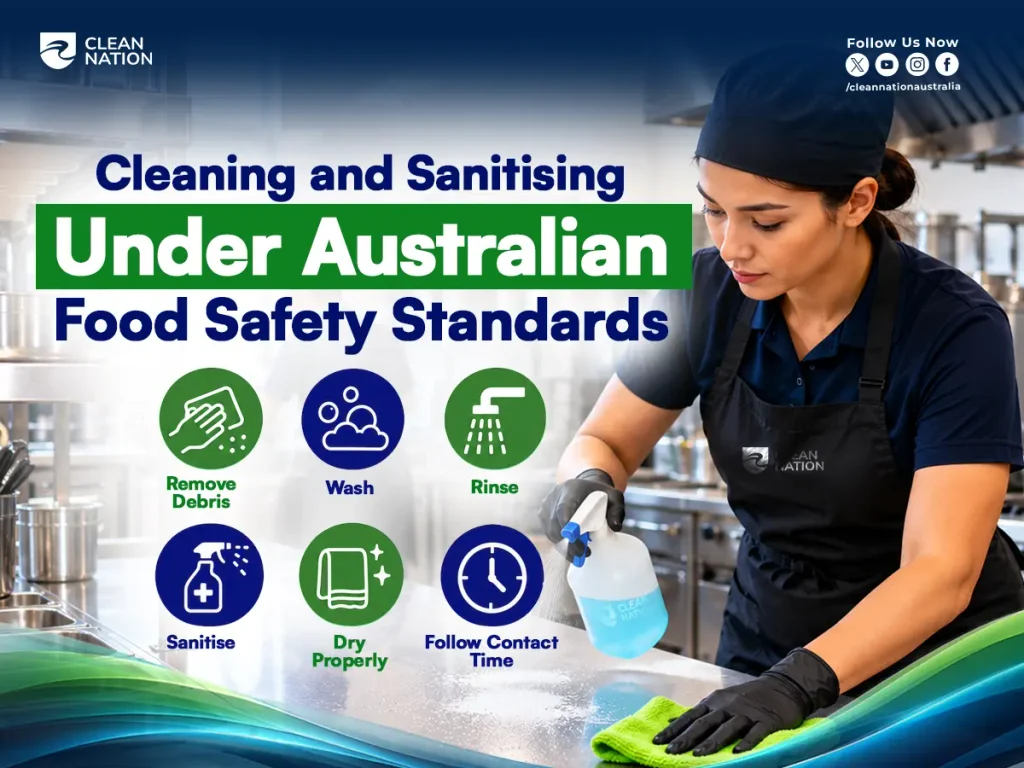
Cleaning and Sanitising Under Australian Food Safety Standards
Restaurant hygiene is not only about making surfaces look clean. Australian food businesses must also follow relevant food safety requirements.
According to Food Standards Australia New Zealand (FSANZ), Standard 3.2.2 requires food premises and equipment to be kept clean, with food-contact surfaces and utensils maintained in a clean and sanitary condition.
Cleaning and sanitising are two separate processes:
- Cleaning removes grease, dirt and food residue.
- Sanitising reduces harmful microorganisms using a suitable method.
A dirty surface should be cleaned before it is sanitised.
How to Clean and Sanitise Food-Contact Surfaces
Use a suitable method for the surface or equipment:
- Remove food scraps and loose debris.
- Wash using an appropriate detergent.
- Rinse away detergent where required.
- Apply a suitable food-contact sanitiser or other approved sanitising method.
- Follow the manufacturer’s instructions for contact time and any final rinse.
- Allow surfaces and equipment to dry appropriately before use.
Restaurants should also choose cleaning products suitable for their surfaces and train staff to use them safely.
Which Australian Food Safety Standards Apply?
Three standards are particularly relevant:
| Standard | What it covers |
| Standard 3.2.2 | Food handling, hygiene, cleaning, sanitising and maintenance |
| Standard 3.2.2A | Additional food safety management tools for certain food service businesses |
| Standard 3.2.3 | Food premises, equipment and facilities |
Under Standard 3.2.2A, some Australian food businesses must also demonstrate that important food safety controls, including cleaning and sanitising, are managed correctly. The requirements depend on the business category and food handling activities.
Who Is Responsible for Restaurant Cleaning Tasks?
A good restaurant cleaning schedule should explain who is responsible for each job.
If responsibilities are unclear, staff may assume someone else has already cleaned an area.
| Team | Typical cleaning responsibilities |
| Front of house staff | Dining tables, service counters, minor spills and shared customer surfaces |
| Kitchen staff | Food preparation benches, utensils, cooking equipment and immediate food safety tasks |
| Shift supervisors | Assign tasks, check completion and report issues |
| Professional cleaners | Agreed routine cleaning, floor cleaning, washrooms and scheduled deep cleaning |
Responsibilities can change depending on restaurant size, staffing and cleaning arrangements.
For example, kitchen staff normally handle immediate food-contact cleaning during meal preparation. A professional cleaning team may clean agreed areas outside trading hours when the kitchen is safe to access.
Managers can use a simple cleaning log with the task name, responsible person, completion time and supervisor’s check.
This also helps identify tasks that are repeatedly missed.
Common Restaurant Cleaning Mistakes to Avoid
Even restaurants with regular cleaning routines can overlook important hygiene problems.
Using the Same Cleaning Tools Everywhere
Using one cloth or mop across toilets, dining spaces and kitchen preparation areas can spread contamination.
Keep cleaning tools separated by area. Colour-coded equipment can make this easier for staff to follow.
Cleaning Only What Customers Can See
A clean dining room does not always mean the kitchen is properly maintained.
Food residue may collect beneath equipment, around storage shelves and behind cooking stations. Include these less visible areas in routine inspections and deeper cleaning schedules.
Leaving Every Task Until Closing
Some cleaning tasks cannot wait until the end of service.
Food preparation surfaces may need cleaning and sanitising between different ingredients. Drink spills should be handled immediately, and customer bathrooms should be checked throughout trading hours.
Using Cleaning Chemicals Incorrectly
Using more detergent or sanitiser than recommended does not necessarily improve cleaning results.
Incorrect dilution, unsuitable products and poor rinsing can create additional risks. Follow product labels, keep chemicals away from food and use appropriate protective equipment.

When Should Restaurants Arrange Professional Deep Cleaning?
Daily cleaning manages routine mess, but some jobs need more time, equipment or specialised cleaning methods.
Restaurants may need additional cleaning support when:
- Grease accumulates around difficult-to-reach kitchen surfaces.
- Floors require detailed machine scrubbing.
- Dining upholstery needs deeper cleaning.
- High-traffic areas cannot be cleaned thoroughly during service.
- A scheduled hygiene inspection identifies areas needing attention.
Professional cleaners can help with agreed routine or after-hours cleaning. Specialist exhaust duct maintenance and other technical tasks may require appropriately qualified contractors.
For restaurants and cafes needing extra support, Clean Nation offers restaurant and cafe cleaning services for hospitality premises.
Businesses operating in Sydney can also explore commercial cleaning services in Sydney for broader commercial property cleaning requirements.
Before booking, confirm the cleaning scope, equipment access, exclusions and any tasks that require specialist maintenance.
Frequently Asked Questions
1. Can the same sanitiser be used in front of house and back of house?
It depends on the product and intended surface. Food-contact areas may require a sanitiser approved for that use, along with specific dilution and rinsing instructions. Always follow the label before applying the same chemical in different areas.
2. How should restaurants clean fabric chairs and booth seating?
Start by vacuuming crumbs and loose dirt. Treat stains with a suitable upholstery product and avoid excessive moisture. Restaurants with heavily used fabric seating may need professional upholstery cleaning to manage stubborn stains and odours.
3. Can restaurants arrange deep cleaning without closing for an entire day?
Yes, some cleaning work can be scheduled after closing or during quieter periods. However, certain tasks involving strong chemicals, equipment movement or restricted kitchen access may require affected areas to remain closed until they are safe to use.
4. What should restaurant staff do after a customer vomits in the dining area?
Keep customers away from the affected space and use an appropriate bodily-fluid cleaning and disinfection procedure. Staff should wear suitable protective equipment, handle contaminated waste safely and follow relevant public health guidance before reopening the area.
5. Should every restaurant use the same cleaning checklist?
No. A restaurant should adapt its checklist to its layout, kitchen equipment, menu, customer numbers and food safety risks. A small café, takeaway shop and large restaurant may share basic hygiene tasks but need different cleaning schedules.
Keep Your Restaurant Ready for Every Service
A practical restaurant cleaning checklist helps staff manage both customer-facing spaces and busy kitchen areas without overlooking essential tasks. Front-of-house cleaning keeps dining areas comfortable and presentable. Back-of-house cleaning supports safe food handling, equipment hygiene and better control of grease and waste.
The best results come from clear responsibilities, regular inspections and a cleaning schedule that fits the restaurant’s operations. If your restaurant needs extra cleaning support, Clean Nation can help you discuss cleaning requirements for your premises. Call +61 480 810 142 or use the online enquiry form to request a quote.