


To choose a commercial cleaning company for your washrooms, check its experience, insurance, staff training, cleaning methods and service quality. Ask for a written quote that explains the cleaning tasks, visit frequency, supplies and extra charges. Compare at least three providers using the same requirements before signing a contract.
The right company should understand your washrooms, offer a suitable cleaning plan and explain how it handles missed tasks or unexpected problems.
This guide covers what Australian businesses should look for, important questions to ask commercial cleaners and how to compare companies before hiring.
Why Choosing the Right Commercial Washroom Cleaning Company Matters
Commercial washrooms are used by employees, customers and visitors throughout the day. Poor cleaning can lead to unpleasant smells, dirty surfaces, empty soap dispensers and complaints.
A company that cleans a small office bathroom may not have the same experience as one servicing a busy shopping centre or large commercial toilet block.
That is why businesses should look beyond general cleaning claims.
An experienced commercial washroom cleaning provider should understand different fixtures, hygiene risks, cleaning equipment and the needs of busy facilities.
The goal is to find a company that can maintain the agreed cleaning standard, not simply offer the lowest hourly rate.
What Should You Know Before Contacting a Cleaning Company?
Before requesting quotes, prepare a short description of your facilities.
This helps commercial cleaning companies understand the work and provide more accurate estimates.
Include the following details:
- Number of washrooms: How many separate toilet areas need cleaning?
- Fixtures: How many toilet cubicles, urinals, basins and showers are there?
- Property type: Is it an office, restaurant, shopping centre, gym or public facility?
- Daily usage: Approximately how many people use the washrooms?
- Operating hours: Can cleaning take place during business hours or after closing?
- Special requirements: Are there accessible toilets, baby-changing stations or other facilities?
- Existing problems: Are there recurring smells, stains or areas needing extra attention?
For example, a two-cubicle office bathroom may only need a small cleaning team. A shopping centre with several public washrooms could require a different staffing arrangement.
You should also decide which cleaning tasks you want included.
Clean Nation’s Commercial Washroom Cleaning Checklist can help you identify routine and detailed cleaning tasks before requesting quotes.
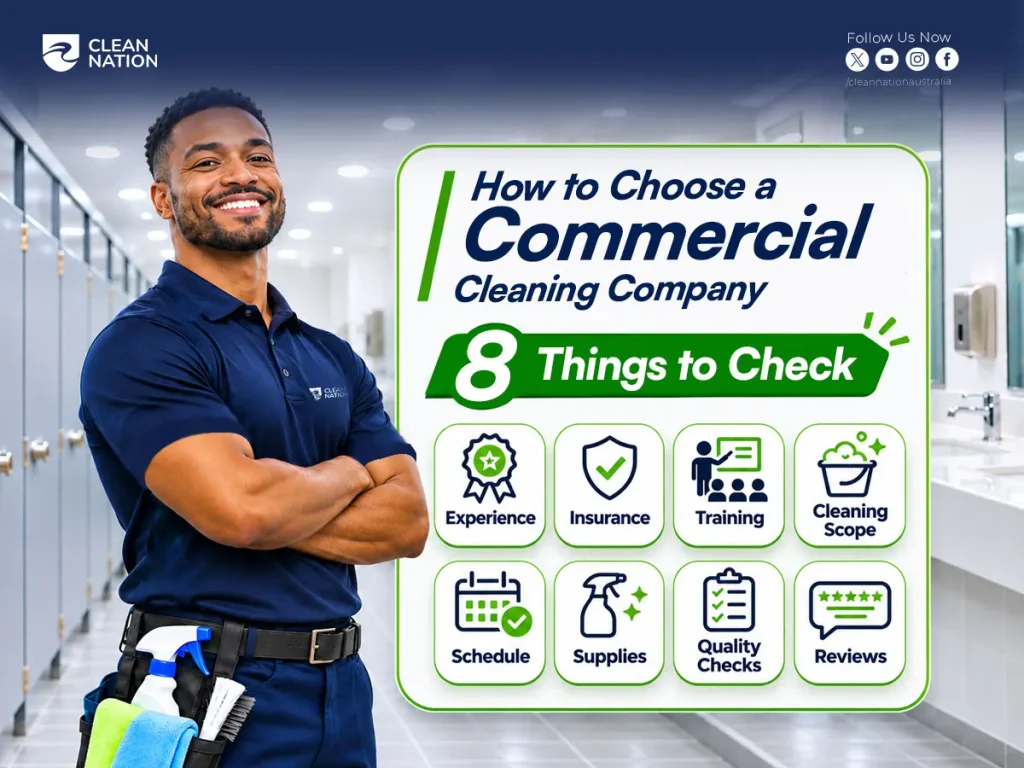
How to Choose a Commercial Cleaning Company – 8 Things to Check
Not every cleaning company offers the same level of service. These eight checks can help businesses select a suitable commercial washroom cleaning contractor.
1. Look for Experience in Commercial Washroom Cleaning
Start by asking whether the company regularly cleans commercial toilets and shared washroom facilities.
Commercial washrooms can be more demanding than residential bathrooms. They often have more fixtures, higher visitor numbers and tighter cleaning schedules.
A suitable provider should understand how to clean different fixtures without damaging surfaces.
Ask about experience with:
- Office toilets and staff amenities.
- Shopping centre washrooms.
- Public toilets and shared facilities.
- Gym showers and changing rooms.
- Restaurant and hospitality washrooms.
For example, a cleaning company experienced with busy retail properties may better understand the need for cleaning around customer traffic.
Relevant experience does not guarantee good results, but it helps you assess whether the provider understands your property.
2. Check Insurance and Business Credentials
Before hiring a commercial cleaning company, ask for evidence of appropriate insurance.
Public liability insurance can protect against certain third-party injury or property damage claims, subject to the policy terms.
Workers compensation arrangements may also be relevant where the company employs cleaning staff.
Ask the provider to confirm:
- Its registered business details and Australian Business Number (ABN).
- Current public liability insurance.
- Relevant workers’ compensation arrangements.
- Any additional insurance or licences required for the agreed work.
You can check a business’s registration status using the Australian Government’s ABN Lookup service.
Insurance needs vary according to the work and circumstances. Do not assume every policy covers every cleaning activity.
A reliable provider should be willing to explain its cover and provide suitable documentation.
3. Ask About Staff Training and Cleaning Methods
Commercial washroom cleaners work around shared surfaces, wet floors and cleaning chemicals.
Ask how the company trains its staff to manage these risks.
For example, equipment used around toilets should be kept separate from equipment used around handwashing areas.
This helps reduce the risk of cross-contamination.
Also ask whether cleaners understand:
- Safe cleaning chemical handling.
- Correct product dilution and contact times.
- Use of suitable personal protective equipment (PPE).
- Safe operation of commercial cleaning equipment.
- Wet-floor signs and slip hazard prevention.
- Safe storage of cleaning products.
Companies using hazardous cleaning chemicals should have suitable procedures and access to relevant Safety Data Sheets (SDS), as required by applicable workplace safety laws.
Some businesses may also need staff screening or site-specific training.
Ask the company to explain its procedures rather than relying on broad claims about professional cleaning standards.
4. Request a Clear Written Cleaning Scope
A written cleaning scope explains exactly what the company agrees to clean.
Without one, different providers may interpret “complete washroom cleaning” differently.
For example, one quote might include regular floor cleaning but exclude detailed grout cleaning.
Another may include restocking dispensers without supplying the consumables.
A clear commercial washroom cleaning agreement should identify the main fixtures and the work included.
| Washroom Area | What to Confirm |
| Toilets and urinals | Which surfaces and fixtures are included? |
| Basins and taps | Are fixtures and surrounding areas cleaned? |
| Floors and tiles | Is detailed grout cleaning included or separate? |
| Mirrors and partitions | Are cubicle surfaces part of every visit? |
| High-touch surfaces | Are handles, locks and flush buttons included? |
| Waste bins | Which bins are emptied and serviced? |
| Washroom supplies | Who refills and purchases consumables? |
The agreement should also explain which tasks are completed routinely and which require separate approval.
This makes it easier to check completed work and compare cleaning companies fairly.
5. Check Cleaning Schedules and Flexibility
A suitable cleaning company should understand when your washrooms need attention.
An office with standard working hours may have different requirements from a restaurant or transport facility operating late into the evening.
Ask whether the provider can offer cleaning visits that match your business hours and visitor numbers.
Also check what happens when your needs change.
For example, a retail business may need extra cleaning during Christmas trading or a major sales event.
The company should explain whether additional visits can be arranged and how they are charged.
For more information about planning cleaning visits, read our guide on how often public toilets should be cleaned in Australia.
6. Confirm Equipment, Products and Washroom Supplies
Commercial cleaning companies do not always include the same products and supplies in their quotes.
Some provide cleaning chemicals and equipment but charge separately for consumables.
Others may offer restocking as part of the agreed service.
Ask who supplies:
- Toilet paper and paper towels.
- Hand soap and dispenser refills.
- Bin liners and general waste supplies.
- Cleaning chemicals and equipment.
- Specialist sanitary waste services.
Sanitary bin servicing may require a separate hygiene provider. It should not be assumed to be part of routine washroom cleaning.
The provider should also confirm whether its cleaning products are suitable for your washroom surfaces.
For example, certain stone finishes, grout and fixtures can be damaged by unsuitable chemicals.
Clear supply arrangements help businesses avoid unexpected charges.
7. Review Quality Checks and Complaint Handling
A professional cleaning company should have a process for checking completed work.
Ask whether a supervisor reviews cleaning quality and how missed tasks are reported.
A cleaning log can record completed visits, while an inspection can identify problems that require attention.
For example, if customers repeatedly report dirty cubicles, the business should know who to contact and how the cleaning company will respond.
Ask these questions:
- Who supervises the cleaning team?
- How is cleaning quality checked?
- Can the business report missed work?
- Who responds to customer complaints?
- What happens if the regular cleaner is unavailable?
A company should be able to explain its process clearly.
This is especially important for regular cleaning contracts, where service quality needs to remain consistent over time.
8. Check Reviews and References From Similar Businesses
Customer reviews can provide useful information about a cleaning company’s reliability.
However, a high rating alone does not prove that the provider is suitable for your washrooms.
Look for feedback from businesses with similar cleaning needs.
For example, a gym owner may find reviews from other fitness centres more useful than general residential cleaning reviews.
Pay attention to comments about reliability, communication and how problems were resolved.
You can also ask the company for references from commercial clients who have agreed to be contacted.
A short conversation with a relevant client may help you understand how the service works after the contract begins.
What Questions Should You Ask Before Hiring a Commercial Cleaning Company?
Once you have shortlisted suitable commercial cleaners, ask each provider the same questions.
This helps you compare their answers fairly.
| Questions to Ask | What a Useful Answer Should Explain |
| Have you cleaned commercial washrooms like ours? | Relevant experience with similar facilities |
| Will you assess our washrooms before quoting? | How the company checks fixtures, access and workload |
| What cleaning tasks are included? | A written scope with clear inclusions |
| How many cleaner-hours are allowed per visit? | The labour time used to calculate the quote |
| Are cleaning products and consumables included? | Who supplies equipment, chemicals and washroom products |
| What happens if a cleaner cannot attend? | Staff replacement or alternative arrangements |
| How do you manage missed cleaning tasks? | Reporting, follow-up and corrective action |
| Can you provide relevant insurance documents? | Current evidence appropriate to the work |
| What happens if we need extra cleaning? | Availability and additional charges |
| What are your contract cancellation terms? | Notice periods and any applicable fees |
A provider does not need to offer every service.
What matters is whether the company can explain what it will deliver and whether that matches your business’s needs.
How to Compare Commercial Washroom Cleaning Quotes
The lowest cleaning quote is not always the best value.
Two companies may offer different prices because they have included different cleaning hours, equipment or services.
For example, Company A may offer a lower weekly price but allow only one cleaner-hour per visit.
Company B may charge more but include two cleaner-hours and additional cleaning tasks.
Neither quote can be judged fairly without comparing the actual work.
Compare the Same Cleaning Requirements
Ask each shortlisted provider to quote for the same number of washrooms, tasks and cleaning visits.
The comparison should include:
- Total price per visit or month.
- Cleaner-hours allocated.
- Cleaning frequency.
- Included equipment and supplies.
- Additional services and exclusions.
- GST treatment.
- Minimum booking or call-out charges.
If one quote is much cheaper, ask what explains the difference.
The company may be using a more efficient process, including fewer tasks or allowing less cleaning time.
A written explanation helps you decide whether the lower cost represents good value.
Review the Contract Before Signing
Before accepting a cleaning contract, read the terms carefully.
Check the start date, cleaning schedule, payment conditions and the process for changing services.
Also review:
Contract length: Is there a minimum term?
Cancellation: How much notice is required?
Price changes: When can rates change, and how will you be notified?
Extra work: How are additional visits or specialist services approved?
Service concerns: What happens when the agreed work is not completed?
Do not rely on verbal promises that are missing from the written agreement.
Commercial Cleaning Company Comparison Checklist
Use this checklist to compare up to three cleaning companies before making a final decision.
| Selection Criteria | Company A | Company B | Company C |
| Relevant commercial washroom experience | ☐ | ☐ | ☐ |
| Appropriate insurance verified | ☐ | ☐ | ☐ |
| Staff training explained | ☐ | ☐ | ☐ |
| Written cleaning scope provided | ☐ | ☐ | ☐ |
| Cleaning hours clearly stated | ☐ | ☐ | ☐ |
| Equipment and supplies confirmed | ☐ | ☐ | ☐ |
| Quality inspection process explained | ☐ | ☐ | ☐ |
| Complaint handling process confirmed | ☐ | ☐ | ☐ |
| Relevant client references available | ☐ | ☐ | ☐ |
| Contract terms reviewed | ☐ | ☐ | ☐ |
You can mark each item once the company has provided a satisfactory answer or suitable evidence.
A provider with more checked boxes is not automatically the best choice.
Consider which requirements are essential for your property. Insurance, safe work practices and a clear service scope should receive particular attention.
Red Flags When Choosing Commercial Washroom Cleaners
Some warning signs may suggest that a cleaning company is not suitable for your business.
No written cleaning scope: A vague promise to clean the bathrooms makes it difficult to know what is included.
Unclear insurance arrangements: A provider that will not explain its coverage may create unnecessary uncertainty.
Very low quotes without explanation: A low price could mean fewer cleaning hours or important exclusions.
No clear contact person: Reporting problems becomes difficult when nobody is responsible for managing the service.
Unclear contract conditions: Long notice periods, unexpected fees or vague cancellation terms can create problems later.
No suitable safety procedures: A company should be able to explain how it handles cleaning chemicals, wet floors and cross-contamination risks.
One concern does not always mean a provider is unsuitable, but it should be resolved before signing an agreement.
If the answers remain unclear, consider another company.
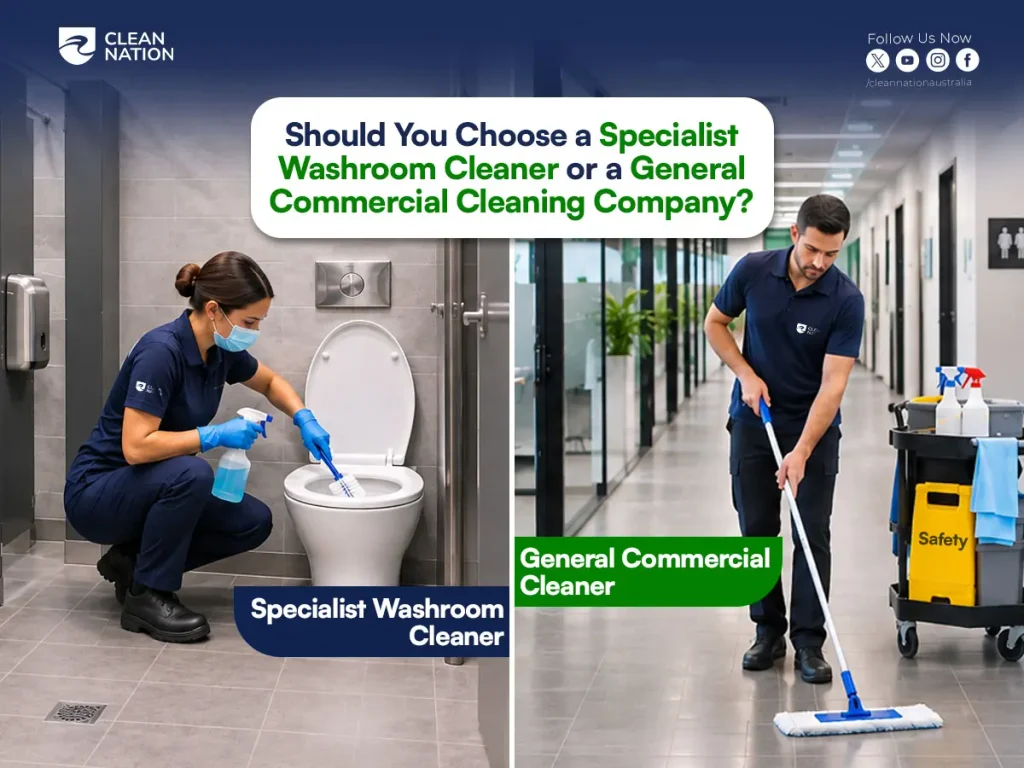
Should You Choose a Specialist Washroom Cleaner or a General Commercial Cleaning Company?
Both options can work, depending on your property.
A specialist washroom hygiene provider may focus on sanitary bins, hygiene products, dispensers or other washroom servicing.
A general commercial cleaning company may offer toilet and bathroom cleaning alongside office, retail or building cleaning.
Some providers offer both.
The best choice depends on the services your business actually requires.
| Business Requirement | What to Look For |
| Routine cleaning of toilets, basins and floors | Commercial cleaning company with washroom experience |
| Cleaning several workplace areas | General commercial cleaning provider |
| Sanitary disposal servicing | Provider offering suitable hygiene waste services |
| Specialist urinal maintenance | Provider experienced with the relevant system |
| Plumbing or drainage repairs | Appropriately licensed plumbing professional |
For example, an office may prefer one cleaning company to handle workstations, kitchens and washrooms.
A busy shopping centre may need separate arrangements for routine cleaning and sanitary waste collection.
Make sure each provider’s responsibilities are clear.
Why Consider Clean Nation for Commercial Washroom Cleaning?
Clean Nation provides professional washroom cleaning services for suitable commercial properties, offices and shared facilities across Australia.
Our published washroom services cover routine toilet and urinal cleaning, basins, floors, high-touch surfaces and other cleaning work based on the agreed scope.
Businesses can discuss their property type, number of washrooms and preferred cleaning arrangements before requesting a quote.
For workplaces that need cleaning across several areas, Clean Nation also offers wider commercial cleaning services.
The right cleaning arrangement depends on your facility’s size, condition, visitor numbers and any additional hygiene requirements.
Request a Commercial Washroom Cleaning Quote
If you are comparing cleaning companies, Clean Nation can discuss your requirements and help you understand the available cleaning options.
Explore our washroom cleaning services in Australia or contact the team to request a tailored quote.
Call +61480810142 or complete the online enquiry form with details about your property.
Frequently Asked Questions
1. Can I arrange a trial clean before signing a long-term contract?
Some cleaning companies may offer a paid trial or one-off service. Ask whether the trial covers your usual washroom requirements and whether its cost is separate from any future contract.
2. Are police checks compulsory for all commercial cleaning staff in Australia?
Not in every cleaning role. Screening requirements depend on the workplace and type of work. Schools, childcare facilities and other sensitive sites may have additional requirements that the cleaning provider must meet.
3. Can one cleaning company service washrooms at several business locations?
Yes, some providers offer cleaning across multiple sites. Ask whether they cover each location and how scheduling, supervision, reporting and invoicing will work under the proposed arrangement.
4. Who is responsible if a cleaner discovers a damaged toilet or leaking tap?
The cleaner should report the problem through the agreed process. Repairs are usually handled by the property owner, manager or maintenance contractor, depending on the contract and the parties’ responsibilities.
5. Can a business change cleaning companies before its contract ends?
It depends on the agreement. Some contracts allow early termination with notice, while others may include fees or minimum terms. Review the cancellation conditions and seek legal advice if the wording is unclear.