

Get three quotes for “warehouse cleaning” and you’ll usually get three different scopes. One company prices a sweep and scrub of the main floor. Another includes racking, docks and the lunchroom. A third quotes for industrial cleaning and asks about your machinery. All three are answering the same request, and none of them is necessarily wrong.
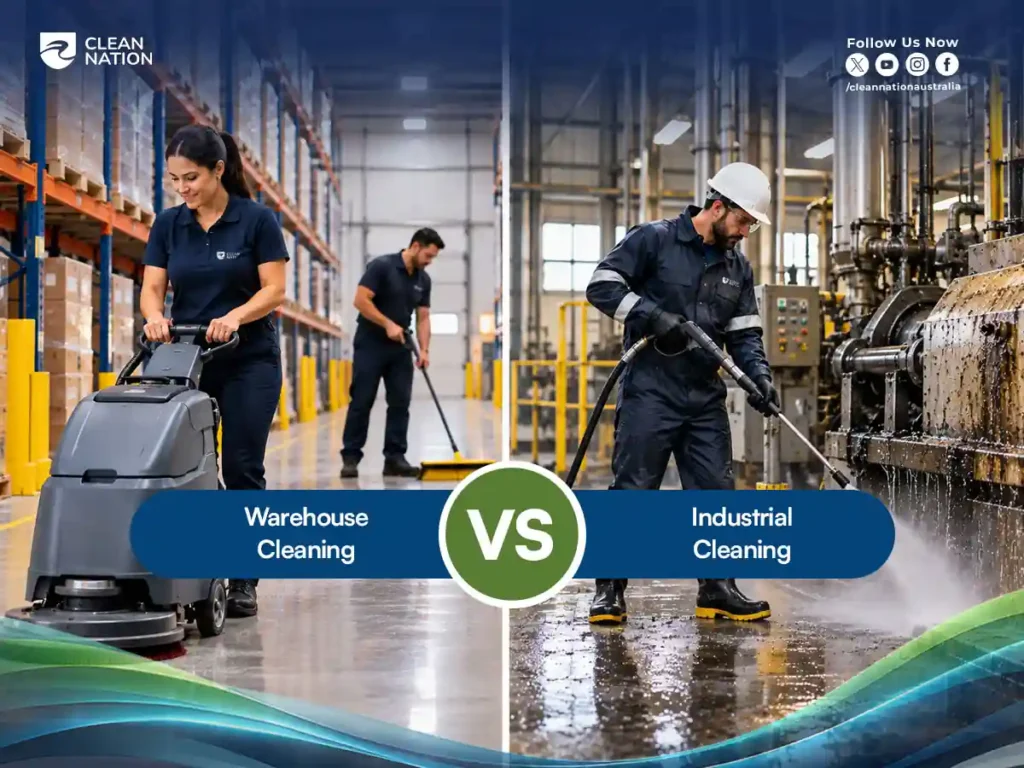
The confusion is understandable, because a warehouse is an industrial-type site. So in the warehouse cleaning vs industrial cleaning question, where does one end and the other begin? The short answer: warehouse cleaning is built around storage and logistics (floors, aisles, docks, racking, dust and packaging waste), while industrial cleaning is built around production (machinery, oil, grease and chemical residue, and equipment that has to be cleaned safely). A lot of sites sit somewhere in the middle, which is why it pays to know which one you’re actually buying.
This guide explains where the two overlap, where they differ, how to tell which one your site needs, and what to ask before you book. If you’re comparing office-style cleaning with industrial work instead, see our guide on the difference between commercial cleaning and industrial cleaning.
Warehouse Cleaning vs Industrial Cleaning – Quick Comparison
| Warehouse cleaning | Industrial cleaning | |
|---|---|---|
| Built around | Storage, picking and dispatch | Production and processing |
| Typical sites | Storage warehouses, distribution centres, logistics hubs | Factories, manufacturing plants, workshops, machinery areas |
| Biggest challenge | Large floor areas, dust, packaging waste, forklift traffic | Grease, oil, chemical residue and machinery |
| Main surfaces | Concrete floors, racking, dock areas, amenities | Production floors, machinery, equipment, process areas |
| Typical equipment | Ride-on scrubbers, industrial sweepers, elevated work platforms | Degreasers, high-pressure washers, steam cleaners, HEPA industrial vacuums, plus the warehouse kit |
| Main hazards | Forklifts, work at height near racking, wet floors | Moving machinery, hazardous chemicals, heavy contamination |
| Scheduling | Around shifts and dock activity | Around production runs, changeovers and shutdowns |
Read the table as a spectrum, not a wall. Plenty of real sites have a bit of both, and we’ll get to those below.
What Is Warehouse Cleaning?
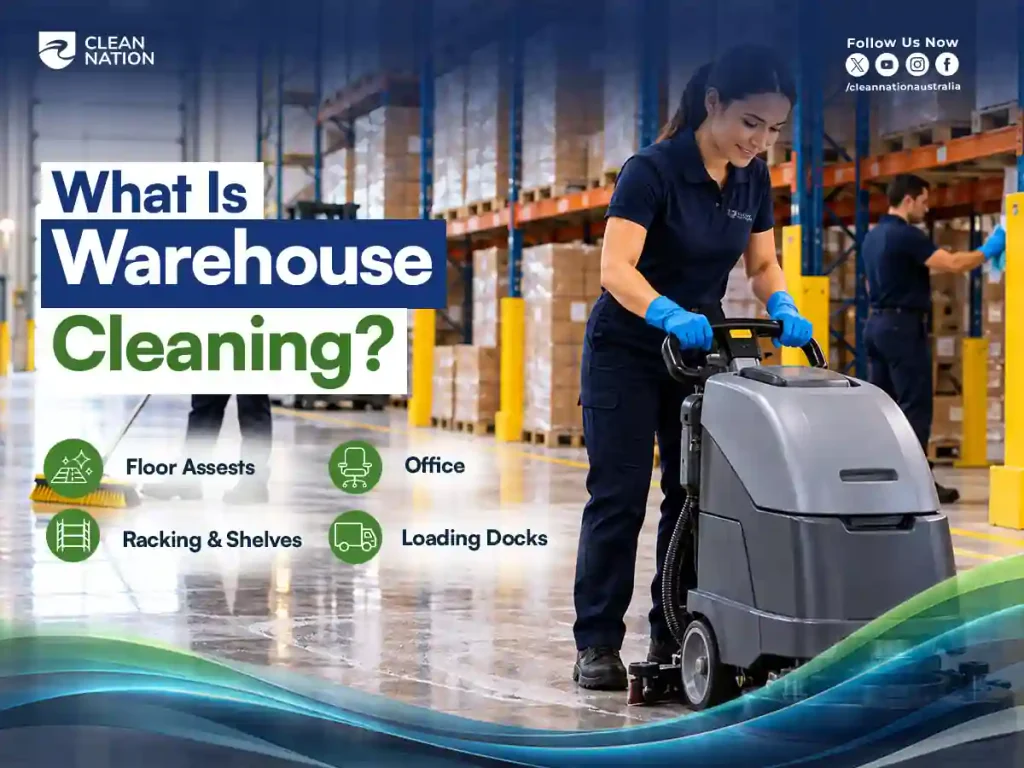
Warehouse cleaning keeps a big, busy storage and distribution space clean, clear and safe to work in. The mess is mostly dust, debris and packaging, and the challenge is scale: you’re cleaning thousands of square metres around live traffic. A typical scope covers five areas.
Floors, Aisles and Walkways
Sweeping and machine scrubbing across large concrete areas so forklift and pedestrian routes stay clear.
Loading Docks and Dispatch Areas
Clearing packaging waste, pallet wrap and tracked-in dirt where the building meets the outside world.
Racking and Shelving
Removing dust build-up from racking and storage areas, including high-level surfaces that need an elevated work platform.
Packaging and Waste Areas
Keeping bins, cardboard, shrink wrap and recycling under control before they turn into a trip or fire hazard.
Offices and Amenities
The part of a warehouse that looks like any other workplace: desks, lunchrooms and bathrooms.
If you’d like the full list of what a working warehouse checklist should contain, see what’s included in a warehouse cleaning checklist.
What Is Industrial Cleaning?
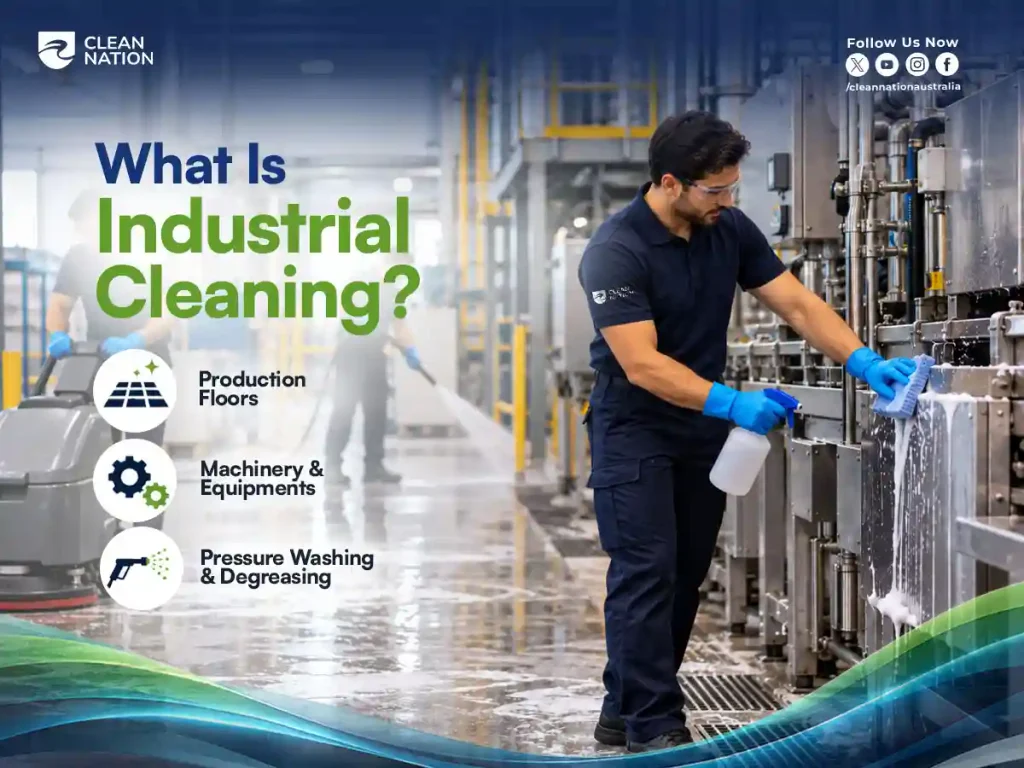
Industrial cleaning covers the parts of a site where products are made or processed, and where the mess is heavier and often more hazardous. Our industrial cleaning services cover this kind of work, and it typically includes the following.
Production Floors
Floors with built-up grease, oil and process residue that a standard scrub won’t shift.
Machinery and Equipment
Cleaning done at the right point in the production cycle, with the equipment made safe first. WorkSafe Victoria’s cleaning guidance says equipment should be isolated and locked out before it’s cleaned, and that people cleaning machines with sharp parts need suitable protective equipment. A crew that’s great on an open warehouse floor still needs the training, procedures and site approval to work on a live plant.
Degreasing and Pressure Washing
Removing oil and grease from floors, plant areas and hardstands with the right products and high-pressure equipment.
High-Level Dust Removal
Clearing dust from ducting, light fittings and overhead surfaces above production areas.
Waste Collection
Removing and disposing of waste from production and maintenance areas.
Shutdown and Deep Cleans
Bigger cleans planned around production schedules. Some jobs, like tanks and vessels, are specialist work again.
Where Do They Overlap?
Most of the confusion comes from the overlap, so it’s worth being upfront about it. A warehouse is an industrial-type site, and the two services share a lot:
- Machine floor scrubbing and sweeping on large concrete floors.
- High-level dusting and elevated work platforms.
- Pressure washing of docks, hardstands and external areas.
- WHS obligations, including forklift traffic, chemicals and work at height. (Our guide to warehouse cleaning and WHS compliance covers who’s responsible for what.)
- The need for a contractor who’s worked on industrial sites and not just offices.
That shared ground is why some providers advertise “industrial warehouse cleaning” and use the words interchangeably. It’s fine as a rough guide, but it’s a poor basis for a quote.
Where Do They Differ?
The two services start to pull apart when a site does more than store and move stock.
Machinery
Cleaning between or around production equipment needs isolation procedures and site-specific approval. Cleaning a warehouse floor doesn’t.
The Type of Mess
Dust and packaging waste are one job. Cutting oil, hydraulic fluid, chemical residue and process build-up are another, and they need different products and methods.
Chemicals
Industrial sites are more likely to have chemicals that affect what products the cleaning crew can use and how they’re stored.
Food Areas
Food warehouses and food production areas need cleaning that fits your food safety program, which means the right products and clear records.
Timing
Warehouse cleaning fits around shifts and dock schedules. Industrial cleaning is often planned around production runs and shutdowns, and sometimes needs the line stopped.
Which Type Is Your Site?
Here’s a practical way to think about it. Most sites fall somewhere along four points.
1. A Storage Warehouse
Stock comes in, sits on racking and goes out. This is warehouse cleaning.
2. A Distribution or Pick-and-Pack Centre
Busier floors, more docks, more packaging waste. Still warehouse cleaning, with more emphasis on floors and docks.
3. A Warehouse With a Workshop or Packing Line
The storage side needs warehouse cleaning; the workshop or line needs industrial-style cleaning. Scope it by zone, and don’t accept a single blanket price. Ask for the warehouse floor, the docks and the production areas to be priced separately so you can see what each costs.
4. A Production Facility
Machinery, process areas and heavy contamination. This is industrial cleaning, and the warehouse part is one zone within it.
A Quick Test to Decide
Ask yourself:
- Is your biggest cleaning problem dust, debris, packaging and wide-open floor space? Warehouse cleaning fits.
- Is it grease, oil, chemical residue or machinery? You’re in industrial territory.
- Is there machinery inside the building that has to be cleaned, or cleaned around? Plan for industrial cleaning on at least part of the site.
- Does the site handle food, hazardous chemicals or dangerous goods? Tell any provider before you get a quote, because it changes the products, the procedures and the records.
- Not sure? Ask for a site walkthrough. A warehouse is far easier to show than to describe over the phone.
How Much Does Each One Cost?
Price doesn’t sort neatly into “warehouse” and “industrial”. Our published starting ranges overlap, and industrial work tends to reach the higher end because heavier equipment, tougher contamination and extra safety steps take more time and more skill.
| Warehouse cleaning | Industrial cleaning | |
|---|---|---|
| Published starting range | $40 to $80 per hour per cleaner | $45 to $100+ per hour per cleaner |
| What pushes the price up | Large floor areas, work at height, out-of-hours access | Heavy grease, machinery, hazardous chemicals |
| Extras to ask about | High-level dusting, elevated work platform access | Degreasing, shutdown work, waste disposal |
| Best way to get a price | Site walkthrough | Site walkthrough plus a list of machinery |
What Changes the Price
Two sites that both call themselves “a warehouse” can be very different jobs. What actually moves the price is:
- The floor area and how many zones need work.
- How heavy the contamination is (dust versus baked-on grease).
- Whether machinery, work at height or hazardous chemicals are involved.
- How often the site is cleaned, and whether work has to happen out of hours.
- Access, shutdown windows and site induction requirements.
That’s why a walkthrough beats a phone quote.
What to Ask Before You Hire
Whichever service you’re buying, ask the provider:
- Have you cleaned sites like mine, with forklifts, racking and dock traffic?
- Who will be on site, and are they police-checked and insured?
- Do you have the equipment for my floor size and for any high-level areas?
- How do you handle machinery, and what do you need from us before you start?
- What products will you use, and can you show us the safety data sheets?
- How will you scope and price the warehouse and production areas separately?
- How do you record and report what’s been cleaned?
If a provider can’t answer these specifically, keep looking.
How Clean Nation Can Help
We do both, and we scope them separately so you only pay for what your site needs. Our warehouse cleaning services cover floors, docks, racking, high-level dusting and amenities, using ride-on scrubbers, industrial sweepers, elevated work platforms, HEPA vacuums and pressure washing equipment. For production areas, we also clean factories, manufacturing plants, workshops and machinery.
Every job starts with a risk assessment and safety plan, our teams wear the right PPE, and our staff are police-checked and fully insured. We work Australia-wide, so one provider can look after a multi-site business.
Frequently Asked Questions
Does the size of my site decide which service I need?
No. The type of activity matters more than the size. A huge storage warehouse may only need warehouse cleaning, while a small workshop with a machine and an oil problem may need industrial methods.
What should I prepare before the first clean?
Your provider will usually ask for site access, an induction, and a list of hazards, chemicals and no-go areas. It also helps to clear stock or equipment from the areas being cleaned, and to confirm water and power access.
How long will a clean take?
It depends on the floor area, the number of zones and how heavy the contamination is, so a fair estimate needs a walkthrough. Be cautious of anyone who gives you a time or price without seeing the site.
Should I book a one-off deep clean before starting a regular contract?
It often makes sense if the site has built-up grime or hasn’t been cleaned properly for a while. A deep clean resets the site, and a regular schedule then keeps it there. Your provider can advise after seeing the condition of the floors and high-level areas.
Will the provider bring their own equipment and products?
In most cases, yes, but confirm it in the quote. Ask what the provider supplies and what you’re expected to provide, such as water, power or storage space for chemicals.
Making the Right Choice
Warehouse cleaning and industrial cleaning aren’t opposites, they’re two ends of a spectrum, and the right service depends on what your site actually does. If it stores and moves stock, warehouse cleaning fits. If it makes or processes products, you’re in industrial territory. If it does both, scope each zone separately and don’t let one blanket price hide the difference.
Not sure where your site sits? Get a free quote from Clean Nation’s warehouse cleaning team and we’ll help you scope it properly.